Join the mailing list Free weekly briefing, no spam.
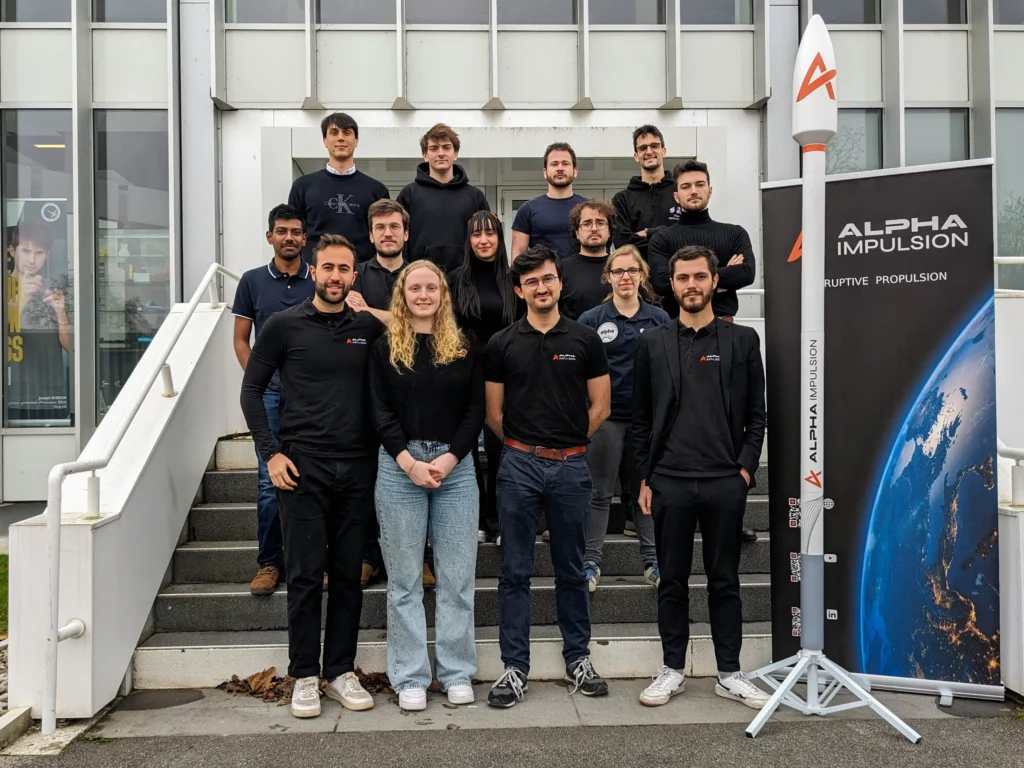
Cover Image: Alpha Impulsion Team – Credit: Alpha Impulsion
A conversation with Marius Celette, CEO of Alpha Impulsion
The space industry is often framed as a race of ambition, a contest of powerful rockets, bold timelines, and national prestige. But speaking with Marius Celette, CEO of Toulouse-based Alpha Impulsion, it becomes clear that before the physics, there is something more fundamental at play: economics.
“The business has to work,” Celette says plainly. Revenue, sustainability, and the capacity to reinvest in research. These are the first principles that shape the company’s direction. The science follows. This is not a dismissal of the engineering challenges ahead, but a recognition that innovation in space propulsion, however brilliant, is irrelevant if the company building it cannot survive long enough to deploy it.
A Concentrated Market
The commercial launch industry might appear to be thriving, with a growing number of private ventures competing to carry satellites into orbit. The reality, however, is more concentrated than the headlines suggest. Only two or three major players account for 80 to 90 percent of the global launch market. The rest of the industry competes for the margins.
In Europe, this dynamic is particularly stark. The number of European companies pursuing launch vehicle development remains small, and the strategic and financial stakes are high. Competing against incumbents who have had decades to refine their operations and who often benefit from substantial institutional support. This is a formidable challenge.
Celette puts it with disarming directness: “If you do the same thing that others did twenty years before, at best you get some results, but you’re still twenty years behind. That’s why young European companies developing disruptive innovation are so important: they’re the guarantors of our long-term competitiveness.”
This is the innovation imperative. Not innovation as a buzzword, but as an engineering and commercial necessity. If a new entrant simply replicates the propulsion architecture of an established player, they begin the race already behind. The answer, according to Celette, lies in returning to the physics and asking what has been left on the table.
Back to First Principles: The Tsiolkovsky Rocket Equation
The Tsiolkovsky rocket equation, also known as the ideal rocket equation, governs the fundamental trade-off in every rocket ever built. In simple terms, it relates the change in velocity a rocket can achieve to two variables: the efficiency of its engine, and the ratio of the propellant mass to the total mass of the vehicle at any given moment.
Specific impulse and mass efficiency are the two variables that define the design space within which every launch company operates.
Specific Impulse (Isp) is a measure of how effectively a rocket engine converts propellant into thrust. Think of it as the fuel economy of a rocket engine. The higher the specific impulse, the more velocity you can extract from a given mass of propellant. This is the metric most companies already focus on, and progress in this area, while important, is incremental. The chemical combinations that yield the best performance are well understood; the gains to be made are real but limited.
Mass efficiency is the other lever. Here, the history of rocketry reveals a long-standing compromise. From the very first rockets to reach orbit, engineers have used staging to manage the mass ratio problem. A multi-stage rocket discards empty propellant tanks and spent engines during ascent, effectively reducing the mass the remaining stages must accelerate. This is a powerful technique, and it remains the dominant architecture in launch vehicle design today.
But staging comes with costs that are easily overlooked. The discarded stages become debris: metal structures tumbling in the upper atmosphere or, in some cases, settling into low Earth orbit. And between ignition and jettison, those empty tanks are inert weight: structure that no longer serves a propulsive function, carried at great expense to the altitude at which it can finally be shed.
The engineering mantra in space systems is “The best part is no part.” Every gram of structure that serves no function at a given moment in flight is a gram of mission payload capacity lost.
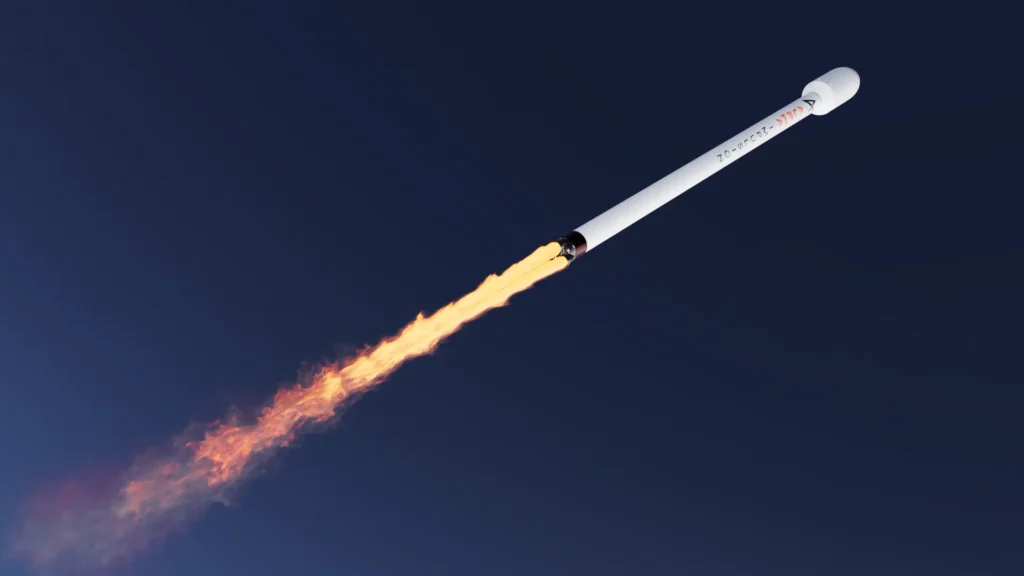
What If the Structure Could Be the Propellant?
This is the question at the heart of Alpha Impulsion’s technology. If the dead weight of spent structure is a fundamental inefficiency in the rocket equation, why not eliminate it entirely, not by staging it away, but by consuming it?
The concept is known as autophage combustion. Rather than carrying inert structure that is eventually discarded, the rocket burns its own body as it ascends. The structure itself, i.e. beginning at the bottom and progressing upward as the vehicle rises, serves first as the rocket’s frame, then as its fuel. Like an inverted candle burning upward, the launcher becomes progressively shorter during flight, until only the engine and the payload remain.
This is not a marginal improvement on existing architecture. It is a fundamental rethinking of what a rocket structure is for, and an attempt to eliminate the distinction between structure and propellant entirely.
The propellant combination used in Alpha Impulsion’s launch vehicle, Garnet, is polyethylene (the same material used in common plastic packaging, also known as polythene) paired with liquid oxygen. Polyethylene serves simultaneously as the rocket’s structural material and as its fuel. There is no separate tank for the solid propellant! The tank and the fuel are one and the same. When the combustion has consumed what it needs, there is nothing left to discard, because there was nothing superfluous to begin with.
Alpha Impulsion was founded in Toulouse in 2022. The company successfully hot-fired the world’s largest autophage rocket engine in 2025 and is targeting the first launch of its Garnet vehicle in 2028.
Beyond the Rocket Revolution: Connecting Space Innovation with Society
ESA and Vast: the new MoU and Europe’s future after the ISS
Image Credits: jonasphotto The European Space Agency has signed a new Memorandum of Understanding with…
Photonic Quantum Processor in Orbit: What the First Test Proved, and What It Didn’t
Illustrative image: CubeSats deployed into Earth orbit from the International Space Station’s Kibo module. Not…
Argotec and Rheinmetall Put an Air Defence Satellite in Orbit Argotec and Rheinmetall Put an…
Starship Flight 14 Recap: It Reached Orbit, Delivered 26 Satellites — and Came Home the Hard Way

Aurora and Saturn at Opposition: The Sky on October 2–4, 2026
Image Credits: NASA, Neil Zeller A weekend with two stars of the show Between October…