Join the mailing list Free weekly briefing, no spam.
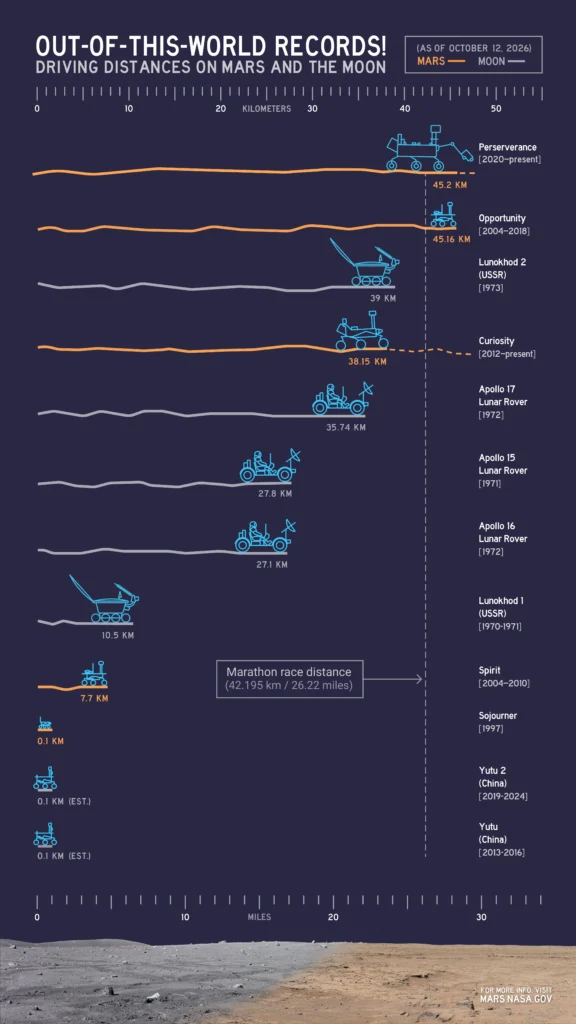
Cover Image: How far rovers have driven on the Moon and Mars. Perseverance and Curiosity totals are current as of October 11, 2026. – Credit: NASA/JPL-Caltech
On October 11, 2026, the odometer of NASA’s Perseverance rover read 28.10 miles (45.22 km). That is 60 meters more than the 45.16 km Opportunity logged between 2004 and 2018, which makes Perseverance the vehicle that has driven farthest on any world other than Earth. NASA announced it the following day.
The headline is correct. It is also the least interesting thing about the milestone. A margin of 0.13% says little about engineering, and the two rovers lived very different lives. What the record does show, if you look at how it was built, is how far robotic driving has moved in two decades. This article covers what the number measures, where the comparison with Opportunity holds and where it does not, and why the real story is a piece of software called AutoNav.
Key facts
All figures below come from NASA/JPL’s release of October 12, 2026, unless marked as my own calculation.
- On October 11, 2026, Perseverance’s odometer read 28.10 miles (45.22 km), on its 2,006th Martian day (sol).
- Opportunity’s total, set between 2004 and 2018, was 28.06 miles (45.16 km).
- The gap is about 0.06 km, or 60 meters (my calculation from NASA’s two figures), roughly 0.13% of the total.
- Perseverance took about five and a half years to get there. NASA says Opportunity needed nearly 15.
- More than 90% of Perseverance’s distance was driven with AutoNav, its autonomous navigation system.
- The rover’s best single-sol drive, per NASA, is 1,351 feet (412 meters).
- Curiosity has logged more than 23.65 miles (38.07 km). Apollo 17’s lunar rover covered 35.7 km and Lunokhod 2 covered about 39 km.
The record in numbers
Five vehicles matter here. Two of them drove on the Moon, three on Mars.
| Vehicle | Distance (km) | Where and when | How it was driven |
|---|---|---|---|
| Perseverance | 45.22 | Mars, 2021 to present | Mostly autonomous (AutoNav, over 90% of distance) |
| Opportunity | 45.16 | Mars, 2004 to 2018 | Ground-planned, limited autonomy (about 5% of distance, per NASA) |
| Lunokhod 2 | about 39 | Moon, 1973 | Remote driving from Earth |
| Curiosity | 38.07 (and counting) | Mars, 2012 to present | Ground-planned with autonomous navigation |
| Apollo 17 lunar rover | 35.7 | Moon, 1972 | Driven by astronauts |
Distances and the Perseverance and Opportunity driving modes are from NASA/JPL. The Curiosity start year, the lunar mission dates and Curiosity’s driving mode are not in NASA’s release. They come from general mission history.
What an odometer on Mars actually measures
A rover odometer is an estimate, and the 60-meter margin is small enough to sit inside its uncertainty. Wheel odometry works from how far the wheels have turned. On firm, flat ground that is close to the distance covered. On loose sand or a steep slope, the wheels turn more than the rover advances. Engineers call the difference slip.
Opportunity gives the clearest example. In 2005 it sank into a ripple of sand called Purgatory Dune and spent more than five weeks digging itself out, with its wheels turning for much of that time without moving the vehicle forward. Rovers correct for slip by comparing camera images before and after a move (visual odometry), and that keeps their position estimates good. A cumulative odometer total is a different quantity. It adds up many drives, each with its own error, over 45 km of changing terrain.
NASA’s release does not describe how the 28.10 miles was computed, and I do not know the error bar. My point is narrower. Two cumulative totals from two different rovers, built by two teams with different tools in different decades, differ by 0.13%. I would not claim the ranking is known to that precision. Calling it a milestone is fair. Calling it a measured, exact win is not.
The record can also be read the other way. Perseverance has, by any reasonable accounting, driven about as far as Opportunity did, in well under half the time. That statement survives any plausible odometry error.
Why Perseverance and Opportunity are not a like-for-like comparison
The two rovers had different terrain, different power systems and different jobs, so equal distance does not mean equal difficulty.
Terrain. Opportunity spent most of its life on the flat, sulfate-rich plains of Meridiani Planum, then crossed to the rim of Endeavour crater. Perseverance has worked on the floor of Jezero crater, around the ancient river delta and up onto the crater rim. Slopes, rock fields and sand ripples cost far more time and risk per kilometer than a plain does, so a kilometer in Jezero is not a kilometer in Meridiani.
Power. Opportunity ran on solar panels. Dust on the arrays, the seasons and the dust storm that ended the mission in 2018 all limited how much it could drive. Perseverance carries a radioisotope power system, which delivers steady electricity through the Martian winter and does not care about dust. That alone accounts for a lot of the difference in kilometers per year: about 8 for Perseverance against about 3 for Opportunity, using NASA’s time spans.
Mission design. Opportunity was built for a 90-sol mission and kept going for nearly 15 years. Perseverance was built to collect and cache samples, with driving as a means to reach rock worth sampling. It carries a bigger instrument suite, a sampling system and a much more capable navigation computer. The two rovers answer different questions.
None of this takes away from either machine. It means the fair reading of the record is not “Perseverance is better.” It is “Perseverance is allowed to drive more, and is able to.”
AutoNav is the real story
The figure that matters in NASA’s release is not the odometer. It is that more than 90% of Perseverance’s distance was driven with AutoNav, against about 5% for the first autonomous navigation system flown on Spirit and Opportunity.
The constraint behind this is communication, not speed. A signal takes between roughly 4 and 24 minutes to cross from Mars to Earth, depending on where the planets are. Commands also move through orbiters that pass overhead only a few times a day, so the ground team plans each sol from images returned the previous one. If the rover can only drive as far as the planners can see and trust, its range is capped by the horizon of its last picture.
AutoNav removes that cap. The rover photographs the terrain ahead, builds its own 3D map, finds a safe path and drives it, correcting as it goes. The earlier generation worked in short steps. It stopped, looked, computed, then moved. Perseverance has a dedicated vision processor, which lets it analyze images while the wheels are turning. Less time spent standing still is a large part of how a single sol can reach 412 meters, the best NASA reports.
NASA frames the improvement in terrain assessment as a jump from Sojourner’s 20 measurement points to 600,000 for Perseverance “with every look.” I would read that as an illustration of how much denser the terrain picture has become, not as a like-for-like computing metric, since the two rovers measured different things in different ways. The direction is what counts. Drives that once needed careful hand planning are now, in the words of Mark Maimone, deputy team chief for robotic operations on Perseverance, something the rover can just do: “Given the autonomy to just go, Perseverance is a better driver than the one that landed, and we’re not done.”
The lunar comparison says more about control than about distance
Perseverance has also passed the distances covered by Apollo 17’s lunar rover (35.7 km) and Lunokhod 2 (about 39 km). Those two numbers are worth a second look, because both vehicles were steered by people who could see where they were going.
The Apollo astronauts drove the lunar rover themselves. Lunokhod 2 was driven by a team on Earth watching camera images, with a round-trip signal delay of a few seconds. That is short enough for a human to steer in near real time, which is how Lunokhod 2 covered its distance in about four months in 1973.
Mars removes that option. With a delay of minutes, there is no live steering, only instructions sent in advance and a vehicle that must handle surprises alone. Reaching 45 km under those rules is a different engineering achievement from reaching 39 km with a joystick, even though the kilometers are the same size.
What actually limits a rover’s range
Distance is a by-product of the science plan, and the hardware sets the ceiling. Three things matter most. Apart from the mobility status NASA reports, what follows is my own engineering reading, not something stated in the release.
Wheels. Curiosity’s thin aluminum wheels were punched and torn by sharp rocks within its first years, and the team changed how it drives to slow the damage. Perseverance’s wheels were redesigned with a thicker skin and a different tread. NASA reports that all of its mobility systems are fully operational, which at 45 km is the most important sentence in the release. Wheel condition decides how aggressively mission planners can choose routes.
Power and heat. The radioisotope generator fades slowly as its plutonium decays, and everything the rover does, driving included, competes for that energy and for the heater budget on cold sols. A long drive is something the rover pays for in science time.
Where the science is. The route follows the geology. Planners drive to targets, sample them, and drive on. A rover can be capable of 412 meters in a sol and still spend weeks in one place.
This is why total distance is a poor score for a science mission. It rewards a vehicle for covering ground, and Perseverance’s job is to cover the right ground.
Where the rover goes next
Perseverance has just entered its first extended mission, which NASA says runs through roughly the end of 2028. The rover has collected 29 rock and regolith samples spanning the crater floor, and it is now heading toward a site called Idubi in the Lac de Charmes region, where scientists hope to find traces of ancient hydrothermal systems. Hot water moving through rock is one of the settings where chemistry that could support life tends to concentrate, which is why the team wants to look.
Further south lies Rainbow Falls, a block of ancient crust about 100 meters wide. Blocks of ancient crust like this are a way to read rock that formed long before Jezero crater did.
The most discussed result so far remains the rock called Cheyava Falls, which NASA has described as showing features that could be potential biosignatures. That finding is still being tested, and the samples that would allow the most detailed testing are still on Mars. How and when they reach Earth is an open question.
As for the odometer, NASA’s Steven Lee, project manager for Curiosity and Perseverance, expects it to keep growing “for many years to come.” The drives, he says, have become routine.
Frequently asked questions
How far has the Perseverance rover driven?
As of October 11, 2026, its odometer read 28.10 miles (45.22 km), reached on sol 2,006 of the mission, according to NASA/JPL.
Did Perseverance break Opportunity’s driving record?
Yes, by a very small margin. Opportunity’s total was 28.06 miles (45.16 km), so Perseverance is ahead by about 60 meters. It got there in about five and a half years, against nearly 15 for Opportunity.
What is AutoNav on the Perseverance rover?
AutoNav is the rover’s autonomous navigation system. It takes images of the terrain, builds a 3D map, picks a safe path and drives it without waiting for instructions from Earth. NASA says more than 90% of Perseverance’s total distance was driven this way.
Why does a Mars rover need to drive itself?
Signals take between roughly 4 and 24 minutes to travel one way between Earth and Mars, and the rover receives commands only at certain times of day. Live steering is not possible, so autonomy lets the rover cover ground beyond the terrain the ground team has already seen.
How does Perseverance compare with Curiosity?
Curiosity has driven more than 23.65 miles (38.07 km). Perseverance has passed it, as well as the lunar distances of Apollo 17 (35.7 km) and Lunokhod 2 (about 39 km).
How far can Perseverance still go?
NASA expects the record to keep growing for many years. The rover is now in its first extended mission, which runs through roughly the end of 2028, and its mobility systems are fully operational according to NASA.
Sources and credits
- NASA’s Perseverance Sets Off-World Record for Total Distance Driven, NASA/JPL, October 12, 2026. Source of every distance, date, sample count and quote.
- Image credit: NASA/JPL-Caltech.
Background on Purgatory Dune, wheel design, power systems, signal delay and the lunar missions is general mission history that is not tied to a single source page.