
Join the mailing list Free weekly briefing, no spam.
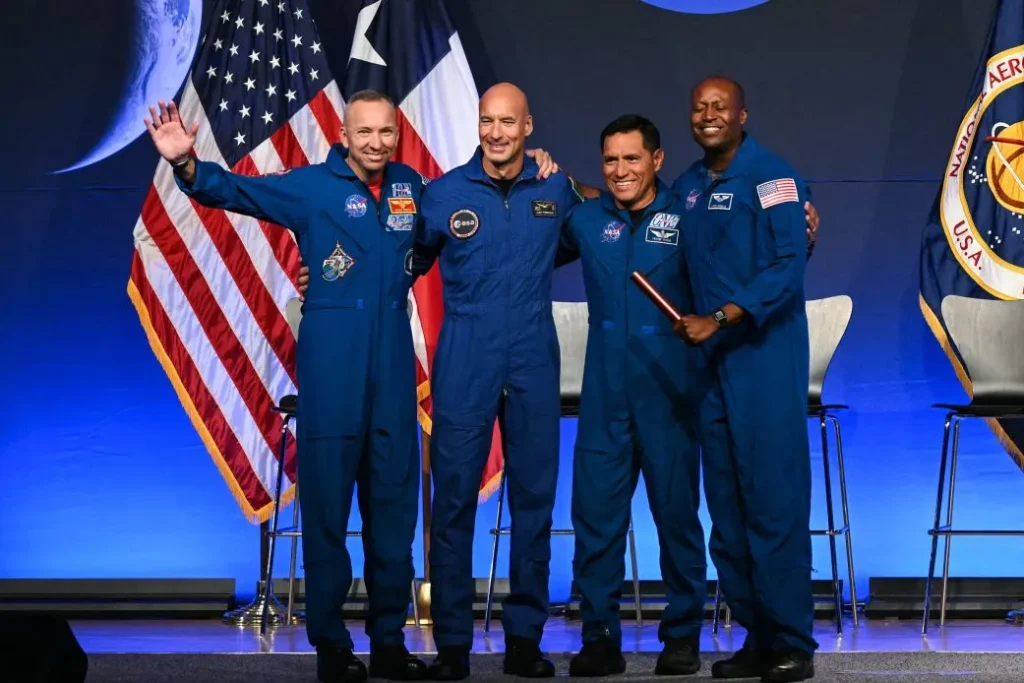
Cover Image: The Artemis III crew at NASA’s Johnson Space Center in Houston following the announcement.
Ronaldo Schemidt/AFP/Getty Images
NASA has officially revealed the four astronauts who will fly aboard Artemis III, a mission scheduled for 2027 that represents a critical milestone in the agency’s long-term strategy for returning humans to the Moon and eventually reaching Mars. The crew announcement marks the beginning of an intensive training period that will prepare four highly accomplished astronauts for one of the most important spaceflight missions of the decade.
Unlike previous Artemis missions, Artemis III is designed to validate key technologies, spacecraft systems, and operational procedures that will enable sustained lunar exploration in the years ahead. The mission will involve the Orion spacecraft and commercial lunar lander systems developed by SpaceX and Blue Origin, testing the complex architecture that future lunar crews will depend upon.
The newly announced crew combines extensive spaceflight experience, military leadership, engineering expertise, and international cooperation. Together, they embody the next chapter of human exploration.

Astronomy Basics

[Preview] Orbital Mechanics – An Introduction

Human Factors and Performances
Space Physics – Basics
Commander Randy Bresnik: Leading the Mission
At the helm of Artemis III will be Randy Bresnik, a veteran NASA astronaut and former United States Marine Corps colonel.
Bresnik brings a wealth of operational experience to the mission. Having previously spent more than 149 days in space across multiple missions, he has served aboard the International Space Station and commanded Expedition 53. Throughout his career, he has demonstrated exceptional leadership in demanding environments, qualities that made him a natural choice to command one of NASA’s most ambitious exploration missions.
As commander, Bresnik will be responsible for the overall success and safety of the mission, overseeing spacecraft operations and coordinating the crew through complex rendezvous and docking activities. His extensive background in both aviation and spaceflight will be instrumental as Artemis III pushes the boundaries of modern exploration.
For Bresnik, Artemis III represents more than another mission—it is an opportunity to help establish the operational foundation for humanity’s permanent return to deep space.
Luca Parmitano: Europe’s Representative in Lunar Exploration
Serving as pilot is Luca Parmitano, one of Europe’s most accomplished astronauts and a proud representative of Italy on the international stage.
Parmitano has already built an impressive spaceflight legacy. A former Italian Air Force test pilot, he has flown two long-duration missions aboard the International Space Station and commanded Expedition 61. His calm professionalism, technical expertise, and international leadership experience have earned him widespread respect within the global space community.
His selection underscores the increasingly international nature of the Artemis program. The European Space Agency has played a vital role in developing the Orion spacecraft’s European Service Module, and Parmitano’s inclusion reflects the growing partnership between NASA and Europe in lunar exploration.
For Italy, Parmitano’s assignment is particularly significant. He becomes one of the most prominent European participants in the Artemis era and a symbol of Europe’s contribution to humanity’s return to the Moon.
Frank Rubio: The Record-Setting Space Veteran
Mission specialist Frank Rubio brings a unique perspective shaped by one of the longest spaceflights ever completed by an American astronaut.
A physician, military pilot, and U.S. Army colonel, Rubio gained international recognition after spending 371 consecutive days in space aboard the International Space Station, setting a record for the longest single-duration American spaceflight. His mission demonstrated remarkable endurance and adaptability under challenging circumstances.
The lessons Rubio learned during his year in orbit have direct relevance to NASA’s future ambitions. As Artemis missions evolve toward longer lunar stays and eventual Mars expeditions, understanding how humans perform during extended periods away from Earth becomes increasingly important.
On Artemis III, Rubio’s operational experience and scientific background will help NASA evaluate systems and procedures essential for future deep-space exploration.
Andre Douglas: A New Generation of Explorers
Joining the crew on his first spaceflight is Andre Douglas, representing the next generation of NASA explorers.
Douglas was selected as a NASA astronaut in 2021 after building a distinguished career as an engineer and researcher. Prior to his astronaut selection, he contributed to advanced technology projects and supported NASA initiatives, including work connected to planetary exploration. He also served on the backup team for Artemis II, gaining valuable experience with Orion systems and Artemis mission operations.
Although Artemis III will be his first journey into space, Douglas arrives exceptionally prepared. His technical expertise and familiarity with the Artemis program make him a valuable addition to the crew.
His selection demonstrates NASA’s commitment to balancing veteran experience with fresh perspectives as it builds the workforce that will carry human exploration deeper into the Solar System.
A Crew for a New Era
The Artemis III crew reflects the broad vision of modern space exploration: experienced commanders, record-setting astronauts, international cooperation, and emerging talent working together toward a common goal.
Whether through Bresnik’s leadership, Parmitano’s international representation, Rubio’s endurance record, or Douglas’s engineering expertise, each astronaut contributes a unique set of skills to the mission. Together, they will help validate the technologies and operational concepts that will support future lunar landings and pave the way toward Mars.
As training begins and preparations accelerate toward 2027, the Artemis III crew stands at the forefront of humanity’s next great chapter in exploration. Their mission is not only about testing spacecraft—it is about building the future of human presence beyond Earth.
Beyond the Rocket Revolution: Connecting Space Innovation with Society

ESA and Vast: the new MoU and Europe’s future after the ISS
Photonic Quantum Processor in Orbit: What the First Test Proved, and What It Didn’t
Argotec and Rheinmetall Put an Air Defence Satellite in Orbit
Starship Flight 14 Recap: It Reached Orbit, Delivered 26 Satellites — and Came Home the Hard Way