
Join the mailing list Free weekly briefing, no spam.
Cover Image Credits: NASA/ESA/STScI Hubble Space telescope
The European Space Agency (ESA) and the International Astronomical Union’s Centre for the Protection of the Dark and Quiet Sky (IAU CPS) have signed a Memorandum of Intent to cooperate on keeping the night sky dark and radio-quiet. According to ESA, the signing took place at the International Astronautical Congress 2026.
The document is a statement of intent, not a treaty. It describes ESA’s technical role and a plan to engage industry, but the published text names no deadlines, measurable targets or funding. What it does show is that ESA’s engineers are now formally working with the astronomers who have documented satellite interference since the first large Starlink launches in 2019.
This article covers what was signed, how satellites interfere with optical and radio astronomy, what has already been tried, which design choices make a satellite less disruptive, and what the agreement still leaves open.
What ESA and the IAU CPS actually signed
The two parties are ESA and the IAU Centre for the Protection of the Dark and Quiet Sky from Satellite Constellation Interference. The International Astronomical Union called for the centre in 2021, and in February 2022 NSF’s NOIRLab and the SKA Observatory were named as its co-hosts. According to ESA, the CPS brings together astronomical institutions, observatories, researchers, companies and citizens.
The agreement is a Memorandum of Intent, a format that generally records a shared direction without creating legal obligations. ESA says it will contribute technical expertise and strengthen its engagement with industry to develop practical ways of reducing the impact of satellites on astronomical observations. The CPS director, Piero Benvenuti, is quoted by ESA saying that the two organisations will “foster dialogue between astronomers and satellite operators” and support new technologies and best practices.
The technical measures ESA mentions are all design-stage ones: darker spacecraft surfaces, radio-quiet electronics, and models that predict how a satellite will look to a telescope on the ground. The published text does not include a timeline, working groups, funding or numerical targets.
Optical astronomy: reflected sunlight and streaks
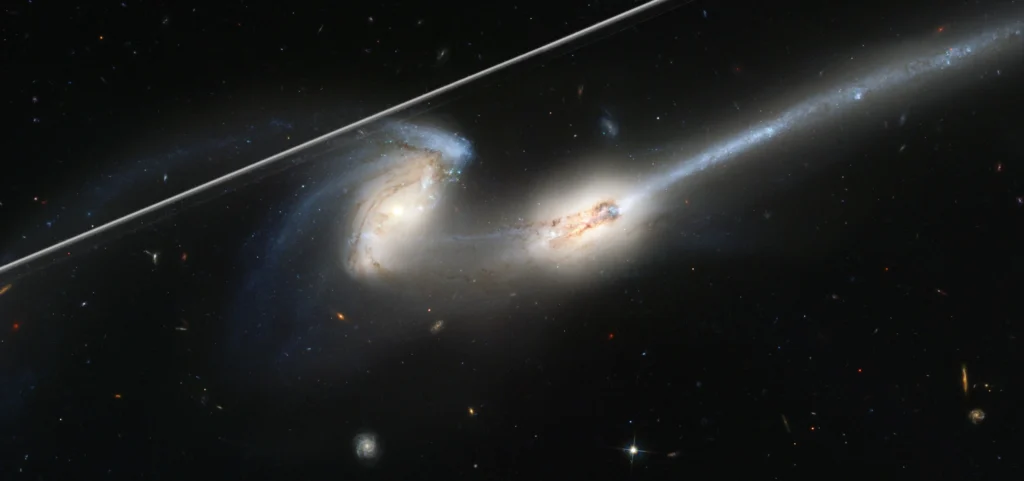
A satellite shines for the same reason the Moon does: it reflects sunlight. For a few hours after sunset and before sunrise, the ground is dark while satellites a few hundred kilometres up are still lit. A telescope exposing for tens of seconds records each one as a line across the frame, and that line can overwhelm the pixels it crosses and hide faint objects behind it.
The scale has changed. The KeepTrack catalogue lists about 16,800 active satellites in orbit as of October 2026, of which 10,838 are Starlink, roughly 65%. Treat these as approximate: the catalogue itself says it is missing most US launches since mid-July.
How bright a satellite looks depends on its size, how reflective its surfaces are, its altitude, and the angle between the Sun, the satellite and the observer. The CPS consolidated recommendations ask operators to keep reflected sunlight fainter than magnitude 7.0 in the V band for orbits at or below 550 km, with a stricter limit for higher orbits, and to operate below about 600 km where practicable. Magnitude 7 sits just beyond what the unaided eye can see under good conditions.
Large antennas are the hard case. AST SpaceMobile’s first five BlueBird satellites unfolded their roughly 64 square metre arrays in October 2024, and EarthSky reported they could reach about magnitude 0.4, brighter than nine of the ten brightest stars. The company plans 100 or more of them.
Radio astronomy: emissions nobody designed
Satellites affect radio telescopes in two ways: through their intended transmissions, and through unintended electromagnetic radiation (UEMR) that leaks from onboard electronics. Astronomers had focused on the first. In 2023, a team led by SKAO spectrum manager Federico Di Vruno used the LOFAR telescope in the Netherlands to observe 68 Starlink satellites and detected UEMR between 110 and 188 MHz, a range that includes a band the ITU allocates to radio astronomy. International rules did not cover this kind of emission.
A 2024 paper on arXiv looked at second-generation Starlink satellites. LOFAR observed them on 19 July 2024, and 27 of the 29 satellites seen in the 10 to 88 MHz band showed clear emission, strongest between 56 and 66 MHz. Flux densities in that range reached 15 to 1,300 Jy (one jansky is 10-26 watts per square metre per hertz). In the 150.05 to 153 MHz radio astronomy band, the authors report the v2-Mini emission is on average 15 dB brighter than first-generation satellites, and up to a factor of 32 stronger once distance is corrected for.
The authors also note that current ITU-R regulations do not address this kind of emission, and they recommend that regulators and operators work on mitigation. SKAO adds that SpaceX had offered to keep discussing ways to reduce the effect on astronomy.
What has already been tried
The ESA agreement arrives after six years of mitigation attempts, some with measurable results and some that fell short.
| Year | Step | What was found |
|---|---|---|
| 2020 | DarkSat, a Starlink prototype with a black coating | About half as bright as a standard Starlink, but still too bright for major survey telescopes such as Rubin |
| 2020 | VisorSat sunshade, and the SATCON1 report | The sunshade first flew on 3 June 2020. Of SATCON1’s 10 recommendations, only one concerns darkening; the rest cover lower orbits (below 600 km), attitude control, removing trails from data and sharing orbit data |
| 2022 | IAU CPS named, with NOIRLab and SKAO as co-hosts | A single coordination point between astronomers, operators, regulators and the public |
| 2023 | Starlink second-generation Mini mitigation | In a Sky & Telescope analysis of 506 measurements, mitigated satellites averaged magnitude 7.1 as observed, right at the 7.0 guideline, so individual satellites can exceed it |
| 2025 | UN COPUOS Scientific and Technical Subcommittee | “Dark and Quiet Skies, astronomy and large constellations” became a standing agenda item, to be discussed annually until 2029 |
The 2023 Mini mitigation combined a dielectric mirror film that reflects sunlight into space, low-reflectivity black paint, and solar panels angled so that observers see only their dark sides. Corrected to a common distance of 1,000 km, the author reports unmitigated Minis at magnitude 5.1 and mitigated ones at 7.9, about a factor of 12 in brightness.
The CPS now organises this work into four hubs, described in its first newsletter. SatHub runs observing campaigns, a public repository of satellite observations and a visibility prediction tool called SatChecker. The Industry and Technology Hub works with operators and manufacturers, including a technical advisory group with representatives of 16 constellation projects at the time of that newsletter. The Policy Hub covers international and national rules and supports the CPS at the UN. The Community Engagement Hub produces public and educational material.
The pattern in this record is that darkening a satellite helps but does not close the gap by itself. That is the context in which ESA’s design-stage approach makes sense.
Design for darkness: what engineers can change
ESA’s press material says that keeping the sky dark and quiet “starts long before a satellite reaches orbit”, at the design stage. The CPS consolidated recommendations give that idea concrete form.
Light. The recommendations ask operators to publish a radiometric visibility model and validate it with ground measurements, to keep flares from raising a streak’s brightness by a factor of two or more, and to share attitude and orbit data. They ask for attitude uncertainty below 0.05 degrees and for ephemerides, attitude data and manoeuvre plans to be refreshed at least every 8 hours, so that observatories can schedule around a pass. The Starlink Mini mitigation described above used three hardware measures: mirror film, dark paint and panel orientation.
Radio. The recommendations call for limiting aggregate interference from all constellations, avoiding direct illumination of radio telescopes, minimising antenna sidelobes, and requiring mitigation near radio quiet zones as a licensing condition. For unintended emissions, the gap is large. The 2024 LOFAR paper cites an ITU-R threshold of 11.7 dB(µV/m) for a single satellite at 550 km in the 150.05 to 153 MHz band. Typical commercial electromagnetic compatibility standards allow about 30 dB(µV/m), and the paper says second-generation Starlink emissions exceed both. Ordinary EMC compliance is therefore not enough: a satellite that passes it can still be many times too loud for a radio telescope.
Trade-offs. From an engineering standpoint, none of these choices is free. Dark paint absorbs more sunlight and shifts the thermal balance. Mirror film moves reflected light away from the observer in the nominal geometry but can create bright glints in others. Flying lower reduces how long a satellite is sunlit at night, but increases drag and propellant use, and coverage needs more satellites. Constraints on attitude can compete with power generation and antenna pointing. And for a very large antenna array, the reflecting area itself is the problem. These are the places where agency expertise and early engagement with industry can matter most, because each trade-off is cheapest to resolve before the design is frozen.
What the agreement leaves open
A Memorandum of Intent is a first step, and the published text leaves several questions unanswered.
The first is who is at the table. Starlink accounts for roughly 65% of active satellites, and SpaceX is not a party to this memorandum. ESA’s value is its technical standing and its influence on European industry, but the text does not say whether it will apply these practices to missions it procures or funds. The CPS, for its part, already has an industry channel through its technical advisory group, so the new element is ESA’s engineering voice rather than access to operators.
The second is measurement. The CPS has put numbers on the table: magnitude 7.0 for reflected light, defined attitude and ephemeris accuracy, and radio-quiet-zone protections. The ESA announcement mentions none of them. A useful next step would be a work plan that says which of these ESA will help turn into design requirements or test methods, and by when.
The third is enforcement. The CPS recommendations ask the ITU and national governments to make data sharing a licensing condition. Cooperation between an agency and an astronomy centre can produce tools and best practices, but it cannot by itself change what operators are required to do. The UN agenda item that runs annually until 2029 is where that discussion is likely to continue.
A smaller point concerns the press release’s reference to animals that rely on natural night conditions for navigation. Artificial light at night does affect wildlife, but the announcement does not say how much of that effect comes from satellites, and it should not be read as a measured result of this agreement.
What to watch: whether ESA and the CPS publish a work plan, whether ESA’s own mission requirements start to reference brightness and emission limits, and whether any large operator joins the effort.
Frequently asked questions
What is the IAU Centre for the Protection of the Dark and Quiet Sky?
It is a coordination centre called for by the International Astronomical Union in 2021 and co-hosted since February 2022 by NSF’s NOIRLab and the SKA Observatory. It connects astronomers, satellite operators, regulators and the public, and works through four hubs covering satellite observations, industry and technology, policy, and community engagement.
Is the ESA agreement legally binding?
It is a Memorandum of Intent, a format that generally records a shared direction without creating legal obligations. The published text states no deadlines, targets or funding.
Can satellites still be seen with the naked eye?
Some can. The CPS asks operators to keep reflected sunlight fainter than magnitude 7.0, just beyond typical naked-eye visibility, but very large satellites such as AST SpaceMobile’s BlueBirds were reported to reach about magnitude 0.4. Mitigated Starlink satellites are mostly invisible to the unaided eye, although that does not mean each one meets the 7.0 guideline.
What is unintended electromagnetic radiation?
It is radio emission from a satellite’s onboard electronics rather than from its communication transmitters. LOFAR observations have detected it from Starlink satellites between 10 and 188 MHz, including in a band reserved for radio astronomy.
Sources
All pages below were opened and read for this article; figures are as published on them. Satellite counts were checked in October 2026.
- ESA, Keeping the sky dark and quiet
- NOIRLab, IAU Centre for the Protection of the Dark and Quiet Sky
- IAU CPS, Consolidated CPS Recommendations
- IAU CPS, Newsletter 1
- SKAO, New observations confirm unintended emissions from satellite constellations
- SKAO, UN meeting features satellites’ impact on astronomy
- arXiv, Bright unintended electromagnetic radiation from second-generation Starlink satellites
- Sky & Telescope, The newest and largest Starlink satellites are also the faintest
- Scientific American, SpaceX’s dark satellites are still too bright for astronomers
- EarthSky, Enormous BlueBird satellites
- KeepTrack, How many satellites are in space