
Join the mailing list Free weekly briefing, no spam.
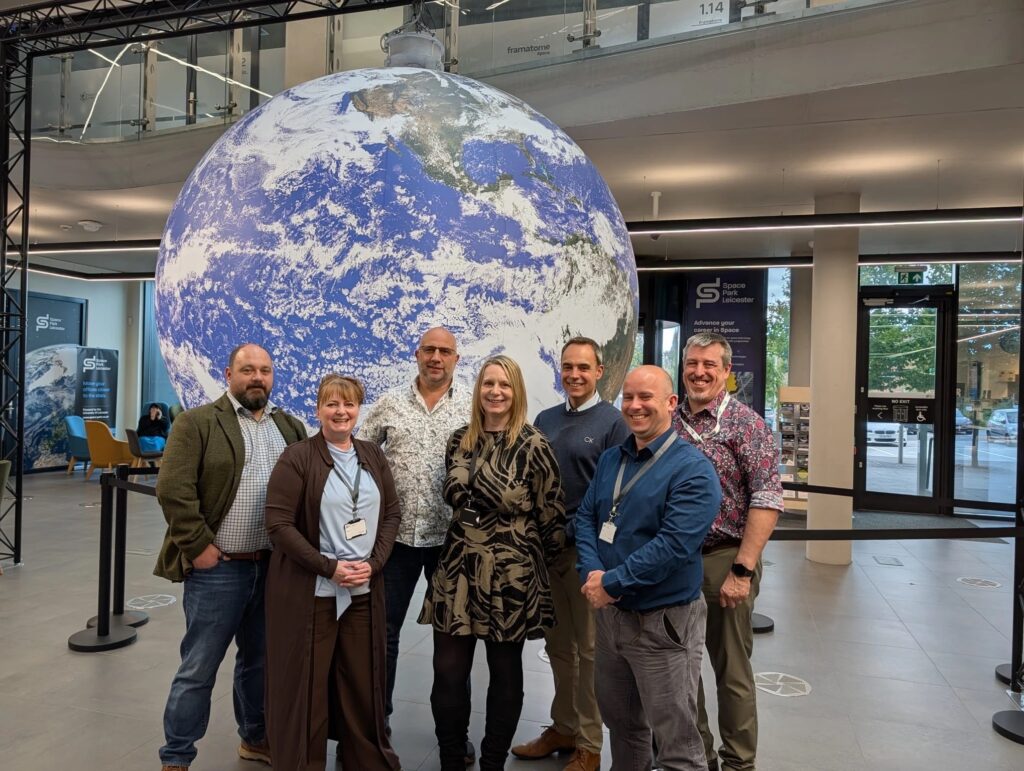
Cover Image: Members of the IDE Systems team at Space Park Leicester – Credits SPL
Sometimes a business decision comes down to spreadsheets and strategy. This time, it also came down to a rock from the Moon.
IDE Systems, an engineering company specialising in systems engineering and safety assurance, has become the latest organisation to base itself at Space Park Leicester. Its managing director, Ian Hobson, handled a piece of lunar material during a visit. According to the company’s chief operating officer, Claire Deans, that moment made the rest of the conversation easy.
Who is IDE Systems?
IDE Systems is a growing small and medium-sized enterprise (SME). Its core work is systems engineering and systems safety and assurance. It also offers:
- data science
- cyber security
- artificial intelligence and machine learning
- electrical, control and instrumentation (EC&I)
- systems thinking
The company has experience in highly regulated, safety-critical sectors, including defence. It works with a network of specialist associates, which lets a small core team scale up for larger projects.
Why systems engineering matters for space
If you follow space news, you hear about rockets, telescopes and rovers. You hear less about the discipline that holds them together.
Systems engineering is the work of making sure that thousands of parts, software, people and procedures behave as one system. Safety and assurance is the work of showing, with evidence, that the system does what it should and fails in acceptable ways when something goes wrong. A spacecraft cannot be repaired by a technician after launch, so this work happens early and is documented carefully.
These skills carry across sectors. The same logic applies to a satellite, a defence platform or a piece of industrial control equipment. That is why a company with a safety-critical background fits naturally into a space-focused research environment.
An engineer’s note: where missions are actually lost
As an aerospace engineer, I can tell you that spacecraft rarely fail because one component was badly designed. They fail at the interfaces, where two parts that each work on their own are asked to work together.
Two well-documented cases show this. In 1996, the first Ariane 5 flight was lost after software reused from Ariane 4 met flight conditions it was never built for. In 1999, NASA’s Mars Climate Orbiter was lost because one team’s software produced results in imperial units while another team’s expected metric. Neither case involved weak engineering in the usual sense. Each was a gap between two sets of assumptions.
This is what systems engineering and assurance exist to catch. They ask uncomfortable questions early: what does each part assume about the others, what happens if that assumption is wrong, and what evidence shows it is not? The work is rarely visible, but it is why a launch that took years to prepare has a good chance of ending in success.
Why Space Park Leicester?
Space Park Leicester is the University of Leicester’s £100 million hub for space research, innovation and teaching. Deans said the company wanted a professional base that matched its growth, with room to meet clients and partners. The company also sees longer-term value in using the park’s facilities as it pursues work in defence and security.
Its stated priorities are:
- Build relationships with other residents, the wider engineering community and academic partners.
- Combine complementary capabilities to tackle complex problems and bid for larger engineering programmes.
- Develop engineering training as part of its services, working with students and early-career professionals.
Vinay Patel, Head of Commercial and Innovation at Space Park Leicester, said the park’s strength lies in bringing together businesses, researchers and talented people who might not otherwise work side by side. He said IDE Systems arrived with a real appetite to collaborate.
And the Moon rock?
The press release does not say which sample Hobson handled. Lunar samples are rare and carefully controlled, so it is a memorable thing to hold. For a team that spends its days on assurance and evidence, the appeal of touching something brought back from another world is easy to understand.
It also makes a point worth keeping in mind. Space research draws people in because it is tangible and inspiring, and that pull can bring in the engineering, data and safety expertise the sector needs.
Frequently asked questions
What does IDE Systems do?
It provides systems engineering and systems safety and assurance services, with additional capabilities in data science, cyber security, AI and machine learning, and electrical, control and instrumentation engineering.
Where is Space Park Leicester?
It is part of the University of Leicester, in the East Midlands of England.
Is IDE Systems a space company?
Not exclusively. It works across engineering, technology, defence and security, and is joining a community built around space research and innovation.
Will IDE Systems offer training?
The company says it is exploring engineering training as a service and wants to work with students and early-career professionals.
Source: press release from Space Park Leicester, with statements from Claire Deans (IDE Systems) and Vinay Patel (Space Park Leicester).