
Join the mailing list Free weekly briefing, no spam.
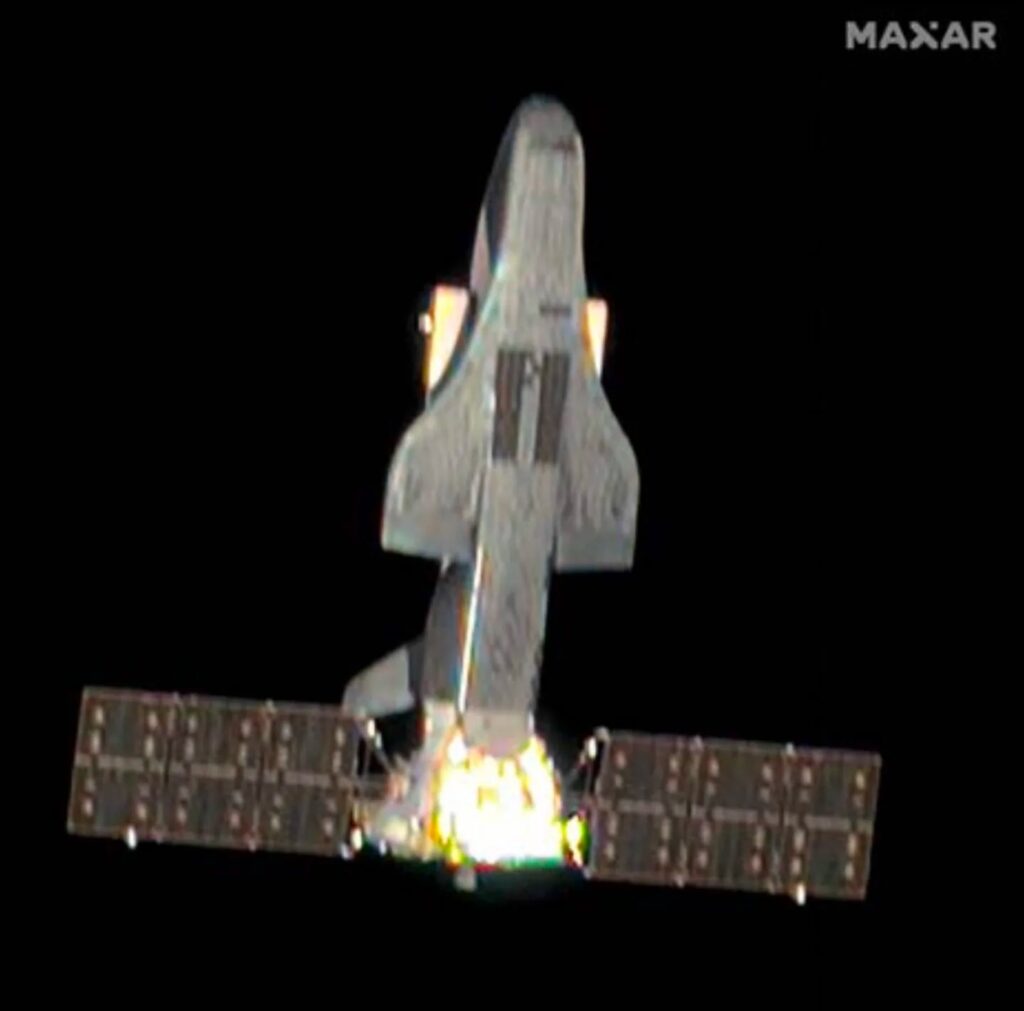
Cover image credit: DIA, Maxar
Published 28 October 2026 by The SpaceInfo Club
China’s experimental reusable spacecraft has never been shown officially, yet we now know what it looks like. On 26 October 2026 the US Defense Intelligence Agency (DIA) published a sharp image of the vehicle in an unclassified assessment of threats in space. The photo was taken in 2024 by a commercial imaging satellite owned by Vantor, then called Maxar, and first reported by Ars Technica.
Key facts
- Four missions since 2020: 2 days, 276 days, about 9 months, and a fourth launched in early February 2026 that is still in orbit.
- Launched each time by a Long March 2F from Jiuquan, then flown as a satellite and landed on a runway.
- The vehicle is nicknamed “Shenlong” (Divine Dragon) by enthusiasts. It is not an official name.
- China says the missions verify reusable technology and on-orbit services for the peaceful use of space. It has published no photos or specifications.
What the image shows
According to Ars Technica’s description of the DIA image, the craft has delta wings, payload bay doors, a dark heat shield and a rear service module with solar arrays. That is, to a great degree, the layout of the US Space Force’s X-37B.
Lower-resolution views of the general shape were already public. What is new is the detail, and where it came from: a US satellite built to photograph the ground, pointed at an object in space.
Four missions, one clear trend
The program has grown step by step:
- 4 September 2020: about two days in orbit, then landing in China.
- 5 August 2022: 276 days in orbit, landing on 8 May 2023.
- 14 December 2023: about nine months, landing in September 2024.
- Early February 2026: launched again and still flying.
From an engineering point of view, the durations matter more than any single flight. Longer missions mean the thermal protection, the autonomous reentry and the runway landing were good enough to fly the vehicle again with confidence. Ground teams then refurbish it for another flight, as with the X-37B. It is not publicly known whether China has one such vehicle or several.
The launcher also hints at size. The Long March 2F lifts roughly eight tonnes to low Earth orbit, which is compatible with an X-37B-class vehicle. This is an inference, not an official figure.
Where it differs from the X-37B
The two programs look alike, but they behave differently.
- Transparency. US officials have released photos of the X-37B, its dimensions and a handful of experiments, while most of its activity remains classified. China has released nothing.
- Orbit. The Chinese vehicle has flown only in low Earth orbit, a few hundred miles up. One X-37B flight went beyond 24,000 miles and then used aerobraking to set up reentry.
- Rendezvous. The Chinese spaceplane has repeatedly released small objects and then approached them. In June 2024 it carried out rendezvous and proximity operations with a released object tracked as “Object G”. On its fourth mission it released a sub-satellite in June 2026 and recaptured it in July, perhaps with a robotic arm, according to Ars Technica. LeoLabs also detected an unidentified object near the vehicle on 22 June 2026.
Catching an object in orbit is hard. It needs precise relative navigation, autonomous guidance and a mechanism that can grip something moving at orbital speed. Whatever the purpose, the capability is real.
Servicing or something else?
The same skills can serve two purposes. Inspecting, repairing or refueling satellites is useful. Approaching an adversary’s satellite is a military concern. The DIA says the “enhanced maneuverability” of spaceplanes makes them better suited to certain missions than traditional satellites.
From the outside, the two uses are almost indistinguishable. Experts cited in the press do not rule out military capability for either the Chinese craft or the X-37B, and China describes its tests as peaceful. The headline of the Ars Technica piece adds that the DIA assessment suggests China may soon place directed energy weapons in space. That is a separate DIA judgment about future threats, not evidence about this spacecraft.
The honest summary is that the capability is observed, while the intent is not.
Why it cannot hide
The title of the Ars piece makes a simple point: low Earth orbit is the most observed region of space. Radar tracking is strong there, so orbits and orbit changes are visible. The second spaceplane mission was followed as it moved from roughly 346 by 593 km to a near-circular 597 by 608 km. A higher, rounder orbit means less atmospheric drag, which is a plausible reason for the change but not a confirmed one.
Released objects are tracked too. On the third mission an object let go in May 2024 was catalogued by US teams, and astrophysicist Jonathan McDowell suggested it might simply be inert hardware. Amateur observers add to the picture: Scott Tilley has followed the vehicle’s signals, and amateur photographs have shown solar panels that no public rendering had.
So the secret is the content of the mission, not its path.
Frequently asked questions
Is China’s spaceplane the same as the X-37B?
No. It looks very similar, but it is a separate Chinese vehicle with its own program. China does not publish its specifications.
How many missions has it flown?
Four so far, the last launched in early February 2026 and still in orbit as of 28 October 2026.
Is it a weapon?
Nothing public proves it. Its demonstrated skills (releasing and recapturing objects) are useful for servicing and could also be used against other satellites. Claims about intent are assessments, not observations.
How do we know what it does if China says nothing?
Radar operators, commercial companies, the US military and amateur astronomers track its orbit, its released objects and its maneuvers.
Sources
- Ars Technica, “China’s top-secret spaceplane can’t hide in low-Earth orbit”, Stephen Clark, 27 October 2026
- South China Morning Post, on the object released in May 2024
- LeoLabs, on the second mission’s maneuvers
- Johns Hopkins, summary of SpaceNews reporting on the 2024 proximity operations
- Universe Magazine, on the LeoLabs detection of 22 June 2026