
Join the mailing list Free weekly briefing, no spam.
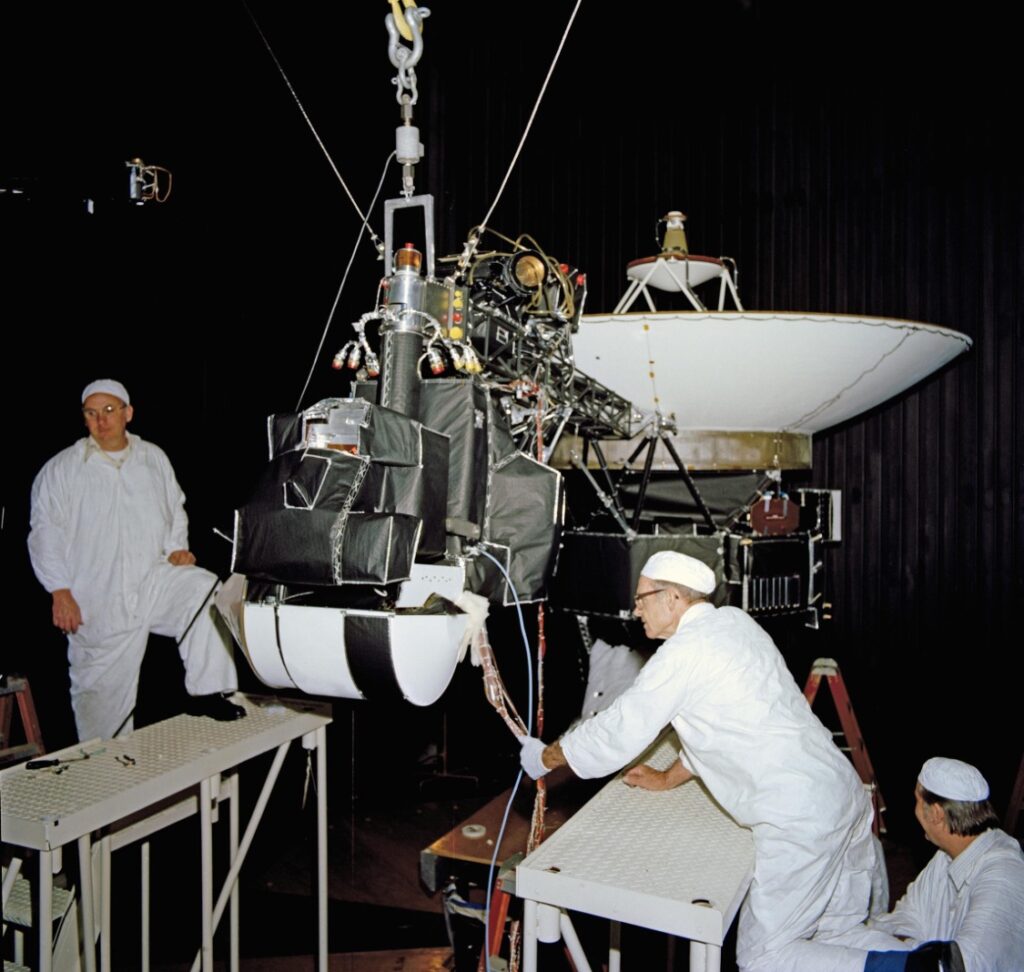
Cover Image: 25-Foot Space Simulator thermal vacuum chamber at NASA’s Jet Propulsion Laboratory in Southern California.
Credit: NASA/JPL-Caltech
NASA’s Voyager 1 is communicating normally again after two scheduled contact attempts on October 18 and 19, 2026 failed to detect any radio signal. The signal reappeared on October 20, and engineers have kept contact since. The cause is still under investigation. The episode follows an energy-saving operation in early September and comes just before Voyager 1 reaches a distance of one light-day from Earth on November 18.
Key facts
- Signal loss: NASA’s Deep Space Network detected no signal from Voyager 1 during two scheduled attempts, 24 hours apart, on October 18 and 19, 2026.
- Recovery: the signal returned on October 20 without any troubleshooting commands from the team. Contact has continued since.
- What engineers have found so far: one group of thrusters went offline and their backups switched on, an automatic response known as fault protection.
- Cause: not yet determined.
- Power saving: in early September 2026, the team swapped three devices for three lower-power alternatives in an operation nicknamed the “Big Bang”.
- Milestone: on November 18, 2026, Voyager 1 will be 16.09 billion miles (25.89 billion km) from Earth, equal to one light-day.
- Source: NASA Jet Propulsion Laboratory, press release published October 29, 2026.
The “Big Bang”: how Voyager 1 is saving power
Voyager 1 and Voyager 2 run on radioisotope thermoelectric generators, which turn the heat of decaying plutonium into electricity. As the plutonium decays, each probe loses about 4 watts of electrical power every year. After almost fifty years in flight, the power margin is thin, so the team has to switch off nonessential equipment to keep the science instruments running.
In early September, engineers turned off three devices on Voyager 1 and replaced them with three lower-power alternatives. The operation was completed about six weeks after the same swap on Voyager 2. The six devices involved help keep the spacecraft warm enough to operate in the cold of interstellar space. NASA says the three swaps had to happen at the same time. Only then could the team reduce power use and still make sure heat stays properly distributed across the spacecraft.
Our engineering reading: on a spacecraft this small, nearly every watt of electrical power ends up as heat inside the structure. Removing an electrical load also removes a heat source, so you cannot treat power and temperature as two separate problems. Swapping the devices one at a time could have left some part of the spacecraft too cold. That is an interpretation based on how spacecraft thermal design works, not a statement from NASA.
The payoff is time. Without the Big Bang, the team would have needed to switch off another science instrument on Voyager 1 as early as summer 2027. Two instruments have already been turned off in recent years. The mission launched in 1977 with 10 dedicated science instruments, and some were shut down after the planetary encounters. The Voyagers are now the only spacecraft ever to study interstellar space directly, so every instrument that keeps working matters.
What happened on October 18 and 19
The Deep Space Network is a set of large antennas at three sites around the world, used to talk to spacecraft at the Moon and beyond. During two scheduled attempts, it could not pick up a radio signal from Voyager 1, which is about 16 billion miles from Earth. The signal came back 24 hours after the second attempt, on October 20, before the team had sent any commands to troubleshoot.
So far, engineers have established one thing: a group of thrusters went offline and their backups turned on. This swap is programmed to happen automatically when the spacecraft computers detect a problem with the active thrusters. This is fault protection. The spacecraft puts itself into a safe, stable configuration and pauses normal operations, which gives engineers time to diagnose the issue.
What NASA has not said is whether the thruster swap is what interrupted the radio link, or why the signal returned on its own. Voyager mission manager Kareem Badaruddin told NASA this is the first time the team has seen the spacecraft do something like this, and that at this stage of the mission they have to expect the unexpected.
Our reading: the careful wording in the NASA release is appropriate. A thruster swap and a lost signal happened around the same time, but the investigation has not yet shown that one caused the other. Until it does, treat the link between them as unconfirmed.
One light-day: what the milestone means
On November 18, Voyager 1 will be 16.09 billion miles (25.89 billion km) from Earth, which is one light-day: the distance light travels in 24 hours. Radio waves move at the speed of light, so a command sent from Earth takes 24 hours to arrive, and the reply takes another 24 hours to come back. Voyager project manager Suzanne Dodd summed it up for NASA: send your message, go home, and wait two days for an answer.
For scale, sunlight takes about 8 minutes and 20 seconds to reach Earth. One light-day is roughly 173 times the distance between Earth and the Sun, by our calculation. Voyager 1 covers that distance at about 38,000 mph (61,155 km/h).
Nothing will change on board when the spacecraft passes this point, and it will not detect anything different in its surroundings. The significance is symbolic: it shows how far the most distant human-made object has traveled, and how long the signal link has held together.
What to watch next
- The cause of the thruster swap and the signal loss, once the team finishes its investigation.
- Whether the lower-power configuration holds up in everyday operations. NASA expects the Big Bang to let the remaining science instruments operate longer than previously planned.
- November 18, 2026, when Voyager 1 crosses one light-day from Earth.
- Further power decisions. With about 4 watts lost per year on each probe, the team will keep having to choose what to turn off.
Frequently asked questions
Is Voyager 1 still working?
Yes. As of NASA’s October 29, 2026 update, the team has been in contact with Voyager 1 continuously since October 20, after a brief loss of signal on October 18 and 19.
Why did Voyager 1 stop communicating in October 2026?
NASA does not know yet. Engineers found that one group of thrusters went offline and their backups turned on through automatic fault protection. The investigation into the cause is ongoing.
What is the Voyager 1 “Big Bang”?
It is the nickname for an energy-saving operation completed in early September 2026. Engineers turned off three devices and replaced them with three lower-power alternatives, all at once, so the spacecraft would use less power while keeping its heat properly distributed.
How far is Voyager 1 from Earth?
About 16 billion miles. On November 18, 2026, it will be 16.09 billion miles (25.89 billion km) away, equal to one light-day.
How much power does Voyager 1 lose each year?
About 4 watts. Both Voyager probes get their electricity from plutonium-powered generators, and the output declines as the plutonium decays.
When will Voyager 1 run out of power?
NASA has not published an end date. The team is turning off nonessential systems to keep the remaining science instruments operating for as long as possible.
Source
NASA Jet Propulsion Laboratory, “NASA’s Voyager 1 Conserves Power, Resolves Brief Communications Pause,” October 29, 2026.
NASA Voyager blog on the Voyager 2 swap
Published October 30, 2026, by The SpaceInfo Club.