
Join the mailing list Free weekly briefing, no spam.
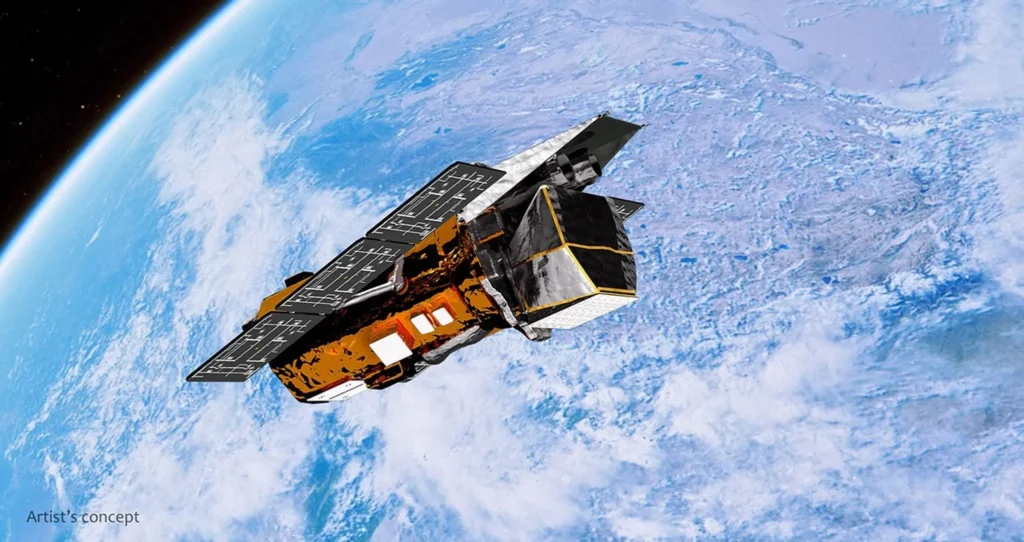
Artist’s concept of NASA’s Swift Observatory falling to Earth. Image credit: NASA.
NASA’s Neil Gehrels Swift Observatory is expected to fall back into Earth’s atmosphere on or around November 4, 2026, after 22 years in orbit and a commercial rescue attempt that never got as far as a capture.
Swift’s final days at a glance
- Launch: November 20, 2004, for a planned two-year primary mission. It kept working for more than two decades.
- Original orbit: about 600 km above the Earth.
- End of science: on October 20, 2026, at about 275 km, atmospheric drag made stable pointing impossible. Swift entered safe mode and the operations team ended observations.
- Reentry forecast: The Aerospace Corporation’s CORDS projected 09:30 UTC on November 4, with an uncertainty of 26 hours either side, based on orbital data from October 30. The US Space Force spoke of a return “around Friday” in the days before.
- Mass and debris: roughly 1.5 tonnes. Most of it should burn up. Some tungsten and mirror parts may survive, and any debris is most likely to land in the ocean.
This article was written on November 4, 2026, before any official confirmation of the reentry. We will update it when one is published.
Why Swift fell: drag and a very active Sun
Swift came down because the thin upper atmosphere at its altitude became denser than planned for, and the spacecraft was never built to climb back up. NASA and the press coverage attribute the faster-than-expected decay to intense solar activity over the past few years.
The physics behind it is compact. The drag deceleration on a satellite is:
aD = ½ · ρ · v² · (CD · A / m)
Here ρ is the local air density, v the speed relative to the air, CD the drag coefficient, A the cross-section facing the flow and m the mass. The last factor is the inverse of the ballistic coefficient. Swift’s mass and shape are fixed, and its speed barely changes between orbits (about 7.6 km/s at 600 km and about 7.7 km/s at 275 km, our own calculation). Density is the only term that moves a lot.
Three effects explain why it moved against Swift:
- Density depends steeply on altitude. In the thermosphere, density drops roughly exponentially with height. Between 600 km and 275 km the difference is several orders of magnitude (order-of-magnitude estimate, not a measured Swift figure).
- The Sun sets the density at any given altitude. Extreme ultraviolet radiation heats the thermosphere and makes it expand, and geomagnetic storms add more heating. Solar Cycle 25 reached its most active phase around 2024 and 2025, so the air at Swift’s altitude was far denser than it would be near solar minimum.
- Decay feeds on itself. A lower orbit meets denser air, which brakes the satellite more, which lowers the orbit further. The orbital period shortens from about 97 minutes at 600 km to about 90 minutes at 275 km (our calculation), and the final stretch of altitude is lost in days or weeks, not years.
This also explains why science ended before reentry. Drag on a satellite with an uneven shape produces a torque as well as a braking force, and the attitude control system has to absorb it. The likely mechanism for Swift’s loss of stable pointing on October 20 is that this torque grew beyond what the system could manage at about 275 km. NASA’s own statement says only that drag prevented a stable observing position, so this part is our interpretation.
The rescue attempt: Katalyst’s LINK
The rescue failed before it reached the capture phase, because LINK, the servicing spacecraft, could not control its own attitude well enough to approach Swift.
NASA awarded Katalyst Space Technologies a contract worth about $30 million, roughly 11 months before the August decision. The plan was for LINK to find “capture locations” on Swift where at least one of its three grippers could hold on, then use its thrusters to raise Swift back toward its original 600 km orbit over two to three months. This was hard by design: Swift was launched in 2004 and was not built to be reboosted, so it has no grapple fixtures.
The timeline, from SpacePolicyOnline:
- July 3, 2026: LINK launched on a Pegasus XL, dropped from Northrop Grumman’s Stargazer L-1011 aircraft over the Kwajalein Island area.
- July 28: Katalyst reported a multi-axis spin lasting 72 hours. Over the next 48 hours the team cut the rate from 9 to about 4 degrees per second.
- August 5: the spin rate was down to 1.47 degrees per second.
- August 11: a software update with new attitude controllers was uplinked.
- August 19: Katalyst and NASA ruled out the reboost, citing attitude control problems with LINK. Some rendezvous and proximity operations were still planned.
- September 25: LINK itself reentered, according to EconoTimes. AP reports that it never came closer to Swift than 7 to 9 miles (12 to 15 km).
What the numbers suggest
The analysis below is ours, not NASA’s or Katalyst’s.
The spin rate came down by a factor of six in about a week, which shows that the control team could recover the vehicle. The problem was time. From launch to the no-go call, seven weeks passed, and Swift was losing altitude the whole time. A servicing mission against a decaying target runs on a clock that the vehicle does not control: every week spent stabilizing LINK was a week of orbit lost, and the capture itself still needed careful proximity operations around an object with no docking aids.
The schedule was also tight by any standard for a first-of-its-kind mission. Going from contract to launch took about ten months, and the target was one that nobody had ever designed to be grabbed. The result does not show that on-orbit servicing of uncooperative satellites is impossible. It shows how little margin a commercial demonstration has when the first attempt also has to be the rescue.
Reentry forecasts and debris risk
Nobody can say where Swift will come down, and the reason is arithmetic, not secrecy. The CORDS projection of 09:30 UTC on November 4 carries an uncertainty of 26 hours either side, which is about 17 orbits of roughly 90 minutes each. A timing error of one minute moves the reentry point by about 460 km along the ground track (speed near 7.7 km/s, our calculation). Earth also rotates about 22.5 degrees of longitude under the orbit during every revolution. Until the final orbits, the forecast can only say when, never where.
Forecasts disagree for the same reason. CORDS and the other estimate we found, which is centered about an hour earlier and uses a window of 11 hours, start from slightly different assumptions about drag and about future solar and geomagnetic activity. Both inputs change from day to day, and the error shrinks quickly only in the last day or so.
What can reach the ground
According to NASA’s Brad Cenko, quoted by AP, most of the roughly 1.5 tonne spacecraft should burn up. Some tungsten pieces, which are denser than lead, and some mirror parts could survive. Dense, high-melting-point components are the usual survivors of uncontrolled reentries, because they heat up and lose mass more slowly than aluminum structure and electronics.
Where it could fall
Swift’s orbit is inclined about 20.6 degrees to the equator, so its ground track never leaves the band between roughly 21 degrees north and 21 degrees south. That band covers about 35% of the Earth’s surface (the sine of 20.6 degrees is about 0.35). It matches the regions AP lists: parts of Africa, Australia, India, Southeast Asia, and Central and South America. Most of that band is ocean, which is why the most likely landing zone for any fragments is the sea.
How risky is it?
NASA’s debris requirement for uncontrolled reentries is an expectation of casualty no higher than 1 in 10,000, described in a NASA technical paper on the IXPE mission. One secondary outlet, EconoTimes, cites a risk of about 1 in 2,100 for anyone on Earth. We could not tie that number to a NASA or Space Force statement, so treat it as unverified. If it were accurate, it would be about five times the 1 in 10,000 figure, which is why it deserves a primary source before anyone repeats it. Even then, 1 in 2,100 means a very small chance for the whole planet, not for any person.
What Swift leaves behind
Swift’s main contribution is speed: it was built to find a gamma-ray burst and point sensitive instruments at it within minutes, while the afterglow is still bright. Over its lifetime it detected more than 2,000 gamma-ray bursts and observed about 1,400 exploding stars, according to AP.
Three instruments made that possible:
- BAT (Burst Alert Telescope): a wide-field hard X-ray monitor, sensitive from 15 to 150 keV, that continuously scans the sky for new bursts.
- XRT (X-ray Telescope): a narrow-field instrument that observes the X-ray afterglow once the spacecraft has slewed.
- UVOT (UltraViolet/Optical Telescope): a narrow-field instrument that covers the ultraviolet and optical bands.
After a detection, Swift slews and starts XRT and UVOT observations within a couple of minutes, as described in a review of Swift’s kilonova work.
That review also gives two examples of the payoff. In 18 years Swift detected over 130 short, hard-spectrum bursts, and about 70% of them were localized by the XRT. Precise positions allowed redshift measurements and searches for kilonovae, the glow from merging neutron stars. And when gravitational waves from GW170817 arrived, Swift’s XRT and UVOT began observing the counterpart AT2017gfo 0.6 days after the trigger, and UVOT detected a bright, rapidly fading ultraviolet and optical source that the paper interprets as kilonova emission.
The loss matters beyond the numbers. Swift is an observatory that reacts to events, and the GW170817 follow-up shows what that means in practice. How much of that rapid-response capability other missions can take over is a question for the community that used it, and we have not assessed it here.
Lessons for servicing and end-of-life planning
The Swift case points to four lessons for satellite designers and agencies. These are our reading of the facts above, not statements from NASA or Katalyst.
- Design for the interface, not only for the mission. Swift had no grapple fixtures, so any rescue had to improvise a grip on hardware built for something else. Fixtures, visual targets and a defined approach corridor cost little at launch and make later servicing a different class of problem.
- Treat the solar cycle as a design input. A satellite in low Earth orbit lives through at least one solar maximum. Orbit altitude, propellant or reboost capability, and deorbit plans should be sized for a dense-atmosphere scenario, not for the average.
- Fix the decision points while the altitude is still high. In a decay scenario, every week of delay is paid for in kilometers. The earlier the go or no-go decision, the more options remain, including a controlled disposal if the hardware allows it.
- Expect first attempts to fail. A demonstration mission with ten months from contract to launch has little room for a spin on day one. Funding a second vehicle, or a longer schedule, is cheaper than a lost observatory.
All of this is about the next mission. Swift itself worked well beyond its two-year design life, and its decay is a consequence of the physics described above, not of a failure on board.
Frequently asked questions
When will Swift reenter?
The most precise projection we found is 09:30 UTC on November 4, 2026, with an uncertainty of 26 hours either side, from CORDS. The US Space Force expected a return around Friday.
Why could NASA not boost Swift to a higher orbit?
Swift was not designed to be reboosted and has no grapple fixtures. The Katalyst LINK spacecraft launched on July 3, 2026 but developed attitude control problems, and the reboost was ruled out on August 19.
Is Swift dangerous to people on the ground?
Most of the spacecraft should burn up. Some dense parts, such as tungsten and mirror components, could survive, and debris would most likely fall in the ocean. NASA’s design requirement is a casualty expectation of no more than 1 in 10,000.
Can I see it reenter?
The spacecraft reenters at a point nobody can predict in advance. A reentry that happens over a populated area at night can produce a visible train of fragments. Nobody can tell you where to look before the final orbits.
Sources
- AP via CP24, October 31, 2026: NASA telescope might plunge back to Earth
- SpacePolicyOnline: No-Go for Katalyst’s Reboost of NASA’s Swift Observatory
- EconoTimes: NASA’s Swift Mission Ends as Tracker Projects Nov 4 Re-Entry
- NASA Technical Reports Server: IXPE experience, casualty risk requirement
- arXiv: Eighteen Years of Kilonova Discoveries with Swift