
Join the mailing list Free weekly briefing, no spam.
Photo Credits in the image
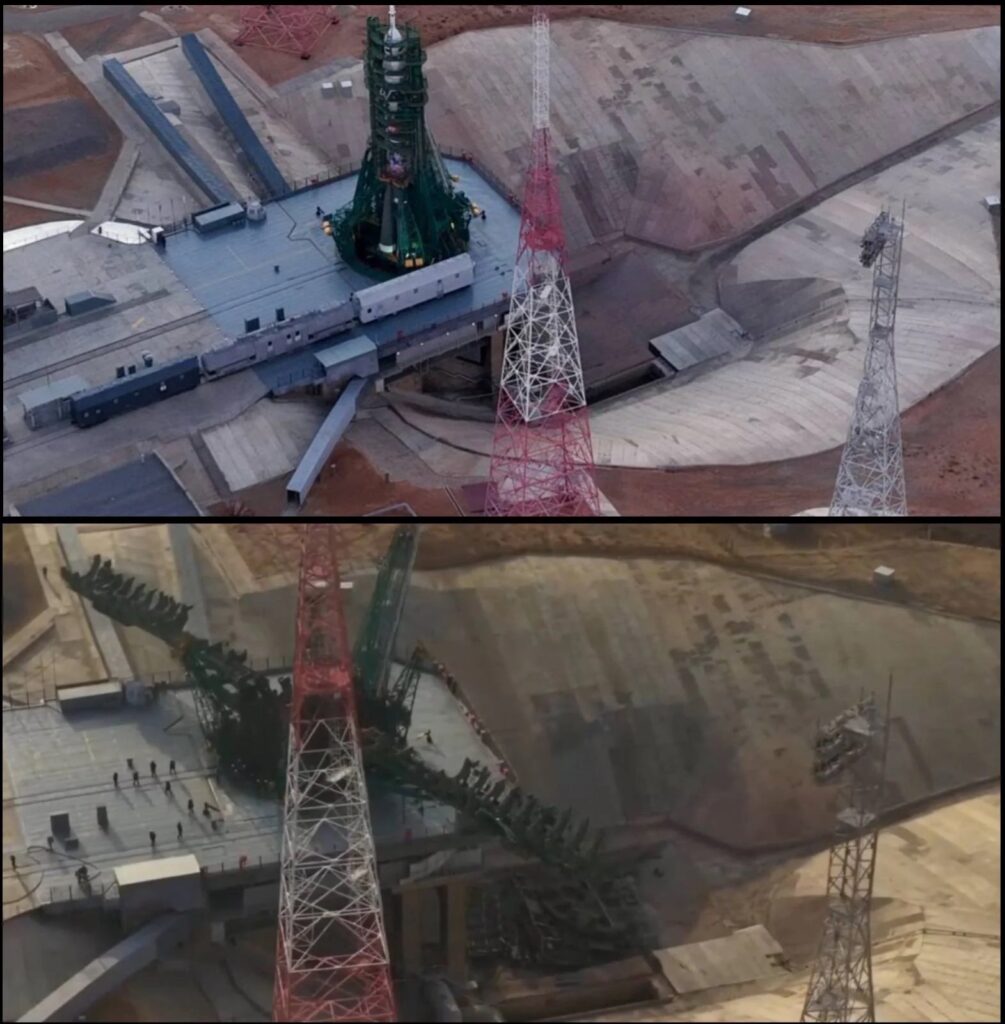
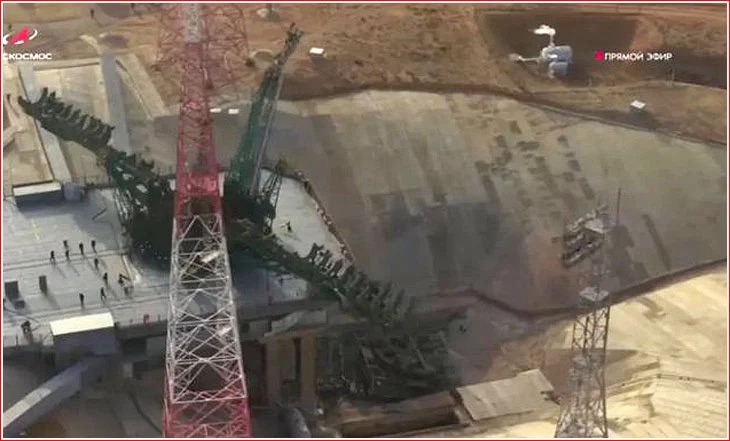
On November 27, 2025, a Soyuz MS-28 launch from the Baikonur Cosmodrome in Kazakhstan sent two Russian cosmonauts and NASA astronaut Christopher Williams to the International Space Station. The crew reached the station as planned. The launch pad did not come through as well. About 10 seconds after liftoff, the mobile service platform at Site 31 fell into the flame trench, putting out of action the only Russian pad used to launch crews and cargo to the ISS.
Roscosmos announced the repair on March 3, 2026, and the first launch from the restored pad took place on March 22. This article covers what is known about the failure, why one pad carries so much weight, how it was fixed, and how the episode fits into the political relationship behind the ISS, which has since been extended to 2030.
Key facts
- Date: November 27, 2025, during the launch of Soyuz MS-28.
- What failed: the mobile service platform at Baikonur Site 31 collapsed into the flame trench roughly 10 seconds after liftoff.
- Why it mattered: Site 31 is Russia’s only pad for ISS crew and cargo launches.
- Repair: Roscosmos announced completion on March 3, 2026. Progress MS-33 launched from the pad on March 22, 2026.
- Cause: a senior Roscosmos official blamed human error by pad personnel. We found no public final investigation report.
- Partnership: in July 2026, NASA and Roscosmos agreed to operate the ISS through 2030 and to continue seat swaps, according to SpacePolicyOnline citing TASS.
What happened on November 27, 2025
Soyuz MS-28 lifted off normally and delivered its three crew members to the ISS. Within hours, Roscosmos said its post-launch inspection had found damage to several pad components, that spare parts were available, and that repairs would follow shortly. NASA said it was aware that Roscosmos was inspecting the pad.
Photos of the site told a more serious story. The whole mobile service platform lay at the bottom of the flame trench, apparently beyond repair, according to RussianSpaceWeb. The Progress MS-33 cargo ship, planned for December 21, 2025, was cancelled.
Why a single pad matters so much
Site 31 is the only Russian pad that supports crewed Soyuz launches and ISS cargo flights. The older Site 1, where Yuri Gagarin launched, was retired in 2019.
Orbital mechanics explains why Russia cannot simply switch pads. A rocket launched due east reaches an orbit whose inclination equals the latitude of the launch site, and it cannot go lower without extra maneuvers. The ISS orbits at 51.6 degrees. Baikonur, at about 46 degrees north, reaches that orbit directly. Vostochny, at about 51.9 degrees north, sits just above the ISS inclination and would pay a performance penalty. Plesetsk, near 63 degrees north, is farther off still. This explanation is our own engineering summary, not a Roscosmos statement.
How the platform failed
The mobile service platform is the structure that lets technicians work around the rocket on the pad. Before launch it is retracted into a shelter below the pad so the exhaust does not hit it.
According to RussianSpaceWeb, a Baikonur veteran reported on a Russian space forum that the platform had not been properly secured in its shelter, so the blast wave pulled it off its guide rails. The same account says a special stopper had not been put in position. These details are unofficial. What is on the record is a January 27, 2026 interview in which Igor Barmin, head of the TsENKI ground infrastructure division at Roscosmos, blamed human error by pad personnel and said several team members were under criminal investigation for possible violations of procedure.
The repair: faster than first estimates
Early estimates suggested the platform repair could take up to two years. Roscosmos finished in about three months.
The work was not simple. Barmin said the replacement platform had to be assembled from components made at different times, and that the core of the spare unit was built in 1977 to blueprints for a refurbishment that was never carried out. The set was incomplete, so missing parts had to be made new. Roscosmos reported that 18 heavy trucks brought components to Baikonur, more than 130 employees worked two shifts, and individual platform elements reached 19 meters in length and 17 tons in mass, which required a dedicated lifting method.
Roscosmos confirmed completion on March 3, 2026. A Soyuz-2.1a with Progress MS-33 launched on March 22, with docking planned for March 24.
Kazakhstan, the landlord
Site 31 stands on land that Russia leases from Kazakhstan. An agreement signed in 2004 extended the lease to 2050 at about $115 million per year. Kazakh officials have said the fee does not fully cover environmental costs, and the joint Baiterek launch complex has been under negotiation for years.
Nothing in the sources we reviewed suggests Kazakhstan played any role in the incident. The point is structural: the single pad on which the ISS depends for Russian crew and cargo flights is located on territory belonging to a third country. Our companion article on the post-ISS era explains why this still matters for Russia’s future station plans.
The ISS partnership after the incident
The pad failure came after four years of political turbulence around the station.
- July 2022: after the invasion of Ukraine, Roscosmos chief Yuri Borisov said Russia would leave the ISS after 2024. NASA was then told Russia intended to stay until 2028.
- October 2022: Roscosmos cosmonaut Anna Kikina flew on a SpaceX Crew-5 mission, the first Russian launched from US soil in about 20 years, under the seat-swap arrangement.
- July 31, 2025: Roscosmos chief Dmitry Bakanov met NASA acting administrator Sean Duffy in person, the first such talks in more than seven years, and agreed to continue ISS operations to 2028.
- July 2026: according to SpacePolicyOnline, citing TASS, Bakanov and NASA Administrator Jared Isaacman agreed to operate the station through 2030, continue seat swaps without exchange of funds, and coordinate satellite operations to avoid collisions.
The seat-swap system worked as intended during this period. NASA’s Crew-12 flight in February 2026 carried Roscosmos cosmonaut Andrey Fedyaev, and Soyuz MS-29 reached the station on July 14, 2026 with NASA astronaut Anil Menon aboard.
What the incident shows (SpaceInfo Club analysis)
This section is our interpretation, not an official position.
First, the most serious failure in this story was not a rocket or a spacecraft but a piece of ground equipment that has to be secured by hand before launch. Ground infrastructure rarely makes headlines until it fails.
Second, redundancy is expensive, and the Soviet-era Russian pad network was never built for a world with one crew pad. The fix worked because old spare hardware existed and could be adapted. That is good luck as much as good planning.
Third, the partnership held. A pad outage of under four months did not break the ISS agreements, and the extension to 2030 came afterward. Practical dependence between the two agencies remains strong, but readers should note that this is our reading of the sequence of events and that both agencies have said little about the political motivations.
What to watch next
- Whether Roscosmos publishes a full root-cause report on the Site 31 collapse.
- Whether Russia adds a second pad capable of supporting ISS flights or crewed launches.
- How the 2030 agreement is formalized and how seat swaps continue.
- The status of the Baikonur lease and the Baiterek project as Russia plans its next station.
Frequently asked questions
Was the Soyuz MS-28 crew affected?
No. According to reports on the launch, the spacecraft delivered its three crew members to the ISS.
Is Site 31 the only pad Russia can use for the ISS?
Yes. Site 31 is the only Russian pad used for ISS crew and cargo missions. Site 1 was decommissioned in 2019.
How long was Site 31 out of service?
From November 27, 2025 until Roscosmos announced completion of repairs on March 3, 2026. The first launch from the pad took place on March 22, 2026.
What caused the collapse?
A Roscosmos official attributed it to human error by pad personnel. Unofficial reports describe a platform that was not secured in its shelter. We found no published final investigation.
Will Russia stay on the ISS until 2030?
According to SpacePolicyOnline, citing TASS, Roscosmos and NASA agreed in July 2026 to operate the station through 2030. Check Roscosmos and NASA for any later changes.
Sources
- RussianSpaceWeb, Russia’s only pad for crew launches suffers major damage in 2025
- SpacePolicyOnline, Russia’s launch pad damaged after Soyuz MS-28 launch
- SpacePolicyOnline, Russia agrees to ISS operations, seat swaps, through 2030
- Space.com, Russia fixes launch pad damaged by Thanksgiving astronaut launch to the ISS
- NASASpaceflight, Baikonur launch pad restored, clearing path for Progress MS-33
- Reuters, Baikonur launch pad damaged after Russian Soyuz launch (November 27, 2025)
- NBC News, Russia extends lease of space-launch site (2004)
- The Moscow Times, Russia and US agree to extend ISS operations to 2028 (August 1, 2025)
Published November 2, 2026, by The SpaceInfo Club.