
Join the mailing list Free weekly briefing, no spam.
NASA’s Neil Gehrels Swift Observatory has come home. After almost 22 years in orbit, the spacecraft re-entered Earth’s atmosphere on 4 November 2026, closing one of the most productive chapters in modern astronomy. The science is not over, though. The University of Leicester, which has been part of Swift since its earliest design phase, has received new funding from the UK Space Agency to keep working on the mission’s data until September 2028.
Swift re-entry status: what we know so far
- Status: re-entered on 4 November 2026. ABC News reports that the US Space Force confirmed the event after tracking the spacecraft’s decaying orbit.
- Time and place: about 12:39 UTC, near Sumatra, Indonesia, according to that report. NASA had not published its own post-event timing at the time of writing.
- Forecast versus reality: the Space Force prediction quoted on NASA’s Swift blog pointed to roughly 08:30 UTC with an uncertainty of 11 hours either side. The reported time falls just outside that window, a reminder of how hard it is to predict the decay of a low, light spacecraft during a period of strong solar activity.
- Debris: it is not yet known how much of the roughly 1.5-tonne spacecraft survived. NASA expected most of it to burn up, with some dense components possibly reaching the surface, most likely over open ocean. Swift’s low inclination limited any debris to latitudes between about 20.6 degrees south and 20.6 degrees north. NASA put the risk of harm to any person at about 1 in 2,100 and called it unlikely.
Times and locations of re-entry events are usually refined in the days after the fact, so these details may be updated. For the technical background on why Swift came down and what the failed rescue attempt means for satellite servicing, read our earlier analysis: Swift Observatory Reentry: What Went Wrong and What We Learned.
Why Swift mattered
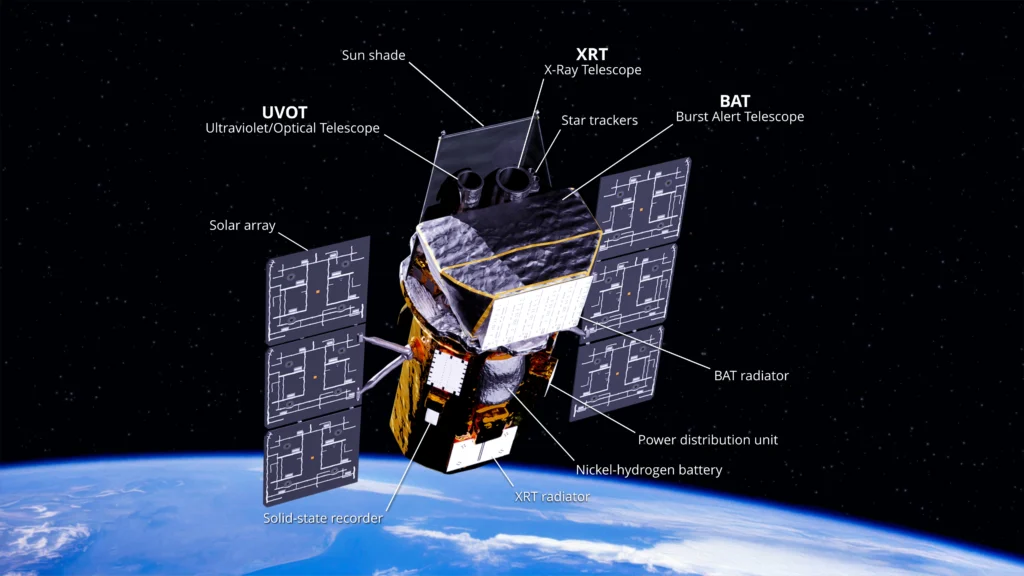
Swift was launched in November 2004 to catch gamma-ray bursts (GRBs), the most powerful explosions known in the Universe. Its key innovation was speed. Before Swift, astronomers often needed hours to point telescopes at a burst. Swift could slew and begin observing within minutes, and in many cases within seconds of the trigger, sending alerts to observatories around the world.
In more than two decades it detected nearly 2,000 cosmic explosions, according to the University of Leicester. Among them was a burst more than six billion light years away that was bright enough to be seen with the naked eye, and another from a time when the Universe was only about 500 million years old. In 2022 Swift also observed the aftermath of the “BOAT”, the brightest gamma-ray burst ever recorded and possibly the brightest of its kind in human history.
The mission grew far beyond its original purpose. It became a pioneer of multi-messenger astronomy, combining light with gravitational waves and neutrinos. In a six-week period in 2017, Swift contributed to two landmark results: the first electromagnetic counterpart to a gravitational wave signal, and the first identified electromagnetic counterpart to a high-energy neutrino event.
Leicester at the heart of the mission
The University of Leicester joined Swift at the start. Professor Paul O’Brien and Professor Mark Simms were among the key figures, and Leicester researchers designed essential parts of the X-ray Telescope (XRT), including its low-temperature camera and the Telescope Alignment Monitor. The university also established, and still hosts, the UK Swift Science Data Centre, which gives scientists worldwide specialist analysis and rapid access to observations, alongside leading X-ray calibration work.
Leicester researchers also built software to search Swift’s X-ray archive for previously unknown events. That work led to the discovery of Swift J0230, a mysterious object believed to be undergoing repeated episodes of disruption as it orbits a more massive companion. More than 15 Leicester PhD students have completed research using Swift observations, and the university’s expertise has also fed into newer missions such as Einstein Probe and SVOM.
Professor Paul O’Brien, Professor of Astrophysics and Space Science at Leicester, said: “Swift has been far more than a satellite. It has been a remarkable journey of discovery, bringing together brilliant minds across the world and allowing us to witness events that were once beyond our imagination.”
The work continues until 2028
The new UK Space Agency award supports post-operations work through to September 2028. Leicester will help produce the final calibration and data products for the XRT, so that observations gathered over more than two decades remain a reliable resource for astronomers everywhere.
Dr Phil Evans, astrophysicist and Principal Investigator of Leicester’s Swift team, who joined the mission in 2006, said: “Although Swift’s operations have now ended, our work here in Leicester is far from finished. We have an important role to play in preparing the final X-ray Telescope calibration and data products, ensuring that the discoveries made possible by Swift can continue long into the future.”
Dr Kim Page, Swift Data Centre Scientist at Leicester, described being part of the team “all the way from before the launch to the end of science operations”, and now into the phase of archiving the final data for posterity. Dr Andrew Beardmore, who joined the XRT team in 2003, recalled a fast-response observatory that could detect new targets within seconds and also monitor sources such as novae and X-ray binaries.
How the mission ended
Atmospheric drag, amplified by intense solar activity, steadily lowered Swift’s orbit. NASA ended science operations on 20 October 2026, when the spacecraft was too close to the atmosphere to keep observing. A commercial attempt to boost its orbit, Katalyst Space Technologies’ LINK spacecraft, launched in July but suffered attitude control problems, and NASA and Katalyst announced in August that the boost could not be completed.
Space Park Leicester
Swift’s story is also a story about the people and facilities behind it. To explore partnerships, missions, residents, facilities, training programmes and innovation products at Space Park Leicester, visit space-park.co.uk.
Sources
- University of Leicester and Space Park Leicester press release, 4 November 2026
- NASA Science, Swift blog: re-entry forecast and debris notes
- NASA Science: Swift mission ends
- ABC News: NASA Swift telescope plummets to Earth over Indonesia