
Join the mailing list Free weekly briefing, no spam.
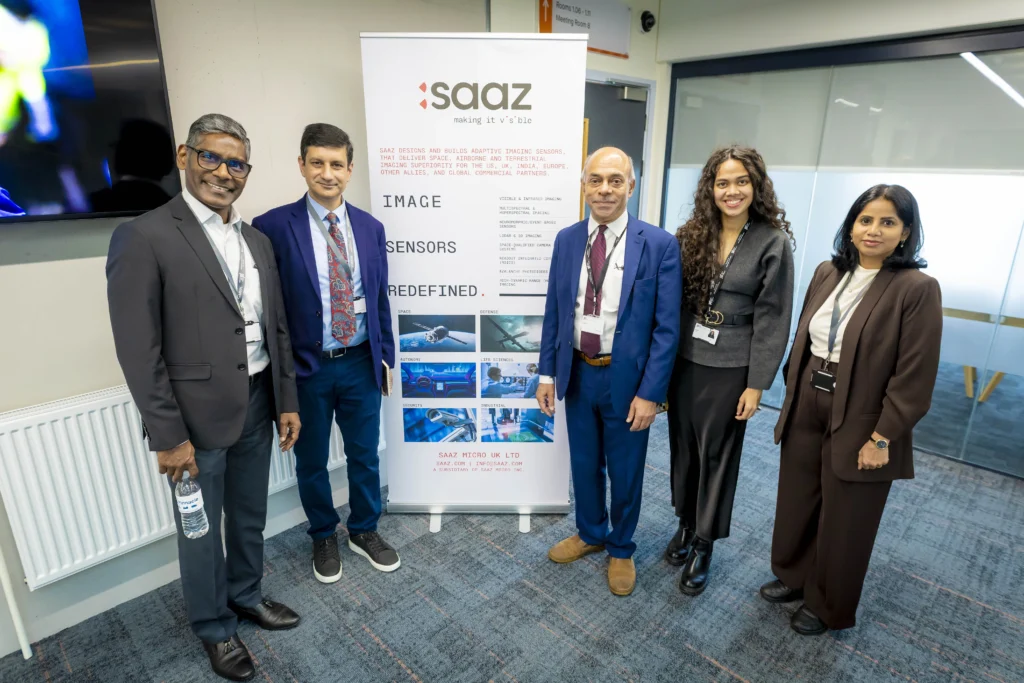
SAAZ Micro, a US deep-tech company that designs and builds adaptive imaging sensors, has opened its new overseas office at Space Park Leicester in the United Kingdom. The new entity, SAAZ Micro UK Ltd, was officially unveiled this week inside the University of Leicester’s £100 million hub for space research, innovation and teaching.
Who is SAAZ Micro?
SAAZ Micro develops adaptive imaging sensors for some of the most demanding environments in space, defence, astronomy and the commercial market. Its technology supports imaging from orbit, from the air and from the ground, and serves customers in the US, India, Europe and other allied nations.
The company’s client list includes NASA, the US government, the US Defense Advanced Research Projects Agency (DARPA), major US defence contractors, the Indian Space Research Organisation (ISRO), and a range of European and international commercial firms. The UK office now gives SAAZ a direct route to bring that experience to British and European projects.
What the UK office will do
According to Founder and CEO Atul Joshi, the goal is to speed up the development of technologies that matter to the UK by partnering with the local space ecosystem on advanced sensing applications. SAAZ Micro UK Ltd plans to design and manufacture:
- infrared, ultraviolet, visible and neuromorphic sensors
- camera systems
- read-out electronics
These products are aimed at space, astronomy, terrestrial and defence applications, and the work will be carried out at Space Park Leicester.
Why Leicester?
SAAZ Chief of Staff Vish Madhugiri points to the concentration of facilities under one roof: electronics testing labs, satellite integration capability, top-rated clean rooms and engineers with experience in designing and fabricating imaging sensors. In his view, this makes the site a strong base for growing the company’s UK and European sensor footprint.
The link with the University of Leicester also played a part. SAAZ intends to recruit PhD students and to offer Master’s students projects lasting between six and twelve months. The company also wants to bring Space Park Leicester team members into its own work, so that technology and know-how can move in both directions. The two organisations have already started a major joint project.
Ruchira Naik joined SAAZ in September as International Operations and Legal Affairs Manager. She is working with Space Park Leicester and the SAAZ US team to scale up the Leicester operation, and says that being part of this ecosystem will help the company co-create and innovate with the Space Park and its associated companies.
A relationship that already works
This is not a first meeting. Vinay Patel, Head of Commercial and Innovation at Space Park Leicester, recalls that SAAZ previously delivered a detector for the Space Park on a very tight schedule. He describes the company as a fantastic partner and says the Space Park is pleased that SAAZ sees its facilities as a good fit.
Patel also links the move to the UK Government’s new space strategy. He expects it to open opportunities to develop new technologies, including neuromorphic sensing, lidar, deep space optical communications and advanced short, medium and long wave infrared sensing.
Why it matters
Imaging sensors sit at the heart of Earth observation, astronomy, defence surveillance and deep space communication. Neuromorphic sensors, which process visual information in a way inspired by biological vision, are of particular interest for fast and efficient detection. Having a company with this profile build and manufacture next to university labs, clean rooms and test facilities is a practical boost for the UK space supply chain, and for students who will get hands-on access to real sensor development projects.
Source: official press release.