
Join the mailing list Free weekly briefing, no spam.
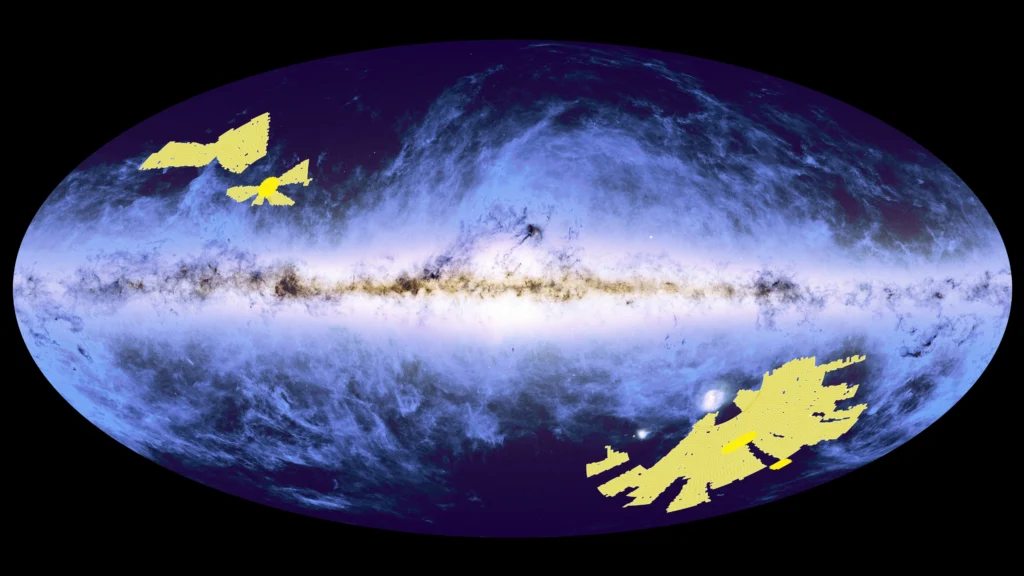
Cover Image: Euclid’s Wide and Deep Surveys – Credits ESA/Euclid/Euclid Consortium/NASA; ESA/Gaia/DPAC; ESA/Planck Collaboration
On 12 November 2026, ESA released DR1-Foundation, the first major data release from the Euclid space telescope since its launch in July 2023. It covers about 13 months of observations, roughly 1,900 square degrees of sky, and more than a billion objects. It is the raw material for what the mission calls its best-ever 3D map of the Universe, but it is not the map itself. That step comes next year.
This article looks at what is actually in the release, why the numbers matter for cosmology, and which parts of the story still depend on work that has not been done yet.
DR1-Foundation in numbers
- About 13 months of Euclid observations, covering 14% of the sky area the mission will eventually survey.
- Euclid Wide Survey results over 1,900 square degrees, equal to about 9,500 full Moons, with a data volume of about 1.7 million GB.
- More than 900 million galaxies in the catalogues.
- About 15,000 strong gravitational lens candidates.
- More than 60 million quasar candidates.
- Spectra for more than 160 million sources.
For comparison, the previous release covered a few days of observations over about 60 square degrees. The jump in area is a factor of roughly 30, and it changes what kind of questions the data can answer.
What “Foundation” means
The name is a precise description. According to ESA, DR1-Foundation delivers raw data, calibrated images, catalogues, spectra and large sky mosaics. The higher-level science products come with the complete DR1, planned for mid-2027. That later release will add weak gravitational lensing measurements and analyses of how galaxies and clusters sit within the cosmic web, with the delay attributed to the time needed to process and validate these products over such a large area.
In practical terms, this means the release is not yet a source of new constraints on dark energy or dark matter. It is the dataset on which those constraints will be built, and it is available to the whole community now. ESA’s Director of Science, Carole Mundell, called it “a scientific milestone in our study of the cosmos”.
Why a 3D map needs spectra
An image gives two coordinates on the sky. The third dimension, distance, comes from spectroscopy. Euclid splits the light of galaxies into spectra and looks for the hydrogen-alpha emission produced by star-forming gas. The wavelength at which that line appears tells astronomers how much the Universe has expanded since the light left the galaxy, and therefore how far away it is.
DR1-Foundation includes spectra for more than 160 million sources, which supports the mission’s main goal of mapping the cosmic web: the network of galaxy clusters connected by filaments that can stretch for many millions of light-years and are made mostly of dark matter. One caveat is worth stating clearly. ESA’s announcement describes the spectra as part of the release, but it does not claim that a finished, validated three-dimensional map already exists. Turning spectra into reliable distances, and measuring how complete and how pure that sample is, is the work still ahead.
The largest strong lens catalogue ever assembled
Strong gravitational lenses are rare. Only about one galaxy in several thousand bends the light of a background object enough to produce arcs or multiple images. Euclid’s wide, sharp, space-based imaging is well suited to finding them, and the release contains about 15,000 candidates, a catalogue larger than all earlier ones combined.
The candidates were found with a mix of machine learning and citizen scientists taking part in the Space Warps project on Zooniverse. The word “candidates” matters: confirmation requires follow-up observations. Still, a uniformly selected sample of this size allows population-level studies instead of one-off curiosities. Lenses let astronomers weigh galaxies, including their dark matter, and they act as natural magnifiers for very distant galaxies behind them. Natalie Lines of the University of Portsmouth, a member of the Euclid Consortium, pointed out that the mission was forecast more than ten years ago to transform lens discovery.
Quasars, clusters and faint starlight
Quasars are the bright cores of massive galaxies, powered by material falling into central black holes. Euclid is building a census of them across cosmic history, and it has already found quasars from a time when the Universe was about 5% of its present age, as we reported in our article on Euclid’s discovery of 31 ancient quasars. DR1-Foundation adds more than 60 million quasar candidates, which will need the same kind of validation as the lenses.
Galaxy clusters are the largest gravitationally bound structures in the Universe. Euclid measures their mass, the number of galaxies they contain and their distance, and it can find protoclusters that are still collapsing. Barbara Sartoris of the JL Lagrange Laboratory in Nice described the release as an unprecedented view of large samples of ancient clusters that were previously out of reach. The data also reveal intracluster light, the faint starlight spread around the brightest cluster galaxy, in hundreds of clusters. Among the targets showcased by ESA are the Messier 81 group and the Horologium Supercluster.
A technical view of the release
Three points stand out from an engineering and data perspective.
First, the selection is uniform. For cosmology, a well-understood selection function is worth more than raw numbers, because it lets researchers model biases instead of guessing at them.
Second, the sheer volume is an infrastructure achievement. ESA archive scientist Bruno Altieri noted that storing and sharing catalogues with more than a billion objects was no small task, and access runs through the Euclid Data Space platform at ESAC.
Third, the hardest measurements are still ahead. Weak lensing depends on controlling subtle systematic effects, such as how the telescope blurs the shape of each galaxy. Covering 14% of the survey is enough to deliver strong statistics, but the quality of the final cosmology will be decided by how well those effects are controlled. That is why mid-2027 is the date to watch.
Frequently asked questions
What is Euclid DR1-Foundation?
It is the first major data release of ESA’s Euclid mission, published on 12 November 2026. It contains raw data, calibrated images, catalogues, spectra and mosaics from about 13 months of observations over roughly 1,900 square degrees.
Does this release include the full 3D map of the Universe?
No. It provides the foundation for that map. The weak lensing and cosmic web analyses are planned for the complete DR1 in mid-2027.
How much of the sky does it cover?
About 14% of the sky area Euclid will survey, equal to roughly 9,500 full Moons.
Who builds and operates Euclid?
Euclid is an ESA medium-class mission with NASA contributions. Thales Alenia Space was prime contractor for the satellite, Airbus Defence and Space developed the payload module and telescope, and NASA provided the detectors of the near-infrared instrument NISP. The Euclid Consortium includes more than 2,000 scientists from about 300 institutes.
Sources
- ESA, Euclid lays the foundation for its best-ever 3D map of the Universe, 12 November 2026.
- ESA Euclid science pages, DR1 timeline.