
Join the mailing list Free weekly briefing, no spam.
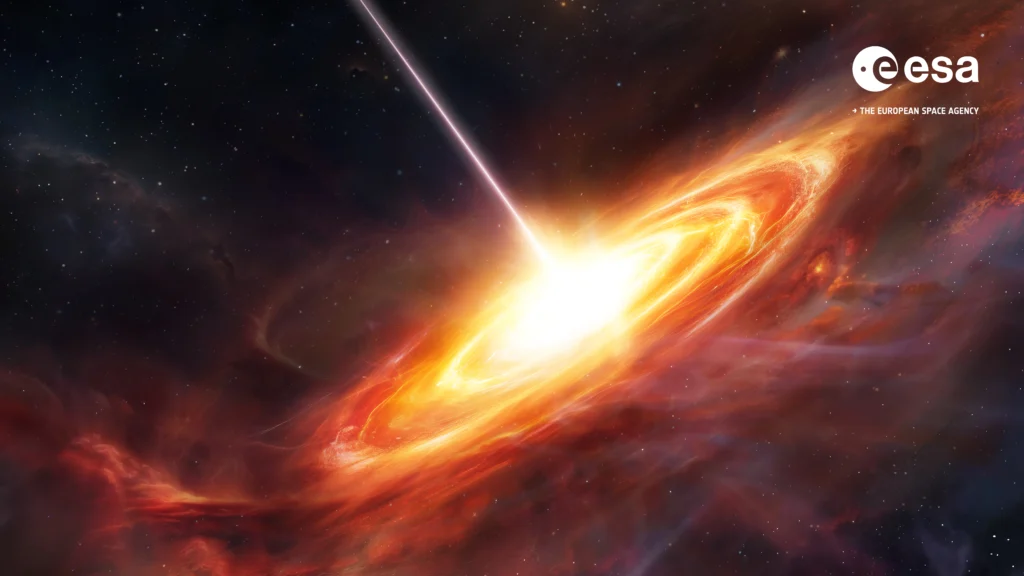
Cover Image: Artist’s impression of a Quasar – Credits ESA
For decades, astronomers have searched for the first quasars that appeared after the Big Bang, hoping to understand how the earliest galaxies and supermassive black holes formed. Now, ESA’s Euclid space telescope has taken a major step forward by discovering 31 previously unknown quasars dating back to the Universe’s first billion years. Among them are the two most distant quasars ever identified, observed as they were only 670 million years after the Big Bang.
The discovery represents one of the most significant early scientific results from the Euclid mission and provides an unprecedented view of a crucial period in cosmic evolution.
Looking back to the dawn of the Universe
Quasars are among the brightest objects in the cosmos. They are powered by supermassive black holes actively consuming surrounding matter, releasing extraordinary amounts of energy as gas spirals into the black hole. During this active phase, the galaxy’s central region can outshine the combined light of all its stars.
Although quasars are incredibly luminous, those from the earliest stages of the Universe are exceptionally difficult to detect. They are both extremely distant and intrinsically rare, since only a small fraction of young galaxies had already grown massive enough to host actively feeding supermassive black holes.
This is where Euclid is proving to be transformative.
Launched in 2023, the telescope combines wide-field observations with high-resolution visible and infrared imaging, allowing astronomers to search enormous portions of the sky while still detecting incredibly faint objects. Instead of finding only the brightest examples, Euclid is beginning to reveal the broader population of primordial quasars that had remained hidden until now.

Astronomy Basics
[Preview] Orbital Mechanics – An Introduction

Human Factors and Performances
Space Physics – Basics
Breaking the distance record
Of the 31 newly discovered quasars, twelve have redshifts greater than 7, meaning their light has travelled for more than 13 billion years before reaching Earth.
Two of them now hold the record as the most distant quasars ever observed.
The most distant, designated EUCL J172902.75+641018.1, has a redshift of 7.77, while EUCL J125308.55+705432.3 follows closely with a redshift of 7.69. Both are seen at a time when the Universe had reached just 5% of its current age.
The previous distance record, established in 2021, has now been surpassed.
Beyond setting new records, the discovery more than doubles the number of known quasars at these extreme distances. Perhaps even more importantly, it provides astronomers with a statistically meaningful sample for studying the earliest generations of active galaxies instead of relying on only a handful of exceptional objects.
A window into the Epoch of Reionisation
These newly identified quasars belong to one of the most fascinating chapters in cosmic history: the Epoch of Reionisation.
After the Big Bang, the Universe entered a long period often called the cosmic dark ages. During this time, neutral hydrogen filled space, preventing light from travelling freely across the cosmos. As the first stars, galaxies and quasars formed, their intense radiation gradually ionised this hydrogen, making the Universe transparent and allowing light to propagate over vast distances.
Understanding exactly when and how this transition occurred remains one of modern astrophysics’ biggest challenges.
Because quasars are extraordinarily bright, they serve as cosmic lighthouses that illuminate the gas lying between them and Earth. By studying how this light is absorbed during its journey, astronomers can reconstruct the physical conditions of the early Universe and better understand how reionisation unfolded.
More than just bright black holes
One of the newly discovered quasars has already been examined in greater detail using ground-based observatories. Those observations revealed that its host galaxy is rich in gas and dust and is producing new stars at an impressive rate.
This suggests that some of the earliest supermassive black holes did not evolve in isolation but inside rapidly growing galaxies experiencing intense star formation. Such systems offer valuable clues about how black holes managed to reach enormous masses in such a relatively short cosmic time, a question that continues to challenge theoretical models.
Euclid’s scientific potential is only beginning
The quasars were identified using data from Euclid’s ongoing Wide Survey, which will eventually map more than one-third of the entire sky. While the mission’s primary objective is to investigate dark matter and dark energy by creating the largest three-dimensional map of the Universe ever assembled, discoveries like these demonstrate the telescope’s versatility.
Its combination of wide sky coverage, excellent image quality and infrared sensitivity makes Euclid exceptionally well suited for finding rare and distant objects that previous surveys could easily miss.
As more observations become available, astronomers expect thousands more quasars to emerge from the mission’s growing dataset. Each new discovery will help refine our understanding of how the first galaxies assembled, how supermassive black holes formed so rapidly, and how the young Universe evolved into the rich cosmic web we observe today.
With only a fraction of its survey completed, Euclid is already proving that it is much more than a cosmology mission. It is rapidly becoming one of the most powerful tools ever built for exploring the earliest chapters of cosmic history.
Scariest Objects in Space: Ghost Nebula, Witch Head Nebula and the Demon Star
Griffin-1 Lunar Lander Completes Environmental Testing at NASA JPL
NASA 4-D Executive Space Programme: Eight Questions Answered by Paul Hawkins
Halloween Fireballs 2026: When to See the Orionid and Taurid Meteor Showers
Perseverance Passes Opportunity’s Driving Record: What 45 Kilometers on Mars Really Means
Why Space Teams Fail: Paul Hawkins on NASA’s 4-D Leadership System
Leicester Scientists Help Train East Africa’s Next Generation of Climate Researchers
Beyond the Rocket Revolution: Connecting Space Innovation with Society
ESA and Vast: the new MoU and Europe’s future after the ISS