
Join the mailing list Free weekly briefing, no spam.
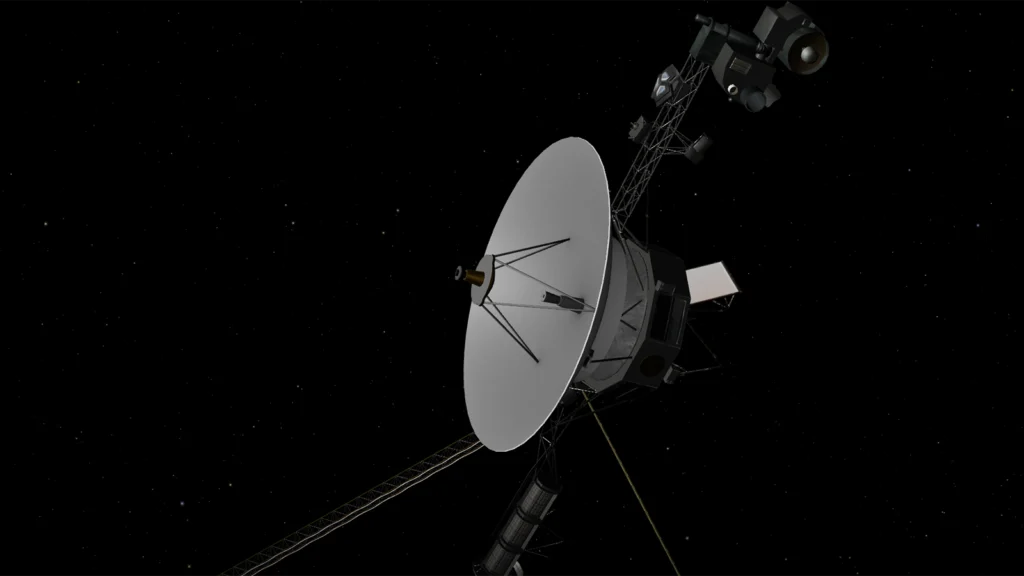
On 18 November 2026, at 10:16:07 UTC, NASA’s Voyager 1 reached a distance of one light-day from Earth: about 25.9 billion kilometres, or 173 astronomical units. No other human-made object has been this far. A radio command sent today needs 24 hours to arrive and the reply takes another 24 to come back. The probe left in September 1977, and it is still talking to us.
It is a good moment to ask an uncomfortable question. If our farthest spacecraft needs 49 years to cover a single light-day, what would it take to reach another star? In this article we compare the propulsion we have today with the ideas that physics allows but nobody can build yet, and we look at what stops each of them. We covered the milestone itself in an earlier article, Voyager 1 Reaches One Light-Day From Earth.
What one light-day means
A light-day is the distance light travels in 24 hours: 16.094 billion miles, or 25.902 billion kilometres. NASA counts 49 years, 2 months and 11 days of flight for Voyager 1 to get there. By comparison, light from the Sun takes about 8.3 minutes to reach us.
Voyager 1 moves at roughly 17 kilometres per second, about 61,000 km/h. NASA’s own pages give a slightly lower figure in one image caption, so we round to “about 17 km/s”. Voyager 2 took a different route, past Uranus and Neptune, and NASA expects it to reach one light-day in November 2035. NASA also expects the Deep Space Network to lose contact with Voyager 1 around 2036, long before a second light-day.
How far the stars really are
The nearest star is Proxima Centauri, about 4.24 light-years away. It belongs to the Alpha Centauri system, whose two bright stars sit at 4.37 light-years. A light-year is 365 light-days, so Proxima is about 1,550 light-days away and Voyager 1 has covered roughly 0.07 percent of that distance.
At Voyager’s speed the trip would take about 75,000 years. That figure is our own arithmetic, not a NASA number. Voyager is not even aimed at Alpha Centauri: it is heading toward the star Gliese 445, and NASA says it will pass within about 1.7 light-years of it in roughly 40,000 years.
The engines we have today
Chemical rockets give us nearly all of our thrust. Their limit is the rocket equation: to reach a higher final speed you need an exponentially larger fraction of the vehicle to be propellant. Past a certain point the tanks cannot grow fast enough to matter.
So deep-space missions cheat. Voyager used the gravity of Jupiter and Saturn to gain speed without burning fuel. Ion engines push a small amount of propellant out at very high speed, which makes them efficient but gives a thrust measured in fractions of a newton, so they take months or years to build up speed.
The fastest object we have ever made, NASA’s Parker Solar Probe, reached 635,266 km/h on 27 September 2023. That is about 0.06% of the speed of light. It gets this speed by falling toward the Sun and using Venus flybys, not from its engines, and the number is relative to the Sun. It shows how far we are from the 10% or 20% of light speed that a star trip would need.
Ideas that physics allows but we cannot build
Nuclear pulse propulsion comes first. Project Orion, studied from 1958, planned to explode nuclear bombs behind a pusher plate. Freeman Dyson’s design aimed at about 3.3% of the speed of light. The Partial Nuclear Test Ban Treaty now prohibits the explosions it depends on.
Fusion is the next candidate. Project Daedalus, a British Interplanetary Society study from the 1970s, imagined an uncrewed ship fed by small fusion fuel pellets ignited by electron beams or lasers. It needed tens of thousands of tonnes of helium-3. The fusion technology required is still beyond what we can do.
Laser sails are the most recent idea. Breakthrough Starshot, announced in 2016 with $100 million, proposed sails a few metres wide carrying chips that weigh less than a gram. A laser array delivering tens of gigawatts would push them to 20% of the speed of light in about four minutes, and they would reach Proxima in around 20 years. The probes could only fly through the system in a few hours, because there is no way to brake. MIT Technology Review noted in 2019 that the laser, the sail material and the tiny spacecraft did not yet exist. We found no recent public update on the project’s status.
Antimatter is the most efficient fuel on paper. Matter and antimatter annihilate and release far more energy per kilogram than any fuel. But we have made only fractions of a nanogram of antimatter in particle accelerators, while a mission would need kilograms per year. The obstacle is production and storage even before the engine.
Warp drives and the speed limit
Faster-than-light concepts such as the Alcubierre warp drive are mathematical solutions of Einstein’s equations that need forms of energy nobody knows how to produce. They are ideas, not engineering. Nearer to home, a spacecraft with mass can approach the speed of light but never reach it, because the energy required grows without limit.
And once we get there?
Suppose one of these routes works. A laser-sail probe would pass Proxima in a few hours and its data would take more than four years to reach us. A crewed ship would be a project of many generations, carrying people who never saw Earth. In both cases the trip would outlast the institutions that launched it.
We do not have an answer for what it would be for, and we are not going to pretend to. Curiosity and the long-term survival of our species are the usual answers, and both have critics. This is the question we leave open at the end of the video, and we would like to hear yours in the comments.
Frequently asked questions
How far is Voyager 1 from Earth?
On 18 November 2026 it reached one light-day, about 25.9 billion kilometres or 173 astronomical units. Its radio signals take 24 hours to reach Earth.
What is a light-day?
The distance light travels in 24 hours: 25.902 billion kilometres, or 16.094 billion miles.
How long would Voyager 1 take to reach the nearest star?
At its current speed, about 75,000 years to cover the distance to Proxima Centauri. That is our calculation, and Voyager is not heading in that direction.
Will Voyager 1 keep sending data?
NASA expects the Deep Space Network to lose contact with Voyager 1 around 2036. The probe may also become unable to point its antenna toward Earth.
Can any engine reach another star within a human lifetime?
Not with anything we can build today. Laser sails could in principle reach Proxima in about 20 years, but only as tiny flyby probes, and the technology does not exist yet.
Sources
- NASA, What is a light-day
- NASA SVS, How far away is Voyager 1
- EarthSky, Voyager 1 reaches 1 light-day
- Popular Science, Voyager 1 is almost one light-day away
- Live Science, Parker Solar Probe speed record
- IEEE Spectrum, How do you fly to Alpha Centauri in just 20 years
- MIT Technology Review, Inside Starshot
- Centauri Dreams, Interstellar flight equations and art
- Physics World, interstellar propulsion
- Wikipedia, Fusion rocket