
Join the mailing list Free weekly briefing, no spam.
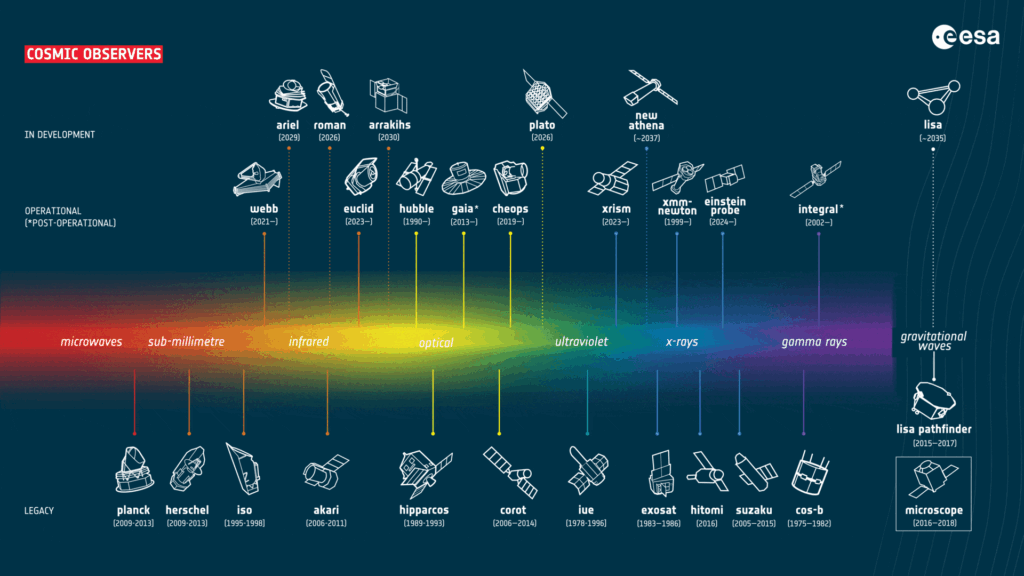
Cover Image: ESA science missions – Credit ESA
The European Space Agency has taken a major step toward shaping the future of space exploration and scientific discovery. During a meeting of the Science Programme Committee held on 10–11 June 2026 at the Instituto Astrofísico de Canarias in Tenerife, representatives from ESA’s 23 Member States approved a series of decisions that will influence European space science well into the next decade.
From extending a fleet of highly successful missions to adopting a new mission dedicated to unraveling the hidden history of galaxies, the decisions reinforce Europe’s commitment to maintaining a leading role in space science. Together, they demonstrate the long-term vision of ESA’s Science Programme, one of the most ambitious and stable scientific endeavors in the world.
Extending Scientific Excellence
Perhaps the most immediate outcome of the meeting was the decision to extend the operational lives of 13 active scientific missions. Mission extensions are not automatic; they are granted only when spacecraft continue to deliver valuable scientific results and remain technically capable of operating effectively.
The Science Programme Committee approved extensions for:
- BepiColombo
- Cheops
- Einstein Probe
- Hinode
- Hubble Space Telescope
- IRIS
- Mars Express
- Proba-3
- SOHO
- Solar Orbiter
- James Webb Space Telescope
- XMM-Newton
- XRISM
ESA’s Hera and NASA’s DART: What Europe’s Asteroid Mission Will Measure at Didymos
Executive Guide to Space at Space Park Leicester: Three Days Inside a Space Mission
MO-Nav on Talon-A: What a Mach 5 GPS-Denied Test Proves
Scariest Objects in Space: Ghost Nebula, Witch Head Nebula and the Demon Star
Griffin-1 Lunar Lander Completes Environmental Testing at NASA JPL
NASA 4-D Executive Space Programme: Eight Questions Answered by Paul Hawkins
These missions span an extraordinary range of scientific disciplines, from planetary exploration and solar physics to exoplanet studies and deep-space astronomy. Their continued operation ensures that scientists across Europe and around the world will retain access to unique datasets that cannot be replicated by any Earth-based facility.
Among the extensions, Solar Orbiter stands out as particularly significant. Since its launch in 2020, the mission has transformed our understanding of the Sun by approaching closer than most previous spacecraft and observing regions never before seen in detail. Earlier this year, Solar Orbiter delivered humanity’s first direct views of the Sun’s polar regions, opening an entirely new perspective on the star that governs the Solar System.
The newly approved extension will allow the spacecraft to reach even higher heliographic latitudes in the coming years. Scientists hope these observations will reveal crucial details about the solar magnetic cycle, solar wind generation, and the processes driving space weather that can affect satellites, communications systems, and power grids on Earth.
The decision also highlights an important reality of modern space exploration: some of the most valuable discoveries occur long after a mission has completed its original objectives.
Arrakihs: A New Archaeologist of the Cosmos
Looking beyond current missions, ESA formally adopted its second Fast-Class mission, Arrakihs, marking the transition from concept to implementation.
Named after an Arabic word associated with delicate structures in the sky, Arrakihs will investigate one of the most elusive components of galaxies: the extremely faint halos of stars and gas that surround them. These diffuse structures preserve a record of how galaxies formed, merged, and evolved over billions of years.
Astronomers often refer to this process as “galactic archaeology.” By studying the faint remnants left behind by ancient interactions between galaxies, researchers can reconstruct the events that shaped today’s cosmic landscape.
Arrakihs is designed specifically to detect these nearly invisible structures. Its observations will provide crucial tests of galaxy formation theories and may offer new insights into the role of dark matter in shaping galactic evolution.
The mission also exemplifies ESA’s Fast-Class philosophy, which emphasizes rapid development schedules, focused scientific objectives, and the adaptation of existing technologies to reduce cost and complexity. Spain is expected to play a particularly important role in the development of the mission.
If development proceeds according to plan, Arrakihs could launch before the end of the decade, becoming one of the first major scientific missions of ESA’s Voyage 2050 era.
The Next Great Medium-Class Mission
While Arrakihs moves forward, ESA is also preparing the next cornerstone mission of its future science portfolio.
The agency has recommended Plasma Observatory as the next Medium-Class mission, a proposal that now awaits final approval by the Science Programme Committee in November 2026.
Medium-Class missions form the backbone of ESA’s scientific activities. They typically address broad scientific questions through sophisticated spacecraft and long operational lifetimes. Previous examples include Solar Orbiter and the dark-universe observatory Euclid.
Plasma Observatory would focus on a phenomenon that affects not only Earth but nearly the entire visible Universe: plasma.
Composed of electrically charged particles, plasma accounts for approximately 99 percent of visible matter in the cosmos. Understanding how energy moves through plasma is essential for explaining processes occurring in environments ranging from the Sun’s atmosphere to exploding stars and distant galaxies.
The mission would use Earth’s magnetosphere—the magnetic bubble surrounding our planet—as a natural laboratory. Scientists aim to investigate how solar particles interact with Earth’s magnetic field, how energy is transferred across different scales, and how these processes trigger space weather events.
What makes Plasma Observatory particularly ambitious is its architecture. Unlike the four-spacecraft Cluster mission that pioneered many magnetospheric discoveries, Plasma Observatory would consist of seven coordinated spacecraft operating simultaneously.
This multi-spacecraft constellation would allow researchers to observe plasma interactions across multiple spatial and temporal scales at the same time, providing an unprecedented three-dimensional view of how energy flows through space plasmas.
If approved later this year, Plasma Observatory would become the first Medium-Class mission selected under ESA’s Voyage 2050 strategic framework.
A Science Programme Built for Decades
The decisions announced in Tenerife reflect the unique strength of ESA’s Science Programme. Unlike many research initiatives that operate on short funding cycles, ESA’s science missions are planned decades in advance through carefully structured long-term strategies.
The programme has evolved through successive planning frameworks, from Horizon 2000 and Horizon 2000+ to the current Cosmic Vision strategy. Today, the future is guided by Voyage 2050, a roadmap designed to address some of the most profound scientific questions facing humanity.
This continuity allows Europe to undertake missions that require years of technological development, international cooperation, and scientific preparation.
As ESA Director of Science Professor Carole Mundell emphasized, the programme remains driven by the needs and ambitions of the scientific community itself. By combining long-term stability with scientific excellence, ESA continues to create missions capable of delivering transformative discoveries.
Looking Ahead
The June 2026 Science Programme Committee meeting may ultimately be remembered as a pivotal moment for European space science. The extension of thirteen productive missions guarantees a steady flow of discoveries throughout the remainder of the decade. The adoption of Arrakihs opens a new window onto the hidden history of galaxies. Meanwhile, the potential selection of Plasma Observatory promises to deepen our understanding of the plasma processes that shape the Universe itself.
Together, these decisions demonstrate that Europe is not merely maintaining its scientific capabilities in space—it is actively expanding them. As humanity seeks answers to fundamental questions about our Solar System, our galaxy, and the wider cosmos, ESA’s roadmap ensures that European scientists will remain at the forefront of exploration for decades to come.
Astronomy Basics
🌠 Explore the Universe Like Never Before!🔭 Discover the secrets of stars, planets, and galaxies…
[Preview] Orbital Mechanics – An Introduction
Discover the fundamentals of orbital mechanics in this beginner-friendly course—no prior experience needed! Explore how…

Human Factors and Performances
Human factors and human performance in space are critical areas of study in spaceflight operations,…
Space Physics – Basics
Explore the dynamic forces that shape our space environment in this exciting journey beyond Earth’s…