
Join the mailing list Free weekly briefing, no spam.
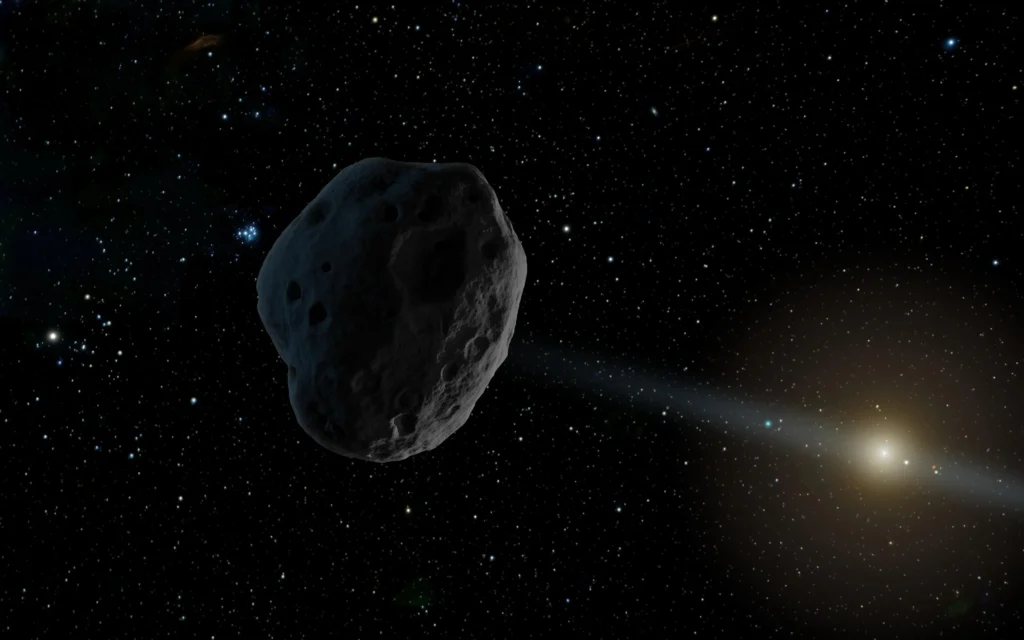
Cover Image: Near Earth Object – Artist Concept – Credit NASA/JPL-Caltech.jpg
A near-Earth object that spent decades classified as an asteroid has now been revealed to be an active comet, thanks to a combination of precise orbital measurements and observations from some of the world’s most powerful telescopes. The discovery not only resolves a long-standing mystery surrounding the object known as 1998 SH2, but also demonstrates how subtle physical processes can dramatically alter the trajectories of small bodies in the Solar System.
The findings, published in Nature Astronomy, provide valuable insights for planetary defense efforts and suggest that other objects currently catalogued as asteroids may actually be dormant or weakly active comets.
A mystery begins with an unexpected trajectory
The investigation gained momentum in August 2025, when 1998 SH2 made a safe flyby of Earth at a distance of approximately 3 million kilometers. The object follows an orbit around the Sun every four and a half years and had been observed since its discovery in 1998.
Scientists at NASA’s Jet Propulsion Laboratory planned to observe the object using the Deep Space Network’s planetary radar, relying on highly accurate orbital predictions that accounted for the gravitational influence of the Sun and planets.
However, the object failed to appear where calculations predicted.
This discrepancy immediately suggested that gravity alone could not explain its motion.
Detecting the invisible forces
Researchers turned to optical astrometry, an observational technique capable of measuring an object’s position in the sky with extraordinary precision. By comparing decades of observations, they discovered that 1998 SH2 was experiencing measurable non-gravitational accelerations.
These tiny deviations are a well-known characteristic of comets.
Unlike asteroids, comets contain volatile ices beneath their surfaces. As they approach the Sun, solar heating causes these ices to sublimate directly into gas. The escaping gas acts like a miniature thruster, producing a continuous but extremely small force that gradually alters the object’s orbit.
Although this effect is usually accompanied by a bright coma and an extended dust tail, very weakly active comets may release too little material for these features to be easily detected.
The orbital behavior of 1998 SH2 strongly suggested that such a process was taking place.
Powerful telescopes reveal the truth
The 2025 close approach to Earth offered astronomers an ideal opportunity to test their hypothesis.
Observations were carried out using the Canada-France-Hawaii Telescope in Hawaii, the Danish Telescope at La Silla Observatory, and the Very Large Telescope (VLT) operated by the European Southern Observatory in Chile.
The images finally revealed what previous observations had missed: a faint but unmistakable cometary tail extending away from the nucleus.
Although extremely weak, the feature provided direct evidence that 1998 SH2 is actively releasing material into space.
Following the confirmation, the object received a cometary designation and is now officially classified as P/1998 SH2.
Why was the comet hidden for so long?
The discovery highlights an increasingly important category of Solar System bodies known as dark comets.
These objects exhibit the orbital signatures of active comets, including measurable non-gravitational accelerations, but lack the bright visible features typically associated with cometary activity.
Several explanations have been proposed.
Some dark comets may possess only small amounts of volatile material, producing gas at rates too low to generate detectable comae or tails. Others could be coated with dark, insulating material that suppresses visible activity while still allowing limited outgassing.
Since the first dark comet was identified in 2016, astronomers have discovered only about a dozen similar objects. The reclassification of 1998 SH2 suggests that many more could be hiding within existing asteroid catalogs, waiting to be identified through increasingly precise orbital measurements.

Beyond the Rocket Revolution: Connecting Space Innovation with Society
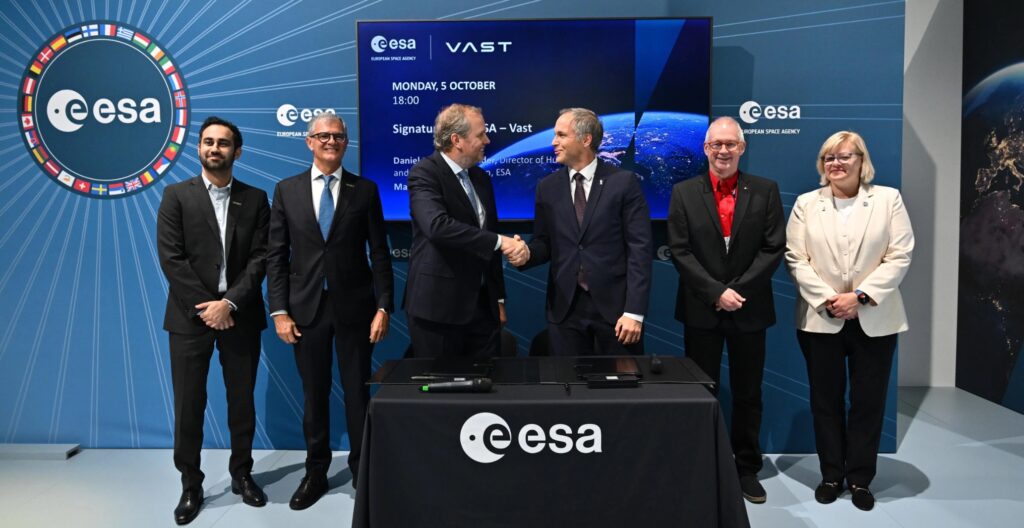
ESA and Vast: the new MoU and Europe’s future after the ISS
Image Credits: jonasphotto The European Space Agency has signed a new Memorandum of Understanding with…

Photonic Quantum Processor in Orbit: What the First Test Proved, and What It Didn’t
Illustrative image: CubeSats deployed into Earth orbit from the International Space Station’s Kibo module. Not…
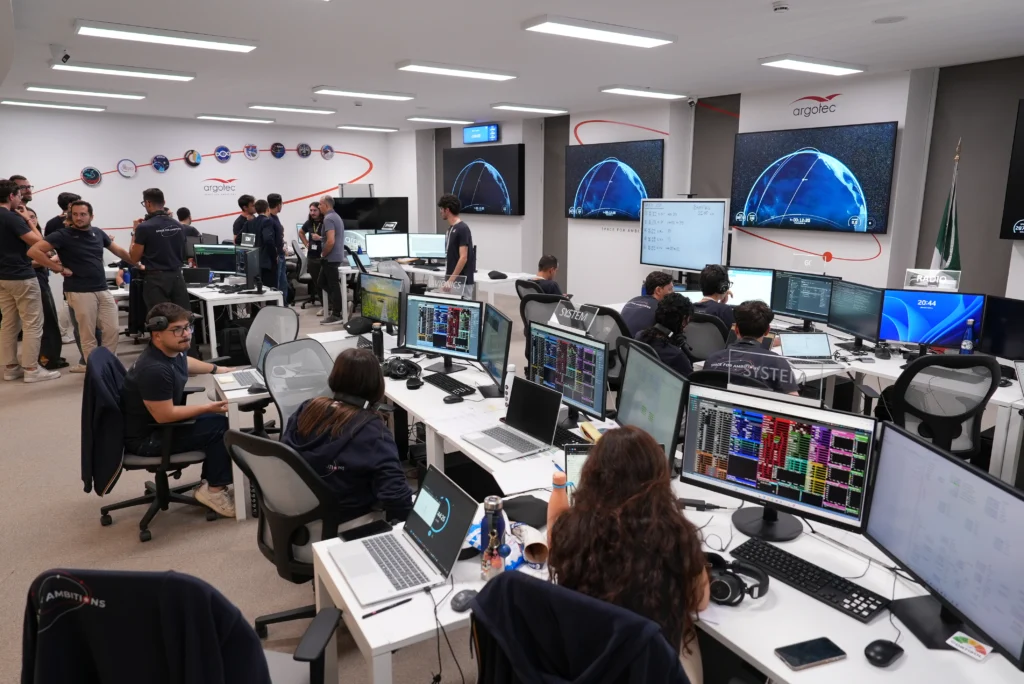
Argotec and Rheinmetall Put an Air Defence Satellite in Orbit Argotec and Rheinmetall Put an…

Starship Flight 14 Recap: It Reached Orbit, Delivered 26 Satellites — and Came Home the Hard Way

Aurora and Saturn at Opposition: The Sky on October 2–4, 2026
Image Credits: NASA, Neil Zeller A weekend with two stars of the show Between October…
Implications for planetary defense
Correctly identifying whether a near-Earth object is an asteroid or a comet is more than a matter of scientific classification.
Outgassing can significantly modify a comet’s orbit over time, making its future trajectory more difficult to predict than that of an inactive asteroid. Even tiny continuous forces can accumulate over years or decades, producing measurable changes in an object’s position.
For planetary defense, understanding these subtle effects is essential for accurately assessing potential impact hazards and improving long-term orbit predictions.
The case of P/1998 SH2 demonstrates that precision astrometry has become one of the most powerful tools available for identifying hidden cometary activity before it becomes visually apparent.
The next generation of asteroid hunting
Future discoveries are expected to accelerate with the launch of NASA’s Near-Earth Object Surveyor, the agency’s first dedicated space telescope designed specifically for planetary defense.
Operating in infrared wavelengths, the mission will be capable of detecting dark asteroids and faint comets that reflect little visible sunlight, including many objects that remain difficult to observe with ground-based telescopes.
Combined with increasingly precise orbital tracking, these observations are expected to reveal previously unknown members of the near-Earth population and improve our understanding of how these objects evolve over time.
The reclassification of 1998 SH2 serves as a reminder that even after decades of observations, the Solar System can still surprise us. As astronomical techniques continue to improve, more objects thought to be ordinary asteroids may reveal themselves to be hidden comets, offering new insights into the dynamic processes shaping our cosmic neighborhood.
Beyond the Rocket Revolution: Connecting Space Innovation with Society
ESA and Vast: the new MoU and Europe’s future after the ISS
Image Credits: jonasphotto The European Space Agency has signed a new Memorandum of Understanding with…
Photonic Quantum Processor in Orbit: What the First Test Proved, and What It Didn’t
Illustrative image: CubeSats deployed into Earth orbit from the International Space Station’s Kibo module. Not…
Argotec and Rheinmetall Put an Air Defence Satellite in Orbit Argotec and Rheinmetall Put an…
Starship Flight 14 Recap: It Reached Orbit, Delivered 26 Satellites — and Came Home the Hard Way
Aurora and Saturn at Opposition: The Sky on October 2–4, 2026
Image Credits: NASA, Neil Zeller A weekend with two stars of the show Between October…
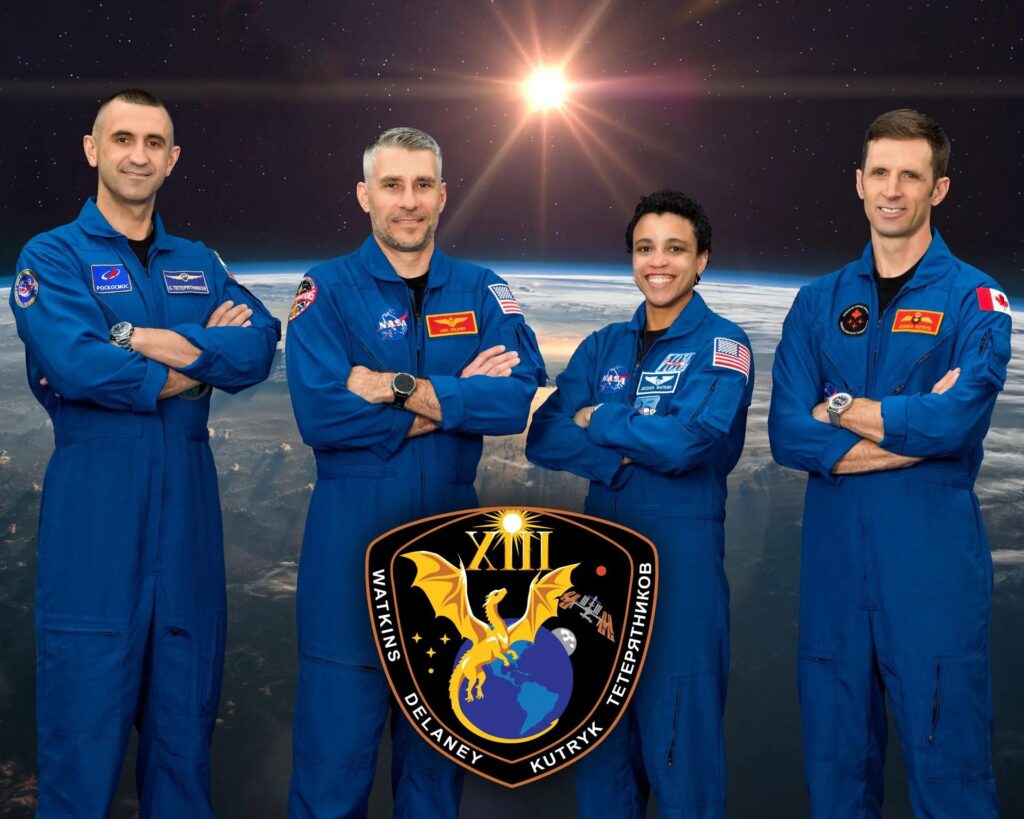
SpaceX Crew-13 Launches to the ISS: What the Mission Will Do and Why It Slipped
Image Credits: NASA SpaceX’s Crew-13 mission is set to launch today, October 1, 2026, at…
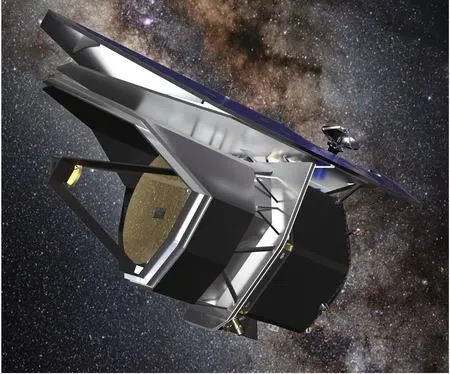
PRIMA Far-Infrared Telescope: NASA’s First Probe Explorer and What It Means for Astrophysics
Image Credits: NASA On September 23, 2026, NASA announced that PRIMA (PRobe far-Infrared Mission for…

HMS Daring Representative Visit Space Park Leicester as Royal Navy and Space Sector Strengthen Ties
tag: Space Park Leicester Cover image credits: SPL Representatives of HMS Daring have visited Space…

Starship Goes Orbital – How Flight 14 is going
Starship Flight 14 has put the world’s largest rocket into orbit for the first time….

BepiColombo Separates From Its Transfer Module Today
BepiColombo separates from its Mercury Transfer Module today, 3 September 2026, at 14:00 CEST (12:00…