
Join the mailing list Free weekly briefing, no spam.
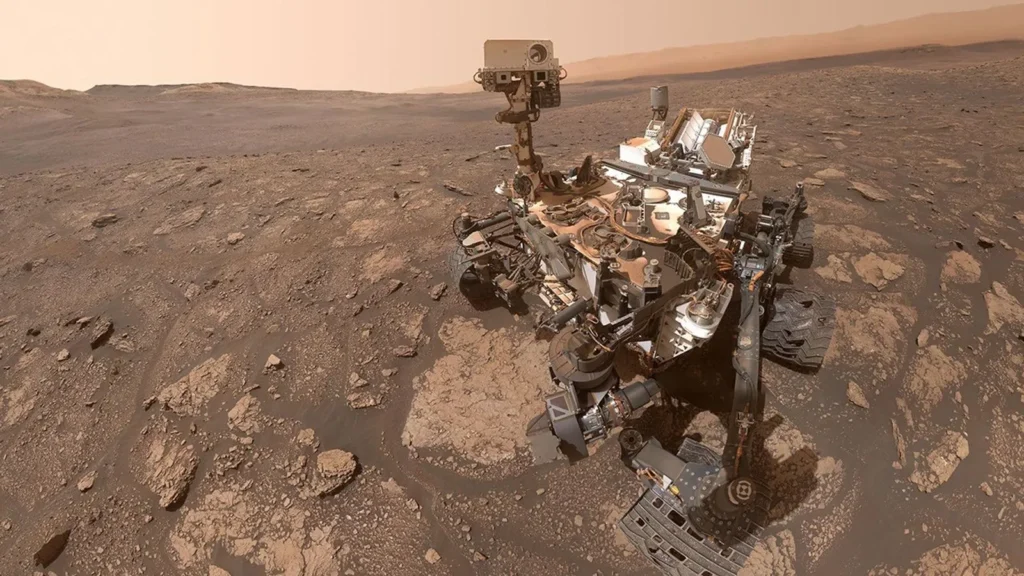
Cover Image: Curiosity Rover taking a Selfie – Credit: NASA/JPL-Caltech/MSSS
In a discovery that is already reshaping the scientific conversation around Mars, NASA’s Curiosity rover has identified a suite of organic molecules never before detected on the Red Planet. Found within ancient rocks in Gale Crater, these compounds are not just chemically intriguing—they are scientifically provocative. They deepen the case for Mars as a once-habitable world, while simultaneously reminding us how difficult it is to prove whether life ever truly emerged there.
A richer organic inventory than ever before
The findings come from a drilled rock sample analyzed using Curiosity’s onboard laboratory, particularly the Sample Analysis at Mars (SAM) instrument. Scientists identified more than 20 organic compounds, including at least seven never previously observed on Mars.
Among these are complex carbon-based molecules containing nitrogen and sulfur—elements essential to life as we know it. Some even resemble chemical precursors to DNA and RNA, placing them firmly in the category of “prebiotic chemistry,” the kind that precedes biology.
This is not the first time organics have been detected on Mars. However, what sets this discovery apart is diversity and complexity. The molecules appear to be fragments of larger macromolecular carbon structures—suggesting that Mars once hosted more sophisticated organic chemistry than previously understood.
Preserved for billions of years
Perhaps even more striking than the molecules themselves is their survival. The samples were collected from clay-rich rocks formed around 3.5 billion years ago—during a time when Mars had liquid water, a thicker atmosphere, and potentially Earth-like environmental conditions.
On today’s Mars, radiation and oxidizing chemicals rapidly destroy organic material at the surface. Yet these compounds endured, likely protected within mineral matrices such as clays. This reinforces a key idea in astrobiology: the best place to search for biosignatures is not the surface, but the subsurface.
Halloween on the International Space Station: How Astronauts Celebrate in Orbit
ESA’s Hera and NASA’s DART: What Europe’s Asteroid Mission Will Measure at Didymos

Executive Guide to Space at Space Park Leicester: Three Days Inside a Space Mission

MO-Nav on Talon-A: What a Mach 5 GPS-Denied Test Proves
Scariest Objects in Space: Ghost Nebula, Witch Head Nebula and the Demon Star
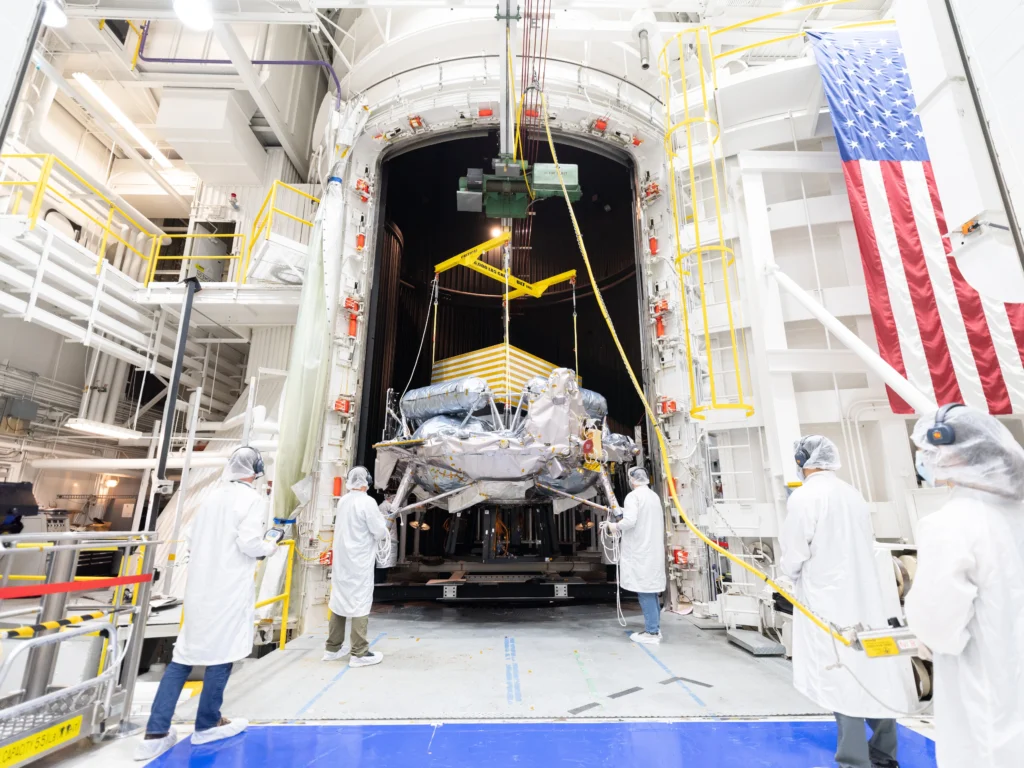
Griffin-1 Lunar Lander Completes Environmental Testing at NASA JPL
Life… or just chemistry?
The obvious question is unavoidable: do these molecules point to past life?
The answer, for now, is no—and that’s not a disappointment.
Organic molecules can form through both biological and non-biological processes. On Mars, they could originate from:
- ancient microbial life
- abiotic geochemical reactions
- delivery by meteorites rich in organic material
Current evidence cannot distinguish between these possibilities. As one scientist put it, the discovery shows Mars had the “right chemistry,” but not necessarily biology.
This ambiguity is not a failure of science—it is a reflection of how high the bar is for claiming life beyond Earth.
A methodological breakthrough
Beyond the molecules themselves, the technique used to detect them may be just as important. The analysis relied on a wet chemistry experiment involving a reagent (TMAH) that helps release otherwise hidden organic compounds.
This approach effectively “unlocks” molecules bound within rock matrices, allowing scientists to see a more complete picture of Martian chemistry. It represents a significant evolution in how planetary missions search for organic material—and it will likely influence the design of future instruments.
Implications for future missions
The discovery arrives at a critical moment in Mars exploration. Upcoming missions, including the European Space Agency’s Rosalind Franklin rover, are specifically designed to drill deeper below the surface—where organic preservation is more likely.
Meanwhile, NASA’s long-anticipated Mars Sample Return mission aims to bring Martian rocks back to Earth, where far more sophisticated analyses could finally determine whether any detected organics are biological in origin.
In this context, Curiosity’s findings act as a roadmap:
- target clay-rich environments
- drill below radiation-exposed layers
- focus on complex, macromolecular carbon
The bigger picture: Mars as a chemical archive
What we are seeing is not yet evidence of life—but it is something arguably just as important: a preserved record of planetary evolution and chemical potential.
Mars is revealing itself as a world where organic chemistry was not only possible, but persistent. The presence of complex molecules suggests that the ingredients for life were not rare or fleeting. Instead, they may have been widespread and stable over geological timescales.
This raises a profound possibility: if life did not emerge on Mars, despite these conditions, what does that tell us about how difficult life actually is to start?
Answers?
Curiosity’s latest discovery does not answer the question of life on Mars—but it sharpens it.
We now know that Mars once hosted a chemically rich environment capable of producing and preserving complex organic molecules. The next challenge is to determine whether those molecules ever crossed the threshold into biology.
Until then, Mars remains what it has always been: not a dead world, but an unfinished story—one that we are only beginning to read properly.