
Join the mailing list Free weekly briefing, no spam.
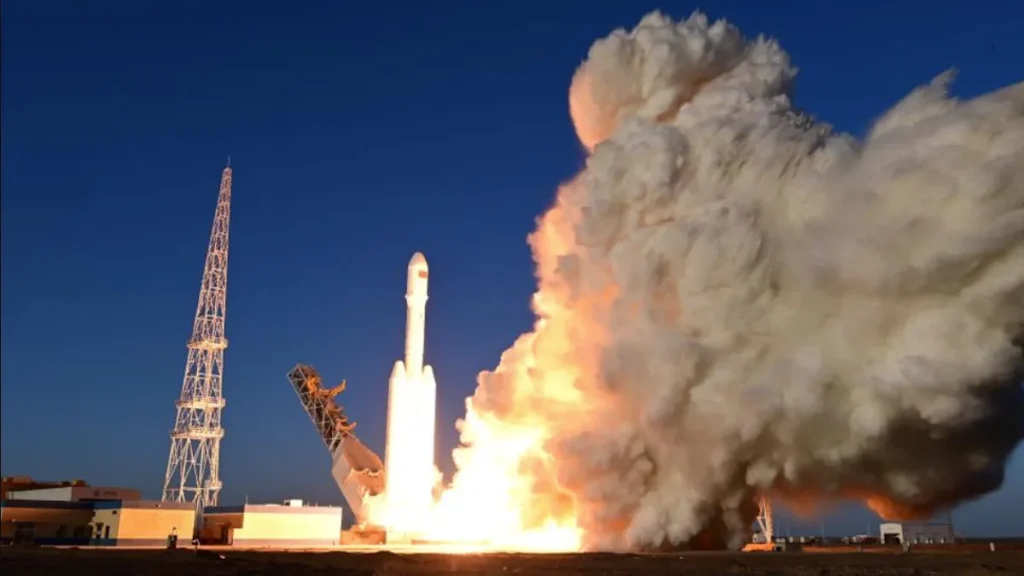
Cover Image: Lijian-2 Rocket – Credits Xinhua
The global space industry has entered a निर्णsive phase. No longer defined primarily by scientific exploration or technological prestige, space is now a central arena of geopolitical competition, economic transformation, and military strategy.
Valued at over $600 billion in 2024, with projections approaching $1.8 trillion by 2035, the sector is increasingly driven by commercial activity—but shaped by geopolitical imperatives.
In 2026, the defining question is no longer who can reach space, but rather:
who controls the infrastructure, rules, and strategic leverage of the orbital domain?
The most consequential driver of today’s space industry is the intensifying rivalry between the United States and China—a competition that increasingly resembles a systemic contest for global influence.
Recent reporting highlights how both nations are accelerating plans for crewed lunar missions and long-term presence on the Moon, with timelines converging around the end of the decade.
This is not merely symbolic. The Moon—particularly the south polar region—is viewed as a strategic asset due to potential water ice deposits, enabling fuel production and sustained operations.
At the same time, China is expanding its state-backed satellite infrastructure, including dual-use networks that blend civilian and military applications, raising concerns about future global dependencies on Chinese systems.
Even political rhetoric reflects this shift: space is increasingly framed not as a domain of discovery, but of dominance and strategic advantage.
Orbital Infrastructure as Power
The most transformative shift in the space economy lies in the rise of orbital infrastructure, particularly in Low Earth Orbit (LEO).

Halloween on the International Space Station: How Astronauts Celebrate in Orbit
ESA’s Hera and NASA’s DART: What Europe’s Asteroid Mission Will Measure at Didymos

Executive Guide to Space at Space Park Leicester: Three Days Inside a Space Mission
MO-Nav on Talon-A: What a Mach 5 GPS-Denied Test Proves
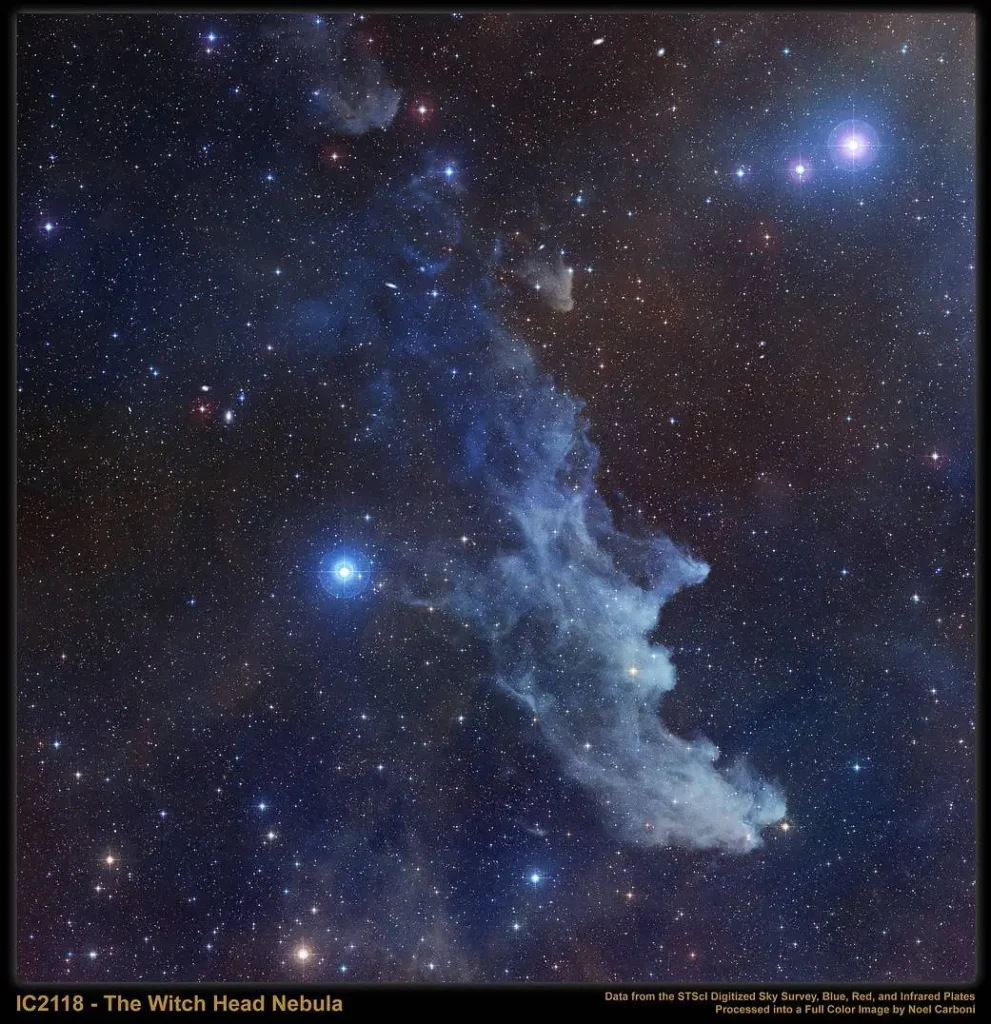
Scariest Objects in Space: Ghost Nebula, Witch Head Nebula and the Demon Star
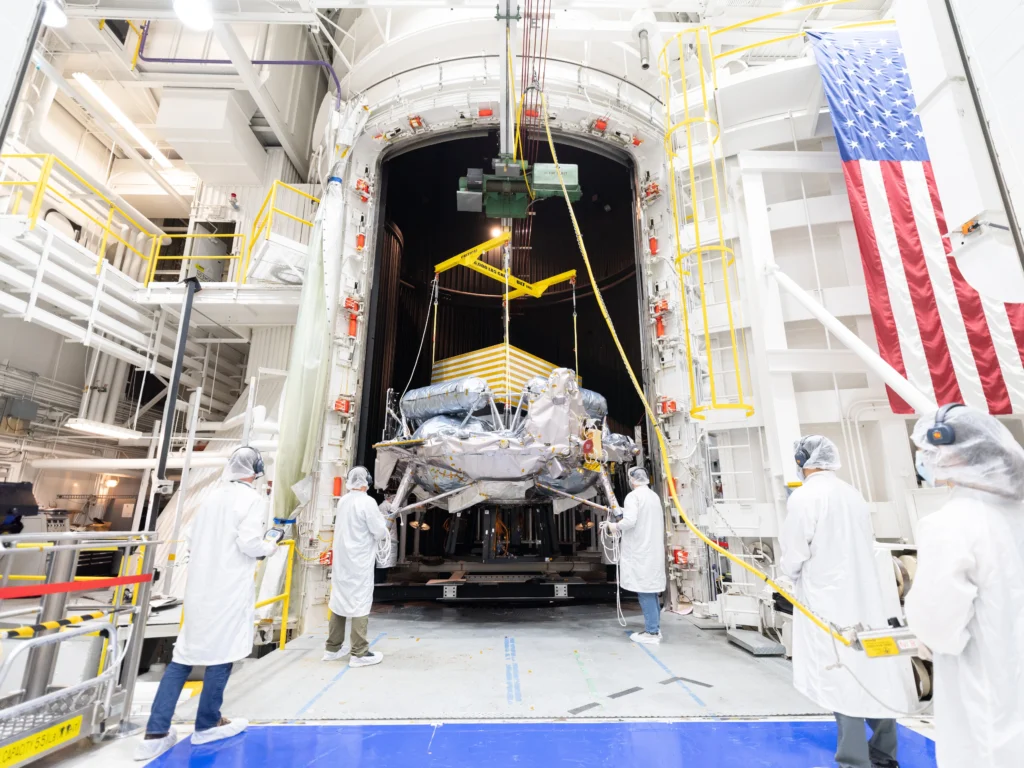
Griffin-1 Lunar Lander Completes Environmental Testing at NASA JPL
Orbital Infrastructure as Power
The most transformative shift in the space economy lies in the rise of orbital infrastructure, particularly in Low Earth Orbit (LEO).
Satellite constellations now underpin:
- global communications
- financial systems
- military operations
- disaster response
Recent analysis underscores how satellite networks—such as those deployed in conflict zones—have demonstrated the ability to enable or deny connectivity in real time, effectively becoming instruments of geopolitical power.
This represents a fundamental shift:
control of LEO is becoming analogous to control of maritime trade routes in previous centuries.
The Commercial Revolution—and Its Strategic Implications
A second defining feature of the current landscape is the rise of the “New Space” economy.
Private actors now dominate large segments of the industry, driving:
- reduced launch costs
- rapid innovation cycles
- scalable satellite manufacturing
Commercial revenues account for the majority of the sector’s growth, with downstream services—such as navigation, Earth observation, and data analytics—forming the economic core.
However, this commercialization introduces a strategic paradox:
- Governments increasingly rely on private companies for critical national capabilities
- Yet these same assets are embedded in global markets and vulnerable to geopolitical pressure
As a result, states are shifting from operators to orchestrators and regulators of space ecosystems, blending public and private power.
Militarization and the End of “Benign Space”
Space is now firmly integrated into defense architectures.
Key functions include:
- intelligence, surveillance, and reconnaissance (ISR)
- missile early warning systems
- secure communications
At the same time, the domain is becoming increasingly contested:
- development of anti-satellite (ASAT) capabilities
- cyber and electronic warfare targeting space assets
- growing integration of civilian and military systems
The implication is clear:
space is no longer a neutral environment, but an operational military domain.
Europe: Between Capability and Constraint
Europe remains a major space actor—but one facing structural limitations.
Despite strong industrial capabilities and scientific excellence, recent data reveals a widening gap:
- 181 orbital launches by the U.S. in 2025
- 92 by China
- just 8 by Europe
Similarly, European investment and scaling capacity lag behind global competitors, limiting the ability of startups to grow into dominant players.
At the same time, the geopolitical environment is pushing Europe toward greater strategic autonomy, particularly in:
- secure communications
- Earth observation
- defense-related space capabilities
Yet a central dilemma persists:
can Europe act as a sovereign space power, or will it remain structurally dependent on U.S.-led systems?
The Rise of a Multipolar Space Ecosystem
While the U.S.–China rivalry dominates, the global space landscape is becoming increasingly multipolar.
Countries such as India, Japan, and emerging space nations are:
- expanding national capabilities
- forming strategic partnerships
- leveraging niche advantages
However, these actors operate within a system shaped by great-power competition, often balancing cooperation with alignment pressures.
This reflects a broader global trend:
fragmented globalization, where collaboration persists—but within increasingly politicized and strategic frameworks.
The space industry in 2026 is not merely a sector—it is a structural layer of the global order.
Three forces define its trajectory:
- Geopolitical rivalry, particularly between the United States and China
- Commercial transformation, reshaping how space is accessed and utilized
- Security imperatives, driving investment, regulation, and competition
Together, these dynamics are transforming space into:
- an economic backbone
- a strategic high ground
- and a contested domain of global power
In this emerging “orbital century,” leadership in space will not be determined solely by technological capability—but by the ability to integrate industry, policy, and geopolitics into a coherent strategic vision.