
Join the mailing list Free weekly briefing, no spam.
Image Credit: ESA/ATG medialab
Understanding space weather requires more than a single vantage point. Over the past decades, heliophysics missions have progressively uncovered how energy and particles travel from the Sun to Earth, shaping the environment around our planet. Yet, each mission has traditionally focused on a specific layer of this complex system.
The upcoming SMILE mission (Solar wind–Magnetosphere–Ionosphere Link Explorer) represents a significant shift in this approach. Rather than zooming in on isolated processes, SMILE is designed to observe the system as a whole—bridging a longstanding gap between global context and local measurements.
From Local Precision to Global Vision
Historically, heliophysics missions have prioritized in-situ measurements—direct sampling of plasma, particles, and magnetic fields at specific points in space.
The Cluster mission, launched by ESA in 2000, pioneered multi-point measurements by flying four spacecraft in formation. This configuration allowed scientists to reconstruct the three-dimensional structure of Earth’s magnetosphere, revealing how plasma behaves across small spatial scales.
Building on this legacy, NASA’s Magnetospheric Multiscale Mission (MMS) pushed the frontier even further. With unprecedented temporal resolution, MMS investigates magnetic reconnection, a fundamental process in which magnetic field lines break and reconnect, releasing vast amounts of energy. These observations occur on scales of milliseconds and kilometers, offering insights into the microphysics that drive space weather.
However, both Cluster and MMS share a fundamental limitation: they observe only a tiny portion of the system at any given time.
Beyond the Rocket Revolution: Connecting Space Innovation with Society

ESA and Vast: the new MoU and Europe’s future after the ISS
Photonic Quantum Processor in Orbit: What the First Test Proved, and What It Didn’t
Argotec and Rheinmetall Put an Air Defence Satellite in Orbit

Starship Flight 14 Recap: It Reached Orbit, Delivered 26 Satellites — and Came Home the Hard Way

Aurora and Saturn at Opposition: The Sky on October 2–4, 2026
Looking Upstream: The Solar Perspective
While Cluster and MMS focus on Earth’s immediate environment, Solar Orbiter shifts attention to the source of space weather—the Sun.
Solar Orbiter studies the solar wind, magnetic fields, and energetic events such as solar flares and coronal mass ejections. By linking solar activity to the heliosphere, it provides critical insight into how disturbances originate and propagate through space.
Yet, despite its importance, Solar Orbiter does not directly observe how these disturbances interact with Earth’s magnetosphere.
SMILE: A System-Level Approach
This is where SMILE mission introduces a transformative capability.
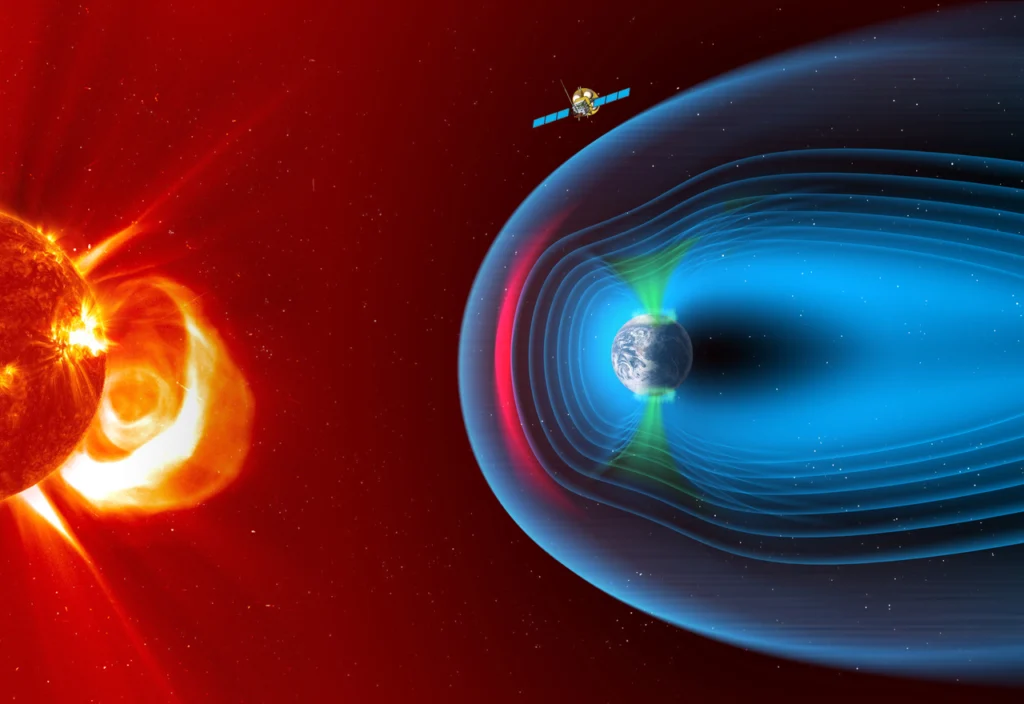
SMILE is the first mission specifically designed to image Earth’s magnetosphere on a global scale. By combining soft X-ray imaging, ultraviolet observations of auroras, and in-situ measurements, it will capture the full chain of interactions from the solar wind to the ionosphere.
Its most innovative feature—global X-ray imaging—will allow scientists to visualize the boundary between the solar wind and Earth’s magnetic field, known as the magnetopause. This boundary is highly dynamic, constantly reshaped by solar activity, yet it has never been observed continuously at a global level.
In effect, SMILE will provide something analogous to a weather satellite for near-Earth space, offering continuous, large-scale observations of processes that have previously been studied only in fragments.
Complementarity, Not Competition
Rather than replacing earlier missions, SMILE enhances their scientific value by providing the missing context.
- Data from MMS can reveal the fine-scale physics of magnetic reconnection—but SMILE will show where and when these events occur globally.
- Cluster’s multi-point measurements can map local plasma structures—while SMILE tracks how those structures evolve across the entire magnetosphere.
- Solar Orbiter identifies disturbances at their origin—SMILE observes their impact on Earth’s space environment.
Together, these missions form a multi-scale observational system:
- Solar Orbiter → origin of space weather at the Sun
- SMILE → global response of Earth’s magnetosphere
- Cluster & MMS → underlying physical processes
A Step Toward Predictive Space Weather
One of the major challenges in space weather science is moving from observation to prediction. This requires not only understanding the physics at small scales, but also capturing how those processes unfold across the entire system.
By linking global imaging with in-situ measurements, SMILE is expected to play a crucial role in this transition. It will enable scientists to connect localized events—such as reconnection—to large-scale consequences, including geomagnetic storms and auroral activity.
The evolution of heliophysics missions reflects a broader trend in space science: from isolated measurements toward integrated, system-level understanding.
Cluster and MMS have revealed the fine details of plasma behavior. Solar Orbiter has illuminated the origins of solar activity. SMILE now brings these perspectives together, offering the first comprehensive view of how energy flows through the Sun–Earth system.
In doing so, it marks the beginning of a new era—one in which space weather can be observed not just as a collection of events, but as a fully connected, dynamic system.

Astronomy Basics
🌠 Explore the Universe Like Never Before!🔭 Discover the secrets of stars, planets, and galaxies…

[Preview] Orbital Mechanics – An Introduction
Discover the fundamentals of orbital mechanics in this beginner-friendly course—no prior experience needed! Explore how…

Human Factors and Performances
Human factors and human performance in space are critical areas of study in spaceflight operations,…
Space Physics – Basics
Explore the dynamic forces that shape our space environment in this exciting journey beyond Earth’s…