
Join the mailing list Free weekly briefing, no spam.
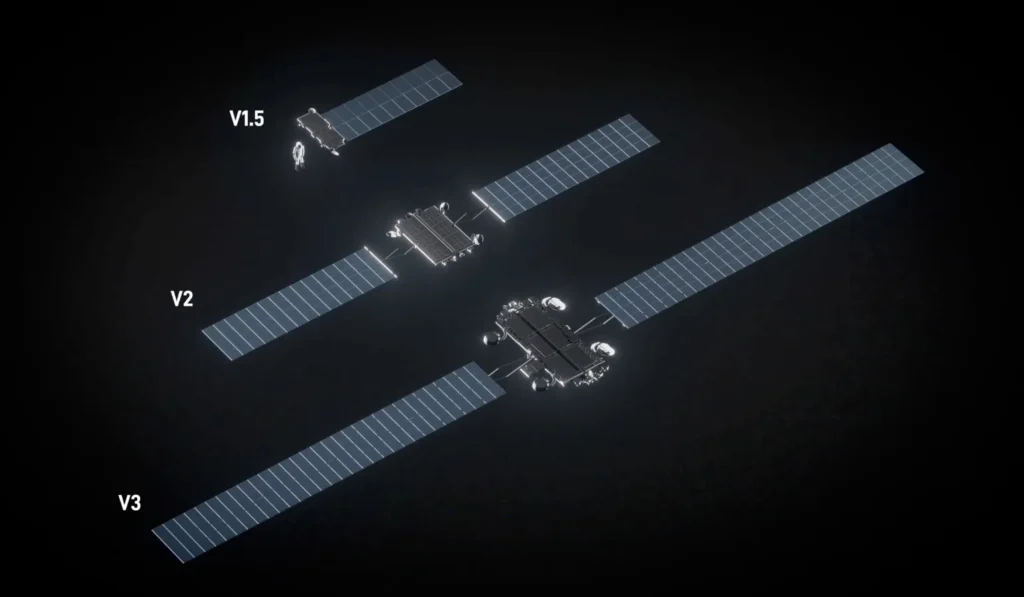
Starlink Versions Compared – Credits: SpaceX
The second generation of the Starlink constellation represents a major technological leap in satellite communications. With the authorization of the Gen2 network, SpaceX is preparing to deploy a new family of spacecraft designed to dramatically increase capacity, improve reliability, and expand global connectivity.
After deploying nearly 4,000 satellites since the initial license in 2018, the company has built one of the largest satellite constellations ever operated. The next phase—Starlink Gen2—introduces a redesigned architecture that addresses throughput scalability, orbital sustainability, and the growing concerns of the astronomical community.
This article analyzes the technical and operational implications of the Gen2 system.
Want to Stay Up-to-date about space? Free, weekly updates and opportunities (yes, opportunities!) in our newsletter:
Beyond the Rocket Revolution: Connecting Space Innovation with Society
ESA and Vast: the new MoU and Europe’s future after the ISS
Image Credits: jonasphotto The European Space Agency has signed a new Memorandum of Understanding with…
Photonic Quantum Processor in Orbit: What the First Test Proved, and What It Didn’t
Illustrative image: CubeSats deployed into Earth orbit from the International Space Station’s Kibo module. Not…
Argotec and Rheinmetall Put an Air Defence Satellite in Orbit Argotec and Rheinmetall Put an…
Starship Flight 14 Recap: It Reached Orbit, Delivered 26 Satellites — and Came Home the Hard Way

Aurora and Saturn at Opposition: The Sky on October 2–4, 2026
Image Credits: NASA, Neil Zeller A weekend with two stars of the show Between October…
The Evolution of the Starlink Architecture
The first-generation constellation of Starlink satellites established the baseline architecture for large-scale low Earth orbit broadband networks. However, increasing demand for global internet connectivity requires higher bandwidth and more efficient spacecraft.
The Gen2 constellation introduces satellites that are larger, more capable, and significantly higher capacity than the earlier spacecraft.
SpaceX plans two variants:
- Full-size V2 satellites designed for launch aboard Starship
- V2 Mini satellites compatible with Falcon 9
Because Starship has not yet entered operational launch cadence, the company developed the V2 Mini as an intermediate platform to accelerate constellation upgrades.
Despite the “Mini” label, these satellites represent a significant improvement.
Key capability upgrade:
- Up to four times the capacity per satellite compared with earlier Starlink spacecraft.
This increase is crucial for improving network performance as the subscriber base grows.
Engineering Improvements in Starlink V2
Increased Throughput
The most important technical improvement in Gen2 satellites is higher data throughput.
From a systems engineering perspective, this is likely achieved through a combination of:
- Larger phased-array antennas
- Higher power availability
- Improved onboard processing
- Enhanced inter-satellite laser links
The result is greater spectral efficiency and network capacity, enabling:
- more simultaneous users
- higher data rates
- improved service reliability
In satellite communications terms, Starlink Gen2 shifts the constellation closer to a high-density space-based mesh network rather than a simple relay system.
Platform Size and Power
The V2 satellites are larger spacecraft compared to the original Starlink units.
Larger satellites allow:
- greater electrical power generation
- larger antenna arrays
- improved propulsion capability
- more powerful computing systems
However, launching them requires higher payload capacity, which is why the full V2 design depends on Starship.
The interim V2 Mini design ensures that capacity expansion can proceed while the next-generation launcher matures.
Orbital Strategy and Space Sustainability
A central element of the Gen2 design is orbital debris mitigation and operational safety.
SpaceX continues to operate the majority of the constellation below 600 km altitude. This strategy has several engineering advantages.
Natural Orbital Decay
At these altitudes, atmospheric drag ensures that inactive satellites will reenter naturally within a few years, preventing long-term orbital debris.
Low Insertion Orbits
New satellites are deployed below approximately 400 km during early operations.
If a spacecraft fails initial checkouts, it rapidly reenters due to drag, preventing stranded hardware in orbit.
Active Deorbiting
Operational satellites are propulsively deorbited within weeks at end-of-life, far exceeding the international guideline of 25 years.
Fully Demisable Design
Starlink satellites are designed to completely burn up during reentry, eliminating the risk of debris reaching the surface.
From an engineering standpoint, this represents one of the most aggressive space sustainability approaches currently implemented in a commercial constellation.
Autonomous Collision Avoidance
One of the most advanced features of Starlink satellites is their autonomous collision avoidance capability.
The spacecraft continuously monitor conjunction warnings and can autonomously execute avoidance maneuvers using onboard propulsion.
This system has been reviewed by NASA through its Conjunction Assessment and Risk Analysis program, which concluded that the system is sufficiently reliable to avoid conflicts with NASA spacecraft.
Key aspects include:
- high-precision orbit predictions
- automated maneuver planning
- real-time data sharing with other operators
This level of autonomy is essential when managing thousands of spacecraft simultaneously.
Addressing Astronomical Concerns
One of the major criticisms of large satellite constellations has been their impact on astronomical observations.
To mitigate brightness issues, SpaceX has experimented with multiple approaches.
VisorSat
Deployable visors that block sunlight reflections from satellite surfaces.
Dielectric Mirror Films
Special coatings that redirect reflected sunlight away from Earth.
Low-Reflectivity Black Paint
Space-qualified coatings that reduce specular reflections.
Solar Array Orientation
Solar arrays can be oriented in a way that minimizes reflections visible from the ground during certain orbital phases.
Interestingly, despite the V2 satellites being larger, SpaceX expects them to appear as dark or darker than earlier spacecraft once fully operational.
However, the company acknowledges that real-world observations will ultimately validate these mitigation strategies.
Technical Significance of Starlink Gen2
From a space engineering perspective, the Gen2 constellation represents several broader industry trends.
Industrialized Satellite Manufacturing
Starlink satellites are produced in large volumes using automotive-style manufacturing processes, a radical departure from traditional satellite production.
Gen2 continues this approach while increasing spacecraft complexity.
Space-Based Networking
With high-capacity satellites and laser interlinks, Starlink increasingly resembles a distributed space-based data network.
This architecture enables:
- low-latency global routing
- reduced dependence on ground stations
- resilient communications infrastructure
Integration with Next-Generation Launch
The full potential of Gen2 depends on the operational maturity of Starship.
Once active, Starship could deploy larger satellites in larger batches, dramatically accelerating constellation expansion.
Challenges Ahead
Despite the technological progress, several challenges remain.
Orbital Traffic Management
With thousands of satellites already in orbit, coordination between operators will become increasingly critical.
Regulatory Oversight
Constellation scale is pushing regulators to rethink policies for spectrum use and space traffic management.
Astronomical Impact
Even with mitigations, the long-term impact on ground-based astronomy remains an active debate.
Conclusion
Starlink Gen2 marks a major step forward in satellite communications engineering. By increasing per-satellite capacity, implementing autonomous collision avoidance, and integrating sustainability measures into the design, SpaceX is pushing the boundaries of large-scale space infrastructure.
At the same time, the constellation highlights the growing complexity of managing Earth’s orbital environment as commercial megaconstellations become a permanent feature of the space economy.
If successful, Starlink Gen2 could become one of the most important pieces of infrastructure in the emerging global space-based internet architecture.The Evolution of the Starlink Architecture
The first-generation constellation of Starlink satellites established the baseline architecture for large-scale low Earth orbit broadband networks. However, increasing demand for global internet connectivity requires higher bandwidth and more efficient spacecraft.
The Gen2 constellation introduces satellites that are larger, more capable, and significantly higher capacity than the earlier spacecraft.
SpaceX plans two variants:
- Full-size V2 satellites designed for launch aboard Starship
- V2 Mini satellites compatible with Falcon 9
Because Starship has not yet entered operational launch cadence, the company developed the V2 Mini as an intermediate platform to accelerate constellation upgrades.
Despite the “Mini” label, these satellites represent a significant improvement.
Key capability upgrade:
- Up to four times the capacity per satellite compared with earlier Starlink spacecraft.
This increase is crucial for improving network performance as the subscriber base grows.
Engineering Improvements in Starlink V2
Increased Throughput
The most important technical improvement in Gen2 satellites is higher data throughput.
From a systems engineering perspective, this is likely achieved through a combination of:
- Larger phased-array antennas
- Higher power availability
- Improved onboard processing
- Enhanced inter-satellite laser links
The result is greater spectral efficiency and network capacity, enabling:
- more simultaneous users
- higher data rates
- improved service reliability
In satellite communications terms, Starlink Gen2 shifts the constellation closer to a high-density space-based mesh network rather than a simple relay system.
Platform Size and Power
The V2 satellites are larger spacecraft compared to the original Starlink units.
Larger satellites allow:
- greater electrical power generation
- larger antenna arrays
- improved propulsion capability
- more powerful computing systems
However, launching them requires higher payload capacity, which is why the full V2 design depends on Starship.
The interim V2 Mini design ensures that capacity expansion can proceed while the next-generation launcher matures.
Orbital Strategy and Space Sustainability
A central element of the Gen2 design is orbital debris mitigation and operational safety.
SpaceX continues to operate the majority of the constellation below 600 km altitude. This strategy has several engineering advantages.
Natural Orbital Decay
At these altitudes, atmospheric drag ensures that inactive satellites will reenter naturally within a few years, preventing long-term orbital debris.
Low Insertion Orbits
New satellites are deployed below approximately 400 km during early operations.
If a spacecraft fails initial checkouts, it rapidly reenters due to drag, preventing stranded hardware in orbit.
Active Deorbiting
Operational satellites are propulsively deorbited within weeks at end-of-life, far exceeding the international guideline of 25 years.
Fully Demisable Design
Starlink satellites are designed to completely burn up during reentry, eliminating the risk of debris reaching the surface.
From an engineering standpoint, this represents one of the most aggressive space sustainability approaches currently implemented in a commercial constellation.
Autonomous Collision Avoidance
One of the most advanced features of Starlink satellites is their autonomous collision avoidance capability.
The spacecraft continuously monitor conjunction warnings and can autonomously execute avoidance maneuvers using onboard propulsion.
This system has been reviewed by NASA through its Conjunction Assessment and Risk Analysis program, which concluded that the system is sufficiently reliable to avoid conflicts with NASA spacecraft.
Key aspects include:
- high-precision orbit predictions
- automated maneuver planning
- real-time data sharing with other operators
This level of autonomy is essential when managing thousands of spacecraft simultaneously.
Addressing Astronomical Concerns
One of the major criticisms of large satellite constellations has been their impact on astronomical observations.
To mitigate brightness issues, SpaceX has experimented with multiple approaches.
VisorSat
Deployable visors that block sunlight reflections from satellite surfaces.
Dielectric Mirror Films
Special coatings that redirect reflected sunlight away from Earth.
Low-Reflectivity Black Paint
Space-qualified coatings that reduce specular reflections.
Solar Array Orientation
Solar arrays can be oriented in a way that minimizes reflections visible from the ground during certain orbital phases.
Interestingly, despite the V2 satellites being larger, SpaceX expects them to appear as dark or darker than earlier spacecraft once fully operational.
However, the company acknowledges that real-world observations will ultimately validate these mitigation strategies.
Technical Significance of Starlink Gen2
From a space engineering perspective, the Gen2 constellation represents several broader industry trends.
Industrialized Satellite Manufacturing
Starlink satellites are produced in large volumes using automotive-style manufacturing processes, a radical departure from traditional satellite production.
Gen2 continues this approach while increasing spacecraft complexity.
Space-Based Networking
With high-capacity satellites and laser interlinks, Starlink increasingly resembles a distributed space-based data network.
This architecture enables:
- low-latency global routing
- reduced dependence on ground stations
- resilient communications infrastructure
Integration with Next-Generation Launch
The full potential of Gen2 depends on the operational maturity of Starship.
Once active, Starship could deploy larger satellites in larger batches, dramatically accelerating constellation expansion.
Challenges Ahead
Despite the technological progress, several challenges remain.
Orbital Traffic Management
With thousands of satellites already in orbit, coordination between operators will become increasingly critical.
Regulatory Oversight
Constellation scale is pushing regulators to rethink policies for spectrum use and space traffic management.
Astronomical Impact
Even with mitigations, the long-term impact on ground-based astronomy remains an active debate.
Conclusion
Starlink Gen2 marks a major step forward in satellite communications engineering. By increasing per-satellite capacity, implementing autonomous collision avoidance, and integrating sustainability measures into the design, SpaceX is pushing the boundaries of large-scale space infrastructure.
At the same time, the constellation highlights the growing complexity of managing Earth’s orbital environment as commercial megaconstellations become a permanent feature of the space economy.
If successful, Starlink Gen2 could become one of the most important pieces of infrastructure in the emerging global space-based internet architecture.