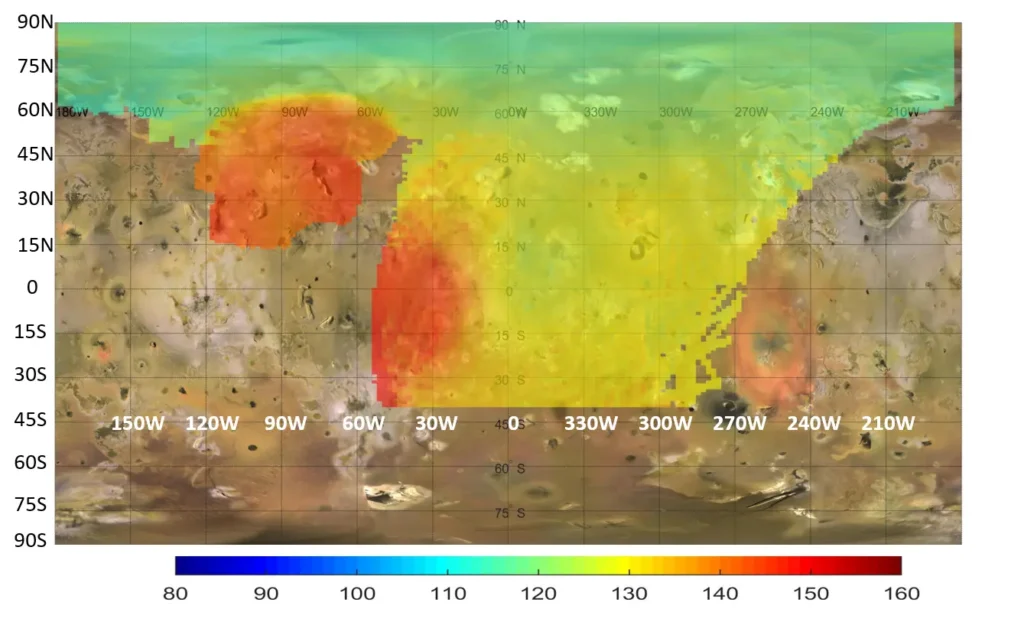
Cover Image: Temperature gradient by the Microwave Radiometer instrument – Credit NASA, JPL-Caltech, SwRI, USGS
Jupiter’s moon Io is the most volcanically active world in the Solar System, with hundreds of volcanoes constantly reshaping its surface. Now, NASA’s Juno spacecraft has gone a step further in understanding what drives this extraordinary activity by detecting heat beneath Io’s surface for the first time.
The new measurements, obtained during two close encounters with the moon, offer a rare glimpse into the shallow subsurface of a world dominated by tidal forces. They also reveal that, despite Io’s dramatic mountains and volcanic landscapes, large portions of its surface are surprisingly smooth.
The findings were published in the Journal of Geophysical Research: Planets and could provide scientists with a new way to investigate how heat moves through rocky worlds, both in our Solar System and beyond.
Looking below Io’s volcanic surface
Io’s intense volcanism is ultimately powered by Jupiter.
The moon follows a slightly elliptical orbit around the giant planet, while gravitational interactions with Jupiter and the other Galilean moons continually stretch and compress its interior. This constant flexing generates enormous amounts of heat inside Io, a process known as tidal heating.
Much of that energy eventually escapes through the moon’s surface and volcanic eruptions. Until now, however, scientists have mainly studied Io’s heat by observing infrared radiation emitted from its surface. These observations tell us where the hottest regions are, but they provide little information about what is happening below the ground.
Juno approached the problem in a different way.
The spacecraft’s Microwave Radiometer, or MWR, was originally designed to investigate Jupiter’s atmosphere beneath its visible cloud tops. Its six antennas observe microwave radiation across a broad range of wavelengths, from around 1.3 to 51 centimeters. Because different wavelengths can penetrate to different depths, the instrument can effectively investigate layers beneath a planetary surface.
Juno had already used this capability to study the subsurface of Jupiter’s icy moons, Ganymede and Europa. During the mission’s extended operations, scientists realized that the same technique could also reveal something unexpected about Io.
And it did.
A steep temperature increase underground
Juno made two particularly close passes over Io on December 30, 2023, and February 3, 2024, approaching to within roughly 1,500 kilometers of the moon’s surface.
The MWR observations revealed a clear increase in temperature with depth. Depending on the wavelength, the instrument was able to detect thermal emission originating from just below the surface down to depths of several meters.
The temperature rose by more than 20 degrees Celsius within only a few meters.
That is a remarkably steep temperature gradient. Solar radiation alone cannot explain it.
One possible interpretation is that heat is continuously flowing upward through Io’s rocky crust from its interior. If so, the measurements point to a background heat flow of roughly 1 to 3 watts per square meter. That may sound modest, but across the entire surface of Io it represents an extraordinary amount of energy, potentially tens of times greater than Earth’s average internal heat loss.
There is another possibility.
The microwave signal could be detecting relatively young lava flows. As molten rock spreads across Io’s surface, its upper layers cool and solidify while hotter material remains beneath. The MWR observations could be seeing these cooling volcanic deposits beneath a solid crust roughly 9 to 11 meters thick.
Such lava-covered regions may account for around 10% of Io’s surface at any given time.
The two explanations are not necessarily mutually exclusive. Io could be experiencing both a widespread upward flow of internal heat and localized heating associated with recent volcanic activity.
A new way to study tidal heating
The importance of these observations extends far beyond Io.
Tidal heating is one of the most important mechanisms shaping moons throughout the outer Solar System. The same basic process that turns Io into a volcanic powerhouse may also provide the energy needed to maintain subsurface oceans beneath the icy crusts of moons such as Europa and Ganymede.
In other words, tidal forces can transform worlds that would otherwise be frozen and geologically inactive into environments with active interiors.
Io represents the extreme end of that spectrum.
By detecting heat beneath the surface rather than simply observing the energy escaping into space, Juno is giving scientists a new opportunity to investigate how tidal energy is transported through a planetary body.
The technique could also have implications closer to home. Researchers suggest that microwave observations similar to those made by Juno could potentially be used to investigate temperature gradients beneath volcanic regions on Earth. Looking below the surface could provide additional information about how heat moves through volcanic systems and how magma interacts with the surrounding crust.
Io’s surprisingly smooth landscapes
The MWR observations also revealed something unexpected about Io’s surface itself.
The moon is famous for its rugged mountains, towering volcanic features, lava fields, and enormous deposits of sulfur and other volcanic materials. Yet the microwave data indicate that large areas away from the most prominent topographic features are remarkably smooth.
Some of these relatively uniform regions extend for more than 100 kilometers.
Juno’s observations were particularly useful because the spacecraft viewed overlapping areas of Io from different angles during its close flybys. This allowed scientists to study how the surface reflects microwave radiation under changing viewing geometries.
The result is a more detailed picture of Io’s surface properties that complements what spacecraft cameras can see.
Visible-light images reveal the spectacular appearance of Io. Microwave observations add another layer of information, helping scientists understand what lies beneath that surface and how the physical properties of the terrain vary from one region to another.
A volcanic world still full of mysteries
Io is a world unlike anything on Earth.
Its surface is constantly being resurfaced by volcanic activity, while its interior is continuously heated by gravitational interactions with Jupiter and the other moons. Volcanoes erupt, lava flows spread across the landscape, and the surface is transformed on geological timescales that are extraordinarily rapid.
Yet the new Juno measurements show that there is still much more to learn beneath the surface.
For the first time, scientists have been able to use microwave observations to investigate Io’s shallow subsurface temperature structure. The data provide a new perspective on how tidal energy travels from the interior toward the surface and may help explain why this small moon is so extraordinarily active.
Io is also a reminder that the most important source of energy for a planetary world does not always have to be its star.
In the outer Solar System, gravity itself can be enough to keep worlds alive.

BepiColombo Separates From Its Transfer Module Today
BepiColombo separates from its Mercury Transfer Module today, 3 September 2026, at 14:00 CEST (12:00…

BepiColombo Sheds Its Transfer Module as the Mercury Arrival Begins
After eight years and nine planetary flybys, ESA–JAXA’s BepiColombo mission is about to reach a…

A SpaceX Rocket Stage Is About to Crash into the Moon. Here’s Why Scientists Are Excited
Juno Peers Beneath Io’s Surface and Finds Heat Rising From Within
NASA Reveals “Asteroid” Is Actually an Active Comet, Highlighting the Importance of Precision Planetary Defense
Psyche’s Close Encounter with Mars Gives NASA a Crucial Dress Rehearsal
Ariane 6 Sets a New European Record with Upgraded Boosters

Spacewear CEO Corinna Sperandini Receives Italy’s “Le donne di ora” Award – But Let’s talk about Technology and Innovation
Cover Image: Le Donne di Ora Prize – Credits Invitalia The recognition highlights a growing…

Leicester Showcases Why the UK Space Sector Is More Than Just Launches