
Join the mailing list Free weekly briefing, no spam.
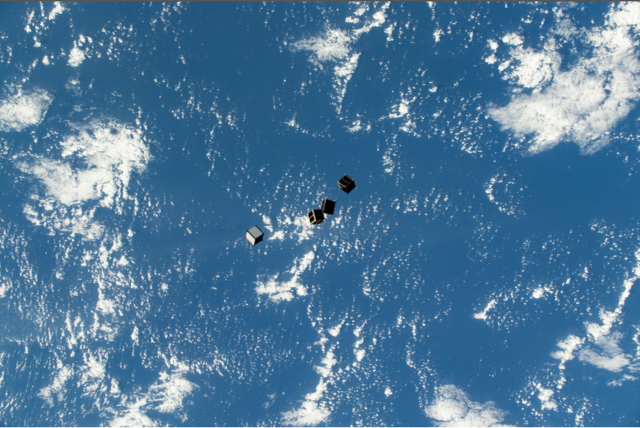
Illustrative image: CubeSats deployed into Earth orbit from the International Space Station’s Kibo module. Not the satellite used in the experiment. Credit: NASA/Tracy Dyson.
A research team led by the University of Vienna has operated a programmable photonic quantum processor in orbit and observed interference between two photons. It is a real technical result and, according to the authors, a first. But it is a feasibility demonstration of basic operations, not a useful quantum computation.
Key takeaways
- What was tested: a programmable photonic quantum processor on a nanosatellite, handling two photons in a six-mode circuit.
- What was observed: two-photon quantum interference, and a circuit that could be reprogrammed in orbit (average fidelity 0.888 across nine settings).
- The limits: only 3 of 6 detectors were usable, measurements were possible for about 30 minutes of each ~92-minute orbit, and performance degraded over time.
- What was not shown: no practical computation and no advantage over conventional systems.
- Status: a preprint on arXiv (21 September 2026), not yet peer reviewed.
How the experiment worked
The payload is a box of about 10 kg (22 lb) measuring roughly 15 × 15 × 46 cm (6 × 6 × 18 in), with an average power draw of 10 W. It launched on 23 June 2025 on SpaceX’s Transporter-14 rideshare mission and operated aboard D-Orbit’s ION SCV orbital transfer vehicle, at an altitude of about 510 km (317 miles) (The Quantum Insider). The paper reports measurements from the first eight months in orbit.
The team is led by Philip Walther at the University of Vienna and includes researchers from Germany’s DLR (the German Aerospace Center) and Italy’s CNR (the National Research Council). The joint first authors are Simon Steiner and Peter Schiansky (The Quantum Insider).
In brief, the system works like this:
- A laser illuminates a crystal that produces pairs of photons.
- Optical fibers guide the photons into a glass chip with six paths for light.
- Tiny heaters change the chip’s optical properties, which is how the circuit is “programmed”.
- Detectors record which outputs the photons emerge from.
The underlying idea is that, when photons are indistinguishable, their paths interfere and this changes where they emerge. That behavior is a resource for photonic quantum computing (The Quantum Insider).
What was observed
The team checked two things: that the circuit was programmable, and that the photons interfered. All figures below come from The Quantum Insider‘s summary of the paper and have not been verified directly against the paper’s full text.
| Measure | Reported value | How to read it |
|---|---|---|
| Average fidelity, 9 settings | 0.888 | How closely the observed photon distribution matches the predicted one (1 = perfect) |
| Average fidelity, excluding 2 settings | 0.949 | The two excluded settings show apparent calibration problems, so this does not describe the whole test |
| Crystal temperature at the dip | about 32.5 °C | Close to the temperature needed in ground tests |
| Interference visibility | 0.908 ± 0.191 | Depth of the drop in coincidences, with a wide uncertainty |
| Distance from the classical limit | 2.14 standard deviations | Evidence of quantum interference, not conclusive proof |
The Hong-Ou-Mandel dip
To test interference, the researchers looked for the so-called Hong-Ou-Mandel dip, a standard quantum-optics test. They varied the crystal’s temperature to make the photons similar enough, and observed the expected reduction in simultaneous detections at separate outputs.
The analysis combines three days of measurements. The dip was independently reproduced on two of them. In a configuration where interference was not expected, the drop did not appear, which works as a check against simple signal loss.
Problems in orbit
The experiment worked despite several failures and degradations, which are an important part of the result (The Quantum Insider):
- Detectors: after launch, only three of the six gave usable signals. One was already faulty before launch; for two others, broken fibers during launch are suspected. The analysis therefore covers three-mode portions of the six-mode device.
- Sunlight: detector noise rises sharply in the sunlit parts of the roughly 92-minute orbit. Measurements were limited to about 30 minutes per orbit, in Earth’s shadow.
- Radiation: it progressively damaged the detectors, increasing dark counts (signals recorded without an incoming photon). Changing the settings recovered useful signal but did not remove the deterioration.
- Laser: its power declined because material released by an internal adhesive contaminated optical components.
- Temperature: variations complicated the calibration of the circuit.
Another source describes the instrument as severely degraded by launch vibration, radiation and vacuum, while still confirming basic operation (Xenospectrum).
Considerations on the results
These notes concern the content of the paper itself. They are considerations, not comparisons with other work.
- The type of result. The paper describes a “programmable quantum photonic processor” and reports basic operations: photon-pair generation, circuit programming and two-photon interference. As The Quantum Insider points out, the study does not demonstrate a practical computation or an advantage over conventional systems. It answers a more basic question: can a compact system generate, manipulate and detect quantum light after launch?
- The scale. Two photons and six modes, of which only part was accessible because of the detector failures.
- Statistical strength. The visibility of 0.908 ± 0.191 has a wide uncertainty, and the 2.14-standard-deviation gap from the classical limit is described as evidence, not conclusive proof. Showing interference in selected measurement windows is an earlier milestone than sustaining it through lengthy processing, which needs many repeated measurements to tell signal from noise.
- The claim of a first. The paper places the novelty in using quantum light as a computational resource, noting that quantum light had already been generated and transmitted in orbit for secure communication and fundamental physics tests (arXiv). The claim is made by the authors and reported by Xenospectrum; we have not verified it independently.
- The application. Onboard processing of Earth-observation data is a direction indicated by the authors, so that selected results, rather than whole datasets, can be sent to the ground. Whether this will bring a useful advantage in orbit remains unverified.
SpaceInfo Club’s take
This section separates what the paper reports (according to The Quantum Insider‘s summary) from what we think.
Reported issues
- Only 3 of 6 detectors usable. One was already faulty before launch; for two others, broken fibers during launch are suspected. The analysis covers three-mode portions of the six-mode device.
- Measurements possible for about a third of each orbit. Sunlight-induced noise limited measurements to about 30 minutes out of an orbit of about 92 (a ratio we calculated).
- Progressive degradation. Radiation increased the detectors’ dark counts, and laser power declined because of contamination from an internal adhesive. Detector settings recovered signal, but not the deterioration.
- Unstable calibration. Temperature changes complicated calibration. Two of nine settings show apparent calibration problems: average fidelity is 0.888 across all of them and 0.949 without those two.
- Moderate statistical evidence. Visibility 0.908 ± 0.191, at 2.14 standard deviations from the classical limit, over three measurement days.
- No applied task. No practical processing was performed, and the method for encoding Earth-observation data into the circuit does not exist yet.
- Preprint. The study has not yet undergone peer review.
Our assessment
- The results describe the behavior of a subset of the device: the capability of the full six-mode circuit has not been verified in orbit.
- The degradation is progressive and the paper covers eight months. The sources we consulted do not tell us how the system would behave over longer periods: this is an open question, not a conclusion.
- If solar noise remained a limit, operational use would have to cope with reduced measurement windows. This is our own inference; among the priorities the authors indicate are shielding, thermal control, radiation-tolerant packaging and automatic recalibration.
- For fidelity we report both values because the higher one covers only a subset of the measurements: quoting only one would change the picture.
- In our view, 2.14 standard deviations calls for further data before it is considered established.
Overall reading (our assessment, not stated by the sources): the results should be understood as a feasibility test of the hardware in the space environment. Their value lies in showing that a photonic circuit can survive and partly operate after launch, radiation and thermal cycling, not in computing performance. The documented failures are also useful information for those who will design future payloads.
What comes next
The authors’ stated next step is to encode Earth-observation data directly into the operations programmed on the circuit (The Quantum Insider).
According to The Quantum Insider, both hardware and algorithmic progress will be needed:
- better shielding, thermal control, radiation-tolerant packaging and automatic recalibration;
- annealing, a treatment that can repair part of the radiation damage in detectors;
- an encoding method suited to this compact platform, which according to the paper does not exist yet.
Longer-term proposals include satellite processors linked by quantum communication links. They would require capabilities that this experiment has not demonstrated.
Frequently asked questions
Is this a quantum computer in space?
The paper describes a programmable quantum photonic processor. It handled two photons in a six-mode circuit and performed basic operations: generating photon pairs, programming the circuit and observing two-photon interference. According to The Quantum Insider, the study does not demonstrate a practical computation or an advantage over conventional systems.
Who ran the experiment?
A team led by Philip Walther at the University of Vienna, with researchers from the German Aerospace Center (DLR) and Italy’s National Research Council (CNR). The joint first authors are Simon Steiner and Peter Schiansky.
How long did the processor operate in orbit?
The paper reports measurements from the first eight months in orbit. The payload launched on 23 June 2025 on SpaceX’s Transporter-14 rideshare mission and operated aboard D-Orbit’s ION SCV orbital transfer vehicle.
What is the Hong-Ou-Mandel dip?
It is a standard quantum-optics test. When two indistinguishable photons enter opposite sides of a balanced beam splitter, they tend to leave through the same output, so coincident detections at two separate outputs become less frequent.
Has the study been peer reviewed?
No. It is a preprint posted on arXiv (arXiv:2609.25248, submitted 21 September 2026) and has not yet undergone peer review.
What are the next steps?
The authors’ stated next step is to encode Earth-observation data directly into the operations programmed on the circuit. According to The Quantum Insider this requires better shielding, thermal control, radiation-tolerant packaging, automatic recalibration and an encoding method suited to the platform, which does not exist yet.
Sources
Figures and details come from the arXiv abstract and from secondary coverage of the preprint.
- Simon Steiner et al., In-orbit operation of a programmable quantum photonic processor, arXiv:2609.25248, 21 September 2026 (preprint): arXiv page
- The Quantum Insider, One Giant Leap: Researchers Demonstrate Programmable Quantum Photonic Processor in Orbit, 29 September 2026: article
- Xenospectrum, Photonic Quantum Circuit Operates in Orbit for the First Time, Vienna Team Reports: article
- Quantum Computing Report, on the University of Vienna work: article
About the author
Sebastiano is an aerospace engineer who runs SpaceInfo Club, a space and astronomy education channel and website. At SpaceInfo Club we separate what a source reports from our own assessment, and we label the difference.