
Join the mailing list Free weekly briefing, no spam.
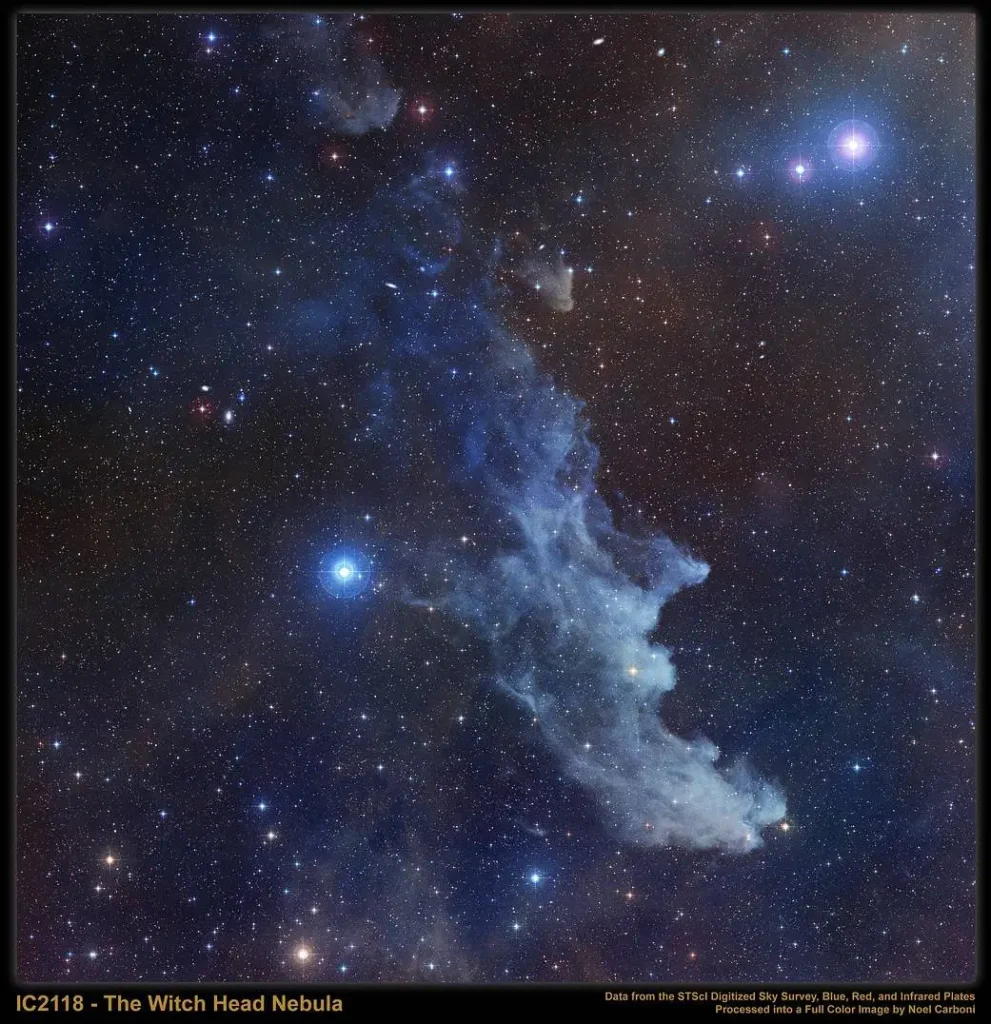
Witch Head Nebula – Credit- NASA, STScI Digitized Sky Survey, Noel Carboni
Key takeaways
- The Ghost Nebula (IC 63) in Cassiopeia is about 550 light-years away and glows because of radiation from the nearby blue giant Gamma Cassiopeiae. Hubble photographed it in an image released on 25 October 2018.
- The Witch Head Nebula (IC 2118) in Eridanus is a faint reflection nebula lit by Rigel, roughly 900–1,000 light-years away. It is a photographic target, not a casual naked-eye sight.
- Algol, the “Demon Star”, in Perseus, is about 94 light-years away and dims from magnitude 2.1 to about 3.4 every 2.87 days. It is the one object here you can watch with the naked eye.
- These names are folklore and nicknames, not official classifications. The real science is in the stories behind them.
Why does the sky have so many spooky names?
Astronomers have always named what they see after what it resembles. Ghosts, witches and demons are not scientific categories: they are nicknames, and they stick because the shapes and stories fit. This guide picks three objects whose Halloween-style names hide real astrophysics, and tells you which of them you can actually go out and look for in October.
At a glance
| Object | Nickname | Constellation | Distance | What is going on | How to see it |
|---|---|---|---|---|---|
| IC 63 | Ghost Nebula | Cassiopeia | About 550 light-years | Dust and gas lit by the blue giant Gamma Cassiopeiae | Telescope and dark sky, or photography |
| IC 2118 | Witch Head Nebula | Eridanus | About 900–1,000 light-years | Reflection nebula, dust scattering the light of Rigel | Long-exposure photography under dark skies |
| Beta Persei | Algol, the Demon Star | Perseus | About 94 light-years | Eclipsing binary star that dims every 2.87 days | Naked eye |
The Ghost Nebula (IC 63): a cloud in the glare of Gamma Cassiopeiae
In the constellation Cassiopeia, next to the naked-eye star Gamma Cassiopeiae at the centre of the “W”, a cloud of gas and dust glows with an eerie, ghostly shape. This is the Ghost Nebula, catalogued as IC 63, about 550 light-years from Earth.
It looks ghostly because of the star beside it. Gamma Cassiopeiae is a hot blue giant that sends out a torrent of radiation, and that radiation hits the nebula and makes it shine. In a Hubble image released on 25 October 2018, taken with the Wide Field Camera 3, the pale, wispy shapes of the cloud stand out against the dark background. It was released a few days before Halloween, and the name suits it.
Can you see it? IC 63 is faint and sits very close to a bright star, whose glare drowns it out. Most people see it through astrophotography or a telescope under a dark sky. Gamma Cassiopeiae, however, is easy to find: look for the “W” of Cassiopeia, high in the northern sky on October evenings, and start from the central star.
The Witch Head Nebula (IC 2118): a profile in Eridanus
The Witch Head Nebula, IC 2118, is a giant, cometary-shaped cloud in the constellation Eridanus, not far from Orion. Its shape, with a pointed “chin” and “nose” in profile, gives it the witchy name. It spans about 3 by 1 degrees of sky, which means that on a photograph it is several times the width of the full Moon.
It is a reflection nebula: it does not produce its own light but scatters the light of nearby stars, here the blue supergiant Rigel in Orion. The dust scatters blue light more efficiently than red, which is why long-exposure photographs show the nebula in blue. Estimates of the distance differ slightly, around 900 to 1,000 light-years. Its origin is still uncertain: it may be the remnant of an ancient supernova, or simply a gas cloud.
Can you see it? Not easily. At magnitude 13 it is described as extremely faint, so it is a target for long-exposure astrophotography under dark skies. The nebula rises in the evening sky as winter approaches, with Orion, so it is a good one to bookmark for the colder months.
Algol, the Demon Star: the one you can watch tonight
Algol, in the constellation Perseus, is the best Halloween object for the naked eye, because you do not need equipment, only patience. Its name comes from the Arabic ra’s al-ghul, “the head of the ogre” or “ghoul”, which is also where the word ghoul comes from. In the sky it marks the head of Medusa that Perseus holds in the constellation’s figure, so the sinister reputation is very old.
The explanation is a real one. Algol is an eclipsing binary: two stars orbit each other, and every 2.87 days (2 days, 20 hours, 49 minutes) the fainter star passes in front of the brighter one. During the eclipse, which lasts roughly 10 hours, the combined brightness falls from magnitude 2.1 to about 3.4. The star appears to “wink” over a single night. John Goodricke proposed this explanation in 1783, making Algol one of the first eclipsing binaries understood.
How to watch it: find Perseus, which is high in the sky in the evening in October, and look for Algol next to the arc of stars below Cassiopeia. Compare its brightness with its neighbours over an hour or two on a night when an eclipse is predicted. Predicted eclipse times are published by astronomy magazines and apps, so check them before you go out.
Which one should you try first?
If you only have a clear evening and your eyes, Algol is the winner: it is bright, it changes within hours, and it needs no equipment. If you own a telescope or a camera on a tracker, try the Ghost Nebula next to Gamma Cassiopeiae. Save the Witch Head Nebula for a long-exposure winter project.
Frequently asked questions
What is the Ghost Nebula?
The Ghost Nebula, IC 63, is a cloud of gas and dust in Cassiopeia, about 550 light-years away. It glows because of the radiation of the nearby blue giant Gamma Cassiopeiae.
Why is it called the Witch Head Nebula?
Because of its shape: on long-exposure photographs the cloud looks like the profile of a witch. IC 2118 is a reflection nebula in Eridanus, lit mainly by the star Rigel.
Why is Algol called the Demon Star?
The name comes from the Arabic ra’s al-ghul, “head of the ogre”. The star’s brightness drops every 2.87 days because it is an eclipsing binary, which may be why ancient observers saw it as sinister.
Can I see these objects with the naked eye?
Only Algol. The Ghost Nebula and the Witch Head Nebula are faint and need a telescope or long-exposure photography under a dark sky.
Related reading
- Halloween fireballs 2026: when to see the Orionid and Taurid meteor showers
- Halloween on the International Space Station: how astronauts celebrate in orbit
Sources and how we checked this article
The SpaceInfo Club is an independent space and astronomy publication. Distances for astronomical objects vary between catalogues, so we give approximate values and say when sources differ.
- AstroPix / STScI: Hubble Captures the Ghost of Cassiopeia (IC 63, Gamma Cassiopeiae, 550 light-years, Hubble WFC3, released 25 October 2018)
- Wikipedia: IC 2118 (Witch Head Nebula) (constellation, angular size, magnitude, Rigel illumination)
- Wikipedia: Algol (distance, period, magnitude range, name origin)