Join the mailing list Free weekly briefing, no spam.
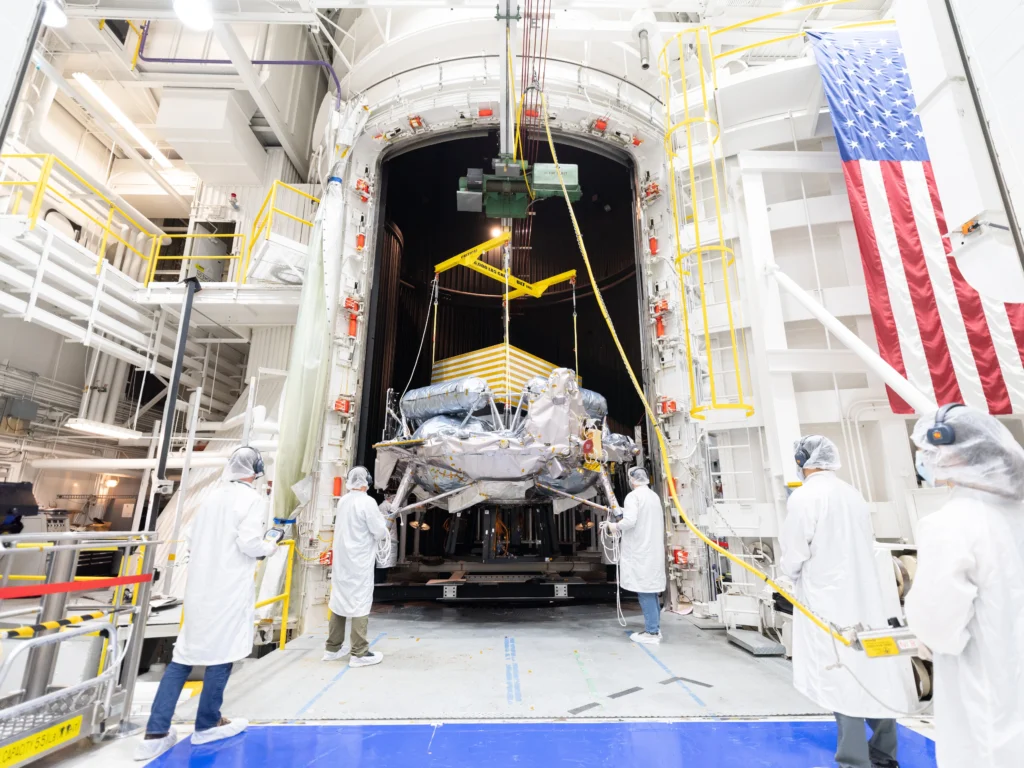
Griffin-1, the lunar lander that Voyager Technologies plans to send to the Moon’s south pole, has completed a round of environmental testing at NASA’s Jet Propulsion Laboratory (JPL) in Southern California. Over several months the 1,265-kilogram spacecraft was spun on a table, blasted with sound, shaken in three directions, and then cycled between hot and cold inside a vacuum chamber. It has now returned to Voyager Lunar Systems in Pittsburgh for final assembly, and launch on a SpaceX Falcon Heavy is planned for later in 2026.
Griffin-1 at a glance
- Lander: Griffin Mission One (Griffin-1), an infrastructure-class lander built by Voyager Technologies, mass 2,789 lb (1,265 kg).
- Program: NASA’s Commercial Lunar Payload Services (CLPS) initiative, which buys delivery services to the Moon from private companies.
- Destination: Nobile Crater, near the lunar south pole.
- Cargo: more than 1,100 lb (about 500 kg), made up of 10 science and technology payloads from six countries.
- Launch: SpaceX Falcon Heavy, later in 2026. Public mission references list a target of no earlier than November 2026.
- Testing site: the Environmental Test Laboratory at NASA JPL, with tests starting in July 2026.
Who is building Griffin-1
Griffin has a long history under another name. The lander was developed by Astrobotic Technology, the Pittsburgh company behind the Peregrine lander. Voyager Technologies announced its plan to acquire Astrobotic on June 2, and the company now operates as Voyager Lunar Systems, still based in Pittsburgh. That is why NASA’s test announcement credits Voyager. John Thornton, executive vice president of Voyager Technologies, described the test campaign as a major milestone toward what the company calls its Moon Base.
The main payload is FLIP, the FLEX Lunar Innovation Platform built by Astrolab, a rover of roughly 500 kilograms that JPL says would be the largest commercial payload delivered to the Moon. FLIP is a precursor to Astrolab’s larger FLEX rover. Griffin was first designed to carry NASA’s VIPER rover, which was cancelled in 2024, so the lander was reconfigured around other payloads while keeping its CLPS task order.
Five tests, five ways to lose a lander
A spacecraft that works on the bench can still fail in flight. Environmental testing exists to find those failures on the ground, where they can be fixed. For Griffin-1, JPL ran five main tests, each aimed at a different kind of problem.
1. Mass properties: is the lander balanced as modeled?
On July 20, engineers spun the spacecraft on a special table in JPL’s Environmental Test Laboratory. The measurement reveals the true center of gravity and how mass is distributed around it. This matters because the guidance software uses a model of those values to decide how long to fire each thruster. If the real lander wobbles differently from the model, the same thruster burn produces a different rotation, and during a powered descent there is little time to correct it.
2. Electromagnetic interference: can the electronics coexist?
The lander then went into an anechoic chamber, a room whose walls are covered in foam spikes that absorb radio waves and sound. Radios, power converters, motor controllers and computers all produce electromagnetic noise. The test confirms that none of them disturbs the others, and that the lander’s transmitters do not upset its own sensitive receivers.
3. Acoustic test: surviving the launch noise
On August 12, horns driven by compressed nitrogen exposed Griffin-1 to up to 153 decibels in a sealed chamber, simulating the noise of a Falcon Heavy liftoff. In pressure terms that is roughly 900 pascals, less than 1 percent of sea-level air pressure. The danger is not the average force but the rapid oscillation across every large panel and bracket, which can loosen fasteners and crack solder joints that looked fine on the ground.
4. Vibration: shaking in three axes
A shaker table then moved the lander along each of its three axes with steadily increasing force while hundreds of sensors recorded the response. Engineers compare those readings with their structural models. Any resonance that amplifies vibration more than predicted shows up here, before it can damage something on the real rocket.
5. Thermal vacuum: hot, cold and no air
The final and longest test took place in JPL’s 25-Foot Space Simulator, a chamber with an 85-foot (26-meter) ceiling. Over about two weeks, Griffin-1 alternated between up to 167 degrees Fahrenheit (75 degrees Celsius) and as low as minus 148 degrees Fahrenheit (minus 100 degrees Celsius) in vacuum. Without air there is no convection, so heat moves only by conduction and radiation, exactly as it does in space and on the lunar surface. The test checks that heaters, radiators, insulation and electronics all work across the temperature range, including when the lander has to restart from cold. The facility is on the National Register of Historic Places and has supported Ranger, Surveyor, Mariner, Voyager, Perseverance and Europa Clipper.
Why the tests matter after Peregrine
Astrobotic’s first lander, Peregrine Mission One, launched in January 2024 and lost most of its propellant to a leak that began soon after separation from the rocket, so it never attempted a landing. That failure was in the propulsion system, which environmental testing alone does not verify, and Griffin is a different and larger design. Even so, the lesson for any lander is the same: failures are cheapest to find on the ground. A clean environmental campaign shows that the structure, electronics and thermal design behave as the models predict. It does not replace propulsion tests, software validation or the landing itself, which remains the hardest part of the mission.
What happens next
Griffin-1 is back in Pittsburgh for final assembly. After that come launch-readiness operations and shipment to Cape Canaveral in Florida, where it will be mated to a Falcon Heavy. If the schedule holds, the lander will head for Nobile Crater, a region near the south pole where permanently shadowed terrain is thought to hold water ice. That makes the area a priority target for NASA and for commercial missions preparing the way for later crewed landings.
Frequently asked questions
When will Griffin-1 launch?
Voyager and NASA JPL say launch is planned for later in 2026 on a SpaceX Falcon Heavy. Public mission references list a target of no earlier than November 2026. Dates for lunar missions often move, so check Voyager’s announcements for updates.
Where will Griffin-1 land?
The target is Nobile Crater, near the Moon’s south pole.
What will Griffin-1 carry?
Ten science and technology payloads from six countries, led by Astrolab’s FLIP rover. The total cargo is more than 1,100 pounds (about 500 kilograms).
Is Griffin-1 an Astrobotic lander?
It was developed by Astrobotic. Following Voyager Technologies’ acquisition, Astrobotic operates as Voyager Lunar Systems, and NASA now credits the lander to Voyager.