
Join the mailing list Free weekly briefing, no spam.
In short: NASA 4-D comes with large numbers: more than 1,500 NASA teams, over 100,000 alumni in 75 countries, a typical 4 to 5% improvement per benchmark and 13 consecutive Best Place to Work titles for NASA. This article traces each figure to the document that states it, points out where sources differ, and lists what you can check yourself before attending the 9 to 13 November 2026 programme in Leicester.
This is part 5 of the SpaceInfo Club series on human performance in high-stakes environments. Part 1 covers the ideas, and this part covers the evidence behind them. Last updated: 14 October 2026.
Key takeaways
- NASA 4-D was designed by former NASA Director of Astrophysics Charlie Pellerin and is now delivered in updated form by Crazy Might Work, an Australian company.
- The 1,500-team, 100,000-alumni and 4 to 5% figures are statements by Crazy Might Work, and we found no independent audit.
- Sources disagree on when the programme began: the late 1990s or the early 2000s.
- The five-day Leicester format is new, so no results exist yet from a full cohort.
Where the programme came from
NASA 4-D was designed by Charlie Pellerin, a former Director of Astrophysics at NASA and the author of How NASA Builds Teams. Its starting point was the aftermath of the Challenger accident, which killed seven astronauts, and of later failed missions. According to Crazy Might Work, the inquiries that followed led NASA to see social context, not technical incompetence, as the root of those failures. Paul Hawkins repeats the point in our YouTube interview: the culture of the time did not let people speak up freely.
The sources do not agree on the decade. The page for the Pellerin and Hawkins fireside chat says the programme launched in the late 1990s. Paul’s written answers say it was developed in the early 2000s. We could not settle this from the material available, so we leave both on record.
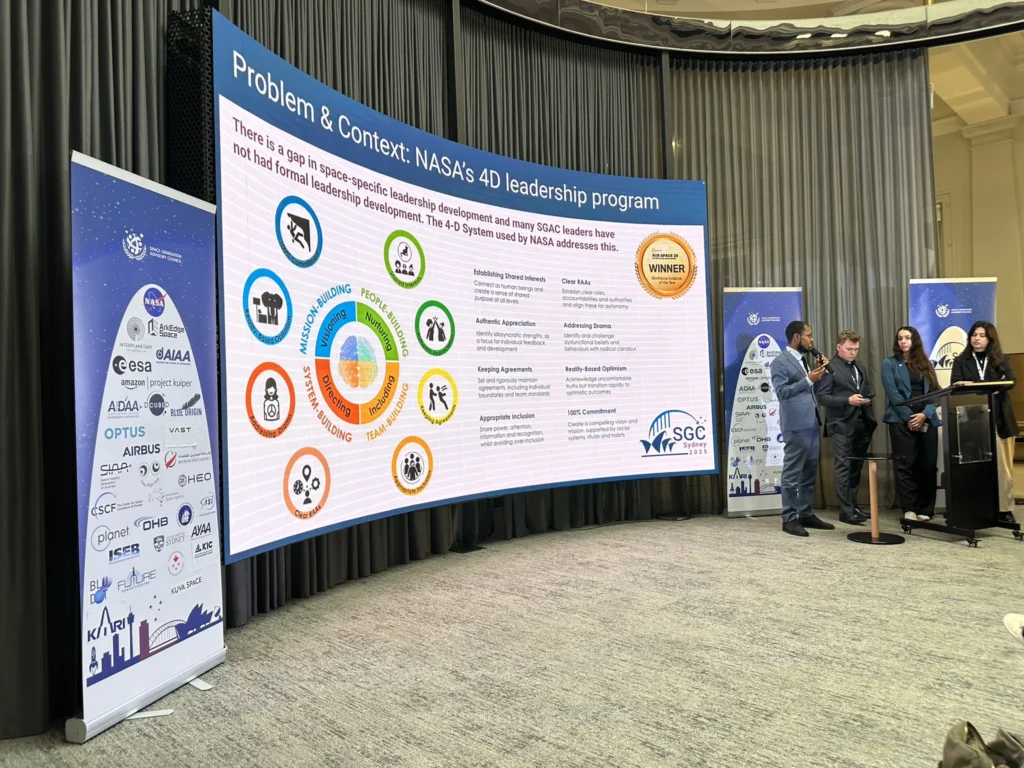
Crazy Might Work, which Paul founded in 2015 and launched in Antarctica, now delivers an updated version with contemporary neuroscience and simulations drawn from the current space programme. NASA itself is described in the sources as the original user of the system, and none of them describes the Leicester course as a NASA course.
The figures, one by one
| Figure | Where it appears | Our note |
|---|---|---|
| More than 1,500 NASA teams completed it voluntarily | Paul’s written answers; Crazy Might Work programme page; fireside chat page | A company statement. We found no independent count. |
| More than 100,000 alumni in over 75 countries | Paul’s written answers | Single source, company statement. |
| Teams typically improve 4 to 5% each time they benchmark | Crazy Might Work programme page | The page gives no method or data set, so the figure cannot be checked from it. |
| NASA named Best Place to Work in the federal government for 11, 12, then 13 years in a row | 2023 prospectus (11); fireside chat page dated May 2024 (12); programme page, May 2025 (13) | The count rises with each document, which is consistent. A single ranking cannot by itself be credited to one programme, and the ranking should be checked with its publisher. |
| Workforce Initiative of the Year 2025 | Crazy Might Work programme page and About page | The award appears as “Australian Space Awards” on one page and “Australian Space Industry Awards” on the other. Check the organiser’s winners list. |
| Regular part of the work of the Space Generation Advisory Council to the United Nations | Paul’s written answers; About page | A company statement. |
How the format has changed
The 2023 prospectus describes a public programme of 90-minute online sessions over eight weeks, with in-house options in virtual, blended and face-to-face form. Participants complete a Context Shifting Worksheet in which they take a real team from dysfunction to high performance, and graduates can apply to become accredited NASA 4-D coaches. The current Crazy Might Work page describes a public online course of eight two-hour modules. The Leicester week is different again: two days of NASA 4-D, delivered in person, followed by three days of the Executive Guide to Space. It is new, and Paul says there are no results from a full cohort yet.
How to judge it yourself
- Ask Crazy Might Work how the 4 to 5% benchmark improvement is calculated and what sample it comes from.
- Ask for the benchmark report format, so you can see what a team actually receives.
- Listen to the two podcast conversations hosted on the Crazy Might Work site: the fireside chat with Charlie Pellerin and the interview with Adam Thorn.
- Read Pellerin’s book, How NASA Builds Teams, for the original argument in his own words.
- Compare the official inquiry reports into the shuttle accidents with the claim that culture was the root issue. Part 1 lists where to find them.
Why it still deserves a look
This is our reading. The problem the programme targets, information that fails to travel up a team, is the kind of organisational factor the shuttle inquiries examined, so the starting point is documented. The mechanism is plausible, because behaviours can be taught and practised. What remains company-reported is the size of the effect. That is a reasonable thing to verify before committing a week of your time. The three-day Executive Guide to Space that follows NASA 4-D does not depend on those numbers, and it can be booked alone. Everything about dates and options is on the official Space Park Leicester page.
Frequently asked questions
Is NASA 4-D an official NASA course?
The system was developed for NASA by Charlie Pellerin, and the sources say more than 1,500 NASA teams completed it. The current version is delivered by Crazy Might Work, an Australian company, and none of the sources describes the Leicester course as run by NASA.
Who created NASA 4-D?
Charlie Pellerin, a former Director of Astrophysics at NASA and the author of How NASA Builds Teams.
Has the 4 to 5% improvement been independently verified?
Not that we could find. The figure appears on the Crazy Might Work programme page without a method or data source.
Are there results from the Leicester programme?
No. The combined five-day programme is new to Leicester, and Paul Hawkins says it is too early to claim outcomes.
Sources
- Crazy Might Work: NASA 4-D programme
- Crazy Might Work: About us
- Crazy Might Work: Charlie Pellerin and Paul Hawkins fireside chat
- Crazy Might Work: Adam Thorn interviews Paul Hawkins
- Crazy Might Work: Leadership lessons from frontiers like space
- NASA 4-Dimensional Leadership Program prospectus (2023, PDF)
- Space Park Leicester: NASA 4-D Executive Space Programme page
- SpaceInfo Club interview with Paul Hawkins (YouTube)
About this article
Written by the SpaceInfo Club editorial team, founded by Sebastiano, an aerospace engineer, who interviewed Paul Hawkins for the series. Facts about the programme come from the sources above. Statements that are our own reading are marked as such, and figures supplied by Crazy Might Work are attributed to it.
More in this series
- Part 1: Why Space Teams Fail: Paul Hawkins on NASA’s 4-D Leadership System
- Part 2: Eight Questions Answered by Paul Hawkins
- Part 3: Executive Guide to Space at Space Park Leicester
- Part 4: Working in Space Without Being an Engineer
Next in the series: how to choose between the two-day, three-day and five-day options before registration closes (scheduled for 30 October 2026).
Image Credits: Crazy Might Work