
Join the mailing list Free weekly briefing, no spam.
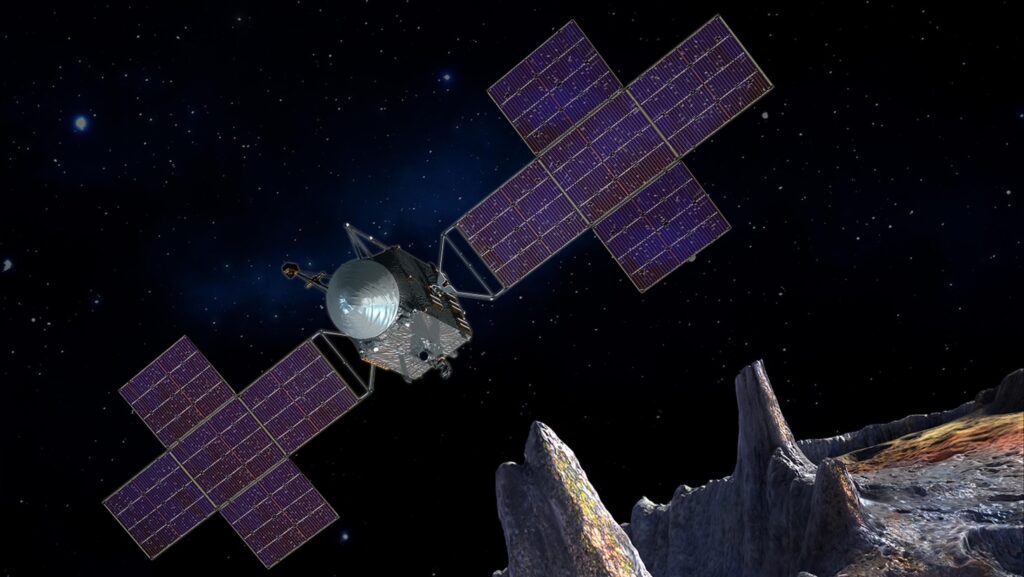
Cover Image: NASA’s Psyche approaching metal rich asteroid, Artist’s Impression. Credit: NASA/JPL-Caltech
Since September 28, 2026, NASA’s Psyche spacecraft has been firing its thrusters almost without pause. It is a quiet change in the mission’s routine, but it explains a lot about how deep space travel works, and it hides a small engineering surprise.
Key facts
- Mission: Psyche, a NASA mission managed by the Jet Propulsion Laboratory (JPL), launched in October 2023.
- Target: the metal-rich asteroid Psyche in the main asteroid belt, about 280 km (173 miles) across at its widest point.
- Arrival: summer 2029, followed by a two-year prime science mission in orbit.
- Current phase: since September 28, the thrusters run nearly continuously, about 90% of the time, with a pause once a week to contact Earth.
- Thrust: up to 250 millinewtons, about the weight of one AA battery held in your hand.
- Propellant: xenon, with about one third of the roughly 1,090 kg (2,400 lb) loaded at launch already used.
What changed on September 28
For the first part of its journey, Psyche used its electric propulsion only now and then. The goal was to line up a Mars gravity assist, a flyby that gave the spacecraft a speed boost and a slight change of direction without spending propellant. That flyby went well.
Now the spacecraft is in long-haul cruise. Don Han, the mission’s navigation lead at JPL, described it as running the propulsion system at every available opportunity, pausing only for necessary engineering activities. The thrusters are expected to operate nearly 90% of the time until arrival.
Why a push this small still works
A conventional chemical thruster delivers a strong push for a short time and burns a lot of propellant doing it. Psyche does the opposite. Its solar electric propulsion system uses electromagnetic fields to deliver a very gentle thrust, but it keeps doing so for months and years.
In space there is almost no drag, so every small push adds to the speed. Thrust comparable to an AA battery’s weight sounds laughable, yet applied for most of a multi-year cruise it builds up. At its maximum cruise speed, JPL says Psyche will travel at more than 100,000 mph (160,900 km/h) relative to an observer on Earth. Speeds in space always depend on the reference frame, so that figure is a useful order of magnitude rather than a single absolute number.
The trade-off is patience. You save a great deal of propellant, but you accept a slow, steady journey.
A blue glow made of xenon
Psyche’s thrusters use the Hall effect. Atoms of xenon, an inert gas, are given an electric charge and then accelerated by an electromagnetic field. The ions are expelled at high speed, which pushes the spacecraft the other way. The process also produces the bright blue glow seen in ground tests at JPL.
The spacecraft carries four thrusters, and only one operates at a time. Power comes from two cross-shaped solar arrays with a combined sunlight-collecting area of about 75 square meters (800 square feet). Those arrays charge the batteries and run everything on board, including the propulsion system.
The hidden problem: swirl torque
Here is the part that makes this cruise scientifically interesting. As the thrusters expel xenon ions, the magnetic field they generate makes the ions swirl. That swirl creates a very slight twisting force, called torque, on the spacecraft. Left alone, it would slowly disturb where Psyche is pointing.
The spacecraft counters it with reaction wheels. These are spinning wheels inside the spacecraft. By changing their spin rate, they absorb the unwanted twisting motion, the way a sponge soaks up water.
A sponge eventually fills up. After several hours, the wheels hold too much accumulated angular momentum. Engineers then command the spacecraft to switch off its thruster, rotate, and fire a different thruster at low power in a different direction for several minutes. That pushes the momentum out of the wheels and resets them.
According to Steve Snyder, the mission’s lead engineer for propulsion operations at JPL, this torque is so small that it can only be measured in space, not on Earth. He says this is the first time the effect has been measured on a Hall thruster as a function of power level and operating time, over such a long duration. In other words, Psyche is also working as a laboratory for the technology that moves it.
Why the thrust will drop to about half power
A solar-powered spacecraft depends on sunlight, and sunlight weakens quickly with distance from the Sun. For the next three months, Psyche will thrust at full power. After that, as it moves farther away and its arrays collect less light, the team will slowly throttle the thrusters down to approximately half power.
This is a good example of how spacecraft design is a balance. The same sunlight that makes the mission possible also sets a limit on how hard it can push as it travels outward.
What Psyche is heading for
The asteroid Psyche is thought to be the partial core of a planetesimal, one of the building blocks of an early planet. If it turns out to be an ancient metallic core, it could offer a rare look into the interior of rocky planets like Earth, which we can never reach directly.
Once there, the spacecraft will enter orbit and map the asteroid through a series of orbits that go lower and then higher in altitude. Lindy Elkins-Tanton, principal investigator of the mission at the University of California, Berkeley, said the Mars flyby let the team calibrate instruments and practice procedures for a planetary encounter before arrival.
What this teaches us
Three ideas are worth keeping. First, small forces matter when they act for long enough. Second, efficiency often means trading speed for propellant savings, and missions are designed around that trade. Third, tiny effects that are invisible in a laboratory on Earth can show up in space over months of operation, which is why long missions are so valuable as engineering tests.
Frequently asked questions
How strong is Psyche’s thrust?
Up to 250 millinewtons, about the force you would feel from holding one AA battery.
What propellant does Psyche use?
Xenon, an inert gas, ionized and accelerated by a Hall-effect thruster. About one third of the original supply has been used since launch.
When will Psyche reach the asteroid?
By the summer of 2029. It will then orbit the asteroid during a two-year prime science mission.
Why does Psyche turn its thrusters off every week?
It pauses about once a week to check in with mission controllers on Earth, and for necessary engineering activities.
What is swirl torque?
A very small twisting force caused by swirling xenon ions in the thruster’s magnetic field. Reaction wheels absorb it, and engineers periodically reset the wheels.
Sources
- NASA Jet Propulsion Laboratory, “Pedal to the Metal: NASA’s Psyche Heads Toward Asteroid Belt”, October 22, 2026.
- NASA, “NASA’s Psyche Mission Aces Mars Flyby, Targets Metal-Rich Asteroid”.
- NASA JPL, “Solar Electric Propulsion Makes NASA’s Psyche Spacecraft Go”.
Published by The SpaceInfo Club, October 27, 2026.
Sebastiano