
Join the mailing list Free weekly briefing, no spam.
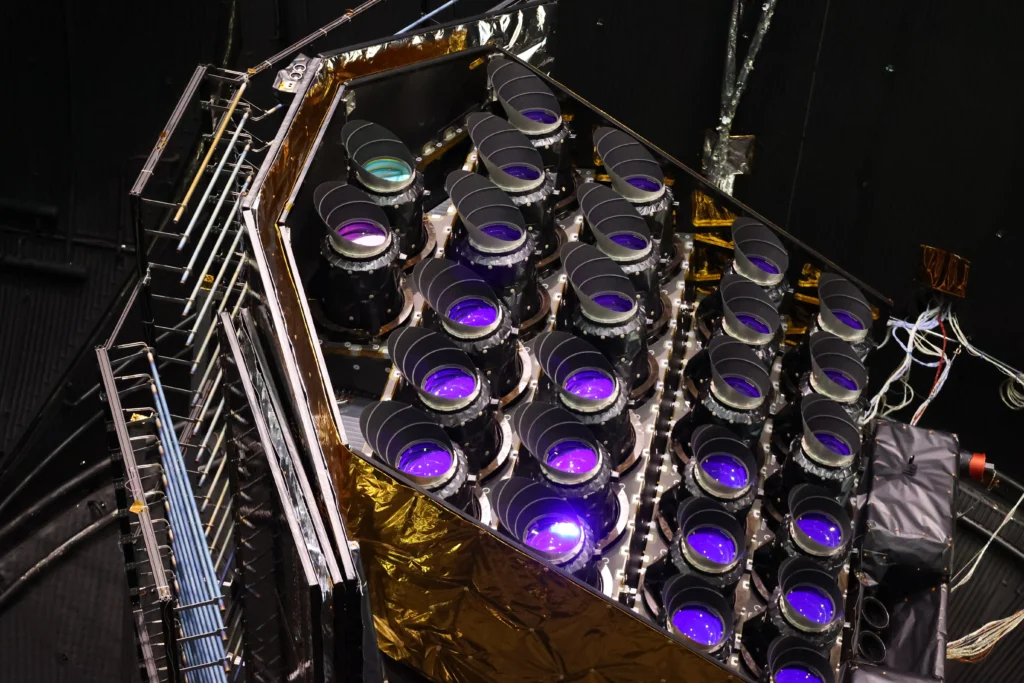
Cover Image: Close-up of Plato’s cameras. Credits: ESA
For thousands of years, humanity looked at the night sky and wondered whether worlds like ours existed elsewhere in the universe. Today, that question is no longer philosophical alone — it has become a scientific investigation powered by increasingly sophisticated space missions.
Among the most important of the next decade is European Space Agency’s PLATO mission, a spacecraft designed not simply to find exoplanets, but to identify and characterize worlds that may resemble Earth in ways previous missions could not fully determine.
Expected to launch aboard an Ariane 6 rocket, PLATO represents a major step forward in the search for potentially habitable planets around Sun-like stars — and perhaps, eventually, in the search for life beyond Earth.
More Than Another Exoplanet Mission
PLATO stands for PLAnetary Transits and Oscillations of stars, a name that reflects its dual scientific strategy.
Like earlier exoplanet observatories, PLATO will use the transit method, monitoring stars for tiny periodic drops in brightness caused by planets passing in front of them.
The basic principle behind this technique is:
Even extremely small variations in a star’s light can reveal the presence of distant planets.
But PLATO’s true innovation lies in what comes next.
Previous missions such as Kepler revolutionized astronomy by demonstrating that planets are common throughout the galaxy. Missions like TESS expanded that work by identifying nearby candidates for follow-up observations.

Astronomy Basics
🌠 Explore the Universe Like Never Before!🔭 Discover the secrets of stars, planets, and galaxies…

[Preview] Orbital Mechanics – An Introduction
Discover the fundamentals of orbital mechanics in this beginner-friendly course—no prior experience needed! Explore how…

Human Factors and Performances
Human factors and human performance in space are critical areas of study in spaceflight operations,…
Space Physics – Basics
Explore the dynamic forces that shape our space environment in this exciting journey beyond Earth’s…
PLATO, however, is being designed to answer deeper questions:
- How old are these planetary systems?
- How stable are they?
- How similar are they to our Solar System?
- Could rocky planets around Sun-like stars remain habitable for billions of years?
In other words, PLATO is not only searching for planets — it is searching for context.
The Importance of Stellar Ages
One of the biggest challenges in exoplanet science is that understanding a planet requires understanding its star.
A rocky planet orbiting in the so-called habitable zone may sound promising, but without knowing the age and evolution of the host star, scientists cannot determine whether the planet has had enough time for stable conditions — or for life itself — to emerge.
This is where PLATO becomes particularly powerful.
The mission will combine exoplanet detection with asteroseismology, the study of subtle oscillations within stars. These vibrations act almost like stellar “earthquakes,” allowing astronomers to probe the internal structure of stars and estimate their age with unprecedented precision.
For exoplanet science, this is transformative.
Rather than merely cataloging distant worlds, PLATO aims to build detailed timelines of planetary systems across the Milky Way.
A Telescope Unlike Any Other
At first glance, PLATO’s design appears unusual.
Instead of relying on a single giant telescope mirror, the spacecraft will carry 26 individual cameras working together simultaneously.
This architecture provides several major advantages:
- an extremely wide field of view,
- high photometric precision,
- built-in redundancy,
- and the ability to monitor enormous numbers of stars at once.
Together, the cameras will observe hundreds of thousands of stars, generating some of the most comprehensive datasets ever produced in exoplanet astronomy.
The mission is expected to focus particularly on relatively bright and nearby stars, making many of its discoveries ideal targets for future atmospheric investigations by observatories such as James Webb Space Telescope and the upcoming ARIEL mission.
The Journey to L2
PLATO is scheduled to travel to the Sun–Earth Lagrange Point 2 (L2), located approximately 1.5 million kilometers from Earth.
L2 has become one of the most strategically important regions in modern astronomy. It provides a stable thermal environment and allows spacecraft to maintain a relatively constant orientation toward both Earth and deep space.
Several landmark observatories already operate there, including:
- James Webb Space Telescope
- Gaia
From this position, PLATO will be able to conduct long, uninterrupted observations essential for detecting the tiny signals produced by Earth-sized planets.
Searching for Another Earth
Perhaps the most exciting aspect of PLATO is its scientific focus on Earth analogues.
Many exoplanets discovered so far are unlike anything in our Solar System:
- hot Jupiters orbiting extremely close to their stars,
- super-Earths with unknown compositions,
- giant planets in chaotic orbits.
PLATO is instead optimized to identify:
- rocky planets,
- orbiting Sun-like stars,
- at distances where liquid water could potentially exist.
These are precisely the kinds of worlds scientists consider most promising in the search for life.
The mission will also help researchers understand whether our Solar System is typical or unusual — a question with profound implications for planetary science, astrobiology, and humanity’s place in the cosmos.
Europe’s Expanding Role in Exoplanet Science
PLATO is also a reflection of Europe’s increasingly central role in space science.
With missions such as:
- CHEOPS,
- Gaia,
- JUICE,
- and ARIEL,
ESA has become one of the world’s leading organizations in planetary and astronomical exploration.
PLATO fits into this broader scientific strategy as a mission capable of bridging discovery and characterization — finding potentially habitable planets while simultaneously providing the stellar data necessary to interpret them properly.
A Mission That Could Change Perspective
The search for exoplanets has evolved rapidly over the last thirty years.
What once seemed speculative is now routine: astronomers have confirmed thousands of planets orbiting distant stars. Yet despite this progress, we still do not know how common truly Earth-like worlds may be.
PLATO could help answer that question.
If successful, the mission may identify nearby rocky planets with stable, long-lived environments suitable for detailed future study. Some of those worlds could eventually become targets in humanity’s first serious search for biosignatures beyond the Solar System.
And while PLATO may not directly discover extraterrestrial life, it could help point us toward the places where we should look next.
For a species that has spent centuries asking whether we are alone, that alone would represent a historic achievement.

Halloween on the International Space Station: How Astronauts Celebrate in Orbit
ESA’s Hera and NASA’s DART: What Europe’s Asteroid Mission Will Measure at Didymos

Executive Guide to Space at Space Park Leicester: Three Days Inside a Space Mission

MO-Nav on Talon-A: What a Mach 5 GPS-Denied Test Proves

Scariest Objects in Space: Ghost Nebula, Witch Head Nebula and the Demon Star
Griffin-1 Lunar Lander Completes Environmental Testing at NASA JPL

NASA 4-D Executive Space Programme: Eight Questions Answered by Paul Hawkins