
Join the mailing list Free weekly briefing, no spam.
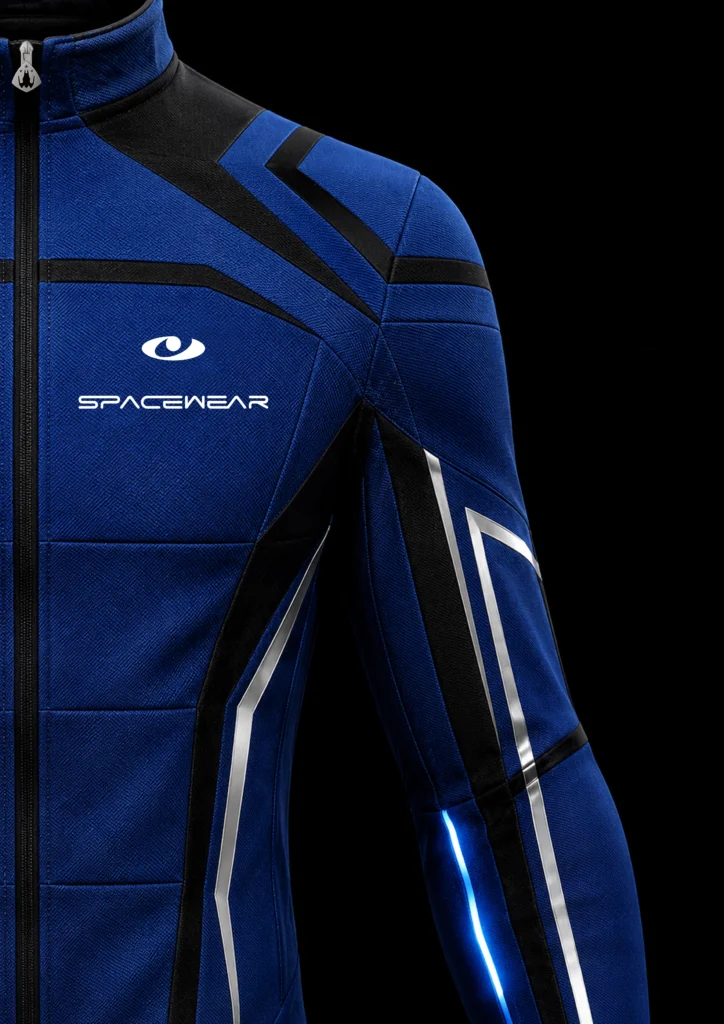
Cover Image: Detail of the new SFS3 design. Featuring next-generation fabric and an innovative ergonomic construction. Highlighted on the suit’s forearm is a light-based alert system designed to signal any critical issues that may arise during use. Credit: Spacewear
Fano, Italy, June 2026
The future of human spaceflight is often associated with rockets, spacecraft, and advanced robotics. Yet one of the most critical technologies enabling long-duration missions may be something far more personal: what astronauts wear every day.
Italian aerospace innovator Spacewear has unveiled the first details of its new Smart Flight Suit 3 (SFS3), the latest generation of its wearable technology platform designed for astronauts operating inside space habitats. Building on the heritage of SFS1 and SFS2, the new suit aims to enhance astronaut comfort, health monitoring, mobility, and operational safety aboard the International Space Station (ISS), future commercial stations, and eventually lunar habitats.
The announcement marks another milestone for a company that has steadily established itself as one of Italy’s most distinctive contributors to the growing field of human-centered space technologies. Earlier generations of the Smart Flight Suit were successfully tested in orbit, with SFS2 becoming the first and only smart flight suit authorized by NASA for operational use aboard the ISS during the Ax-3 mission.
From SFS1 to SFS3: An Evolution Driven by Human Factors
Spacewear’s development philosophy differs from that of traditional spacesuit programs. Rather than focusing on extravehicular activity (EVA) systems designed for operations in the vacuum of space, the company specializes in intravehicular suits, garments worn inside spacecraft and orbital habitats.
This category may appear less dramatic than lunar or Mars surface suits, but it addresses a growing challenge in modern spaceflight. As commercial missions increase in duration and the prospect of private space stations becomes reality, astronauts will spend extended periods living and working inside confined environments where comfort, health monitoring, hygiene, and mobility directly affect performance.
SFS3 represents the latest step in a development path that began with SFS1, tested during the Virtute 1 mission, and continued with SFS2 aboard the ISS during Ax-3. Each iteration has refined the integration of advanced textiles, wearable technologies, and ergonomic design principles.
Scariest Objects in Space: Ghost Nebula, Witch Head Nebula and the Demon Star
Griffin-1 Lunar Lander Completes Environmental Testing at NASA JPL
NASA 4-D Executive Space Programme: Eight Questions Answered by Paul Hawkins
Halloween Fireballs 2026: When to See the Orionid and Taurid Meteor Showers
Perseverance Passes Opportunity’s Driving Record: What 45 Kilometers on Mars Really Means
Why Space Teams Fail: Paul Hawkins on NASA’s 4-D Leadership System
The new suit maintains the key characteristics that have become a Spacewear signature: lightweight construction, breathability, antibacterial properties, thermal regulation, and fire resistance. However, the company states that SFS3 introduces significant advances in both monitoring capabilities and user interaction.
A Spacesuit That Communicates
Perhaps the most visually distinctive feature of SFS3 is the integration of a light-based alert system positioned on the astronaut’s forearm.
While Spacewear has not yet disclosed the complete operational architecture of the system, the concept reflects a broader trend in aerospace human-machine interfaces: reducing cognitive workload by providing immediate visual feedback directly within the astronaut’s field of view.
In future orbital habitats where crews may simultaneously manage scientific experiments, maintenance activities, communications, and health monitoring, wearable alert systems could provide an additional layer of situational awareness.
The suit also expands its capability to monitor physiological parameters, building upon the biometric data collection technologies previously demonstrated by SFS2 during orbital testing. Earlier versions of the suit were designed to collect astronaut health data in real operational conditions aboard the ISS, providing insights that cannot be replicated entirely through ground-based testing.
Engineering Comfort for Life in Orbit
One of the less visible but potentially most impactful innovations in SFS3 lies in its textile architecture.
According to Spacewear, the suit employs new construction techniques using elastic-tension textile structures that achieve flexibility without relying on conventional elastomeric materials. The goal is to increase freedom of movement while maintaining comfort during prolonged use.
This focus on mobility reflects an often-overlooked reality of spaceflight. Even in microgravity, astronauts experience physical fatigue. Daily activities require constant body stabilization, repetitive movement patterns, and adaptation to a three-dimensional environment unlike anything on Earth.
By designing garments that follow human anatomy more naturally and reduce movement constraints, companies like Spacewear are addressing an increasingly important aspect of future space operations: human performance optimization.
Solving a Hidden Challenge: Laundry in Space
Among the most practical aspects of SFS3 is its approach to hygiene.
The combination of breathable and antibacterial textile technologies is intended to allow astronauts to wear the suit during everyday activities, including training sessions, without requiring regular washing.
This capability addresses a surprisingly significant challenge in space habitation.
On the ISS, clothing is not washed in the conventional sense. Water is an extremely valuable resource, and garments are generally worn until they must be discarded. Future missions to the Moon and Mars will face even stricter resource constraints.
Reducing or eliminating the need for washing not only improves operational efficiency but also contributes to sustainability goals. It is a reminder that innovations developed for space often generate benefits on Earth as well, particularly in sectors such as technical apparel, healthcare, sportswear, and high-performance occupational clothing.
This downstream potential has been a recurring theme in Spacewear’s strategy. The company has consistently emphasized that technologies designed for astronauts can inspire solutions for everyday users, creating a bridge between space exploration and terrestrial applications.
Design as a Functional Technology
SFS3 also continues Spacewear’s emphasis on industrial design.
The concept was developed by Chief Designer Marcello Azzoni and follows a philosophy that combines anatomical ergonomics with a strong visual identity. Rather than treating appearance as secondary, the design highlights the suit’s functional areas while maintaining a recognizable aesthetic language.
This approach reflects a broader evolution occurring throughout the space industry. As commercial spaceflight expands and human presence in orbit becomes more routine, equipment is increasingly expected to combine engineering performance with user experience, comfort, and even brand identity.
The future astronaut may not simply wear equipment. They may wear technology designed with the same attention to usability and design thinking that transformed consumer electronics on Earth.
Preparing for the Next Era of Human Spaceflight
Spacewear’s announcement arrives at a pivotal moment for the human spaceflight sector.
The ISS is approaching the final phase of its operational life, while multiple commercial space stations are under development. At the same time, international lunar exploration programs are progressing toward sustained human presence beyond low-Earth orbit.
In this evolving landscape, intravehicular systems will become increasingly important. Astronauts will spend months living in orbital habitats, lunar gateways, and eventually planetary bases where everyday operational clothing must provide far more than simple protection.
It must support health monitoring, optimize performance, improve safety, minimize resource consumption, and adapt to increasingly complex environments.
With SFS3, Spacewear is positioning itself at the intersection of all these requirements.
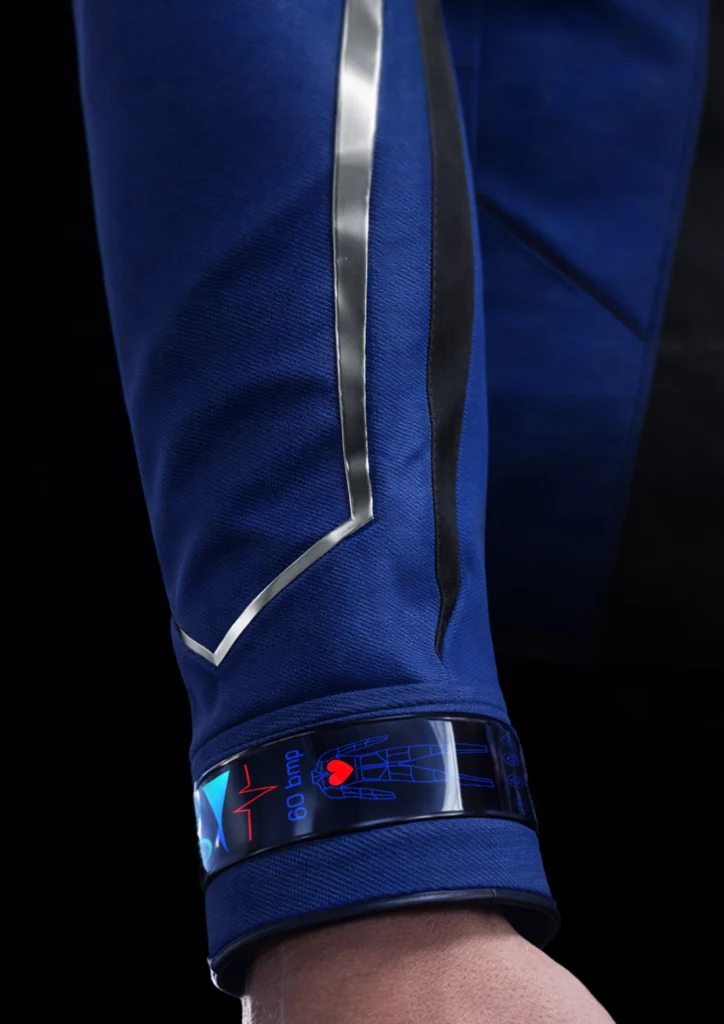
The new smartwatch integrated into the SFS3 wrist section, featuring a flexible, long-lasting design and displaying the medical data collected by the suit. Credit: Spacewear
As CEO Corinna Sperandini stated during the announcement, the company’s vision remains centered on people: developing materials, construction methods, comfort solutions, and monitoring technologies that contribute to astronaut safety and well-being while generating innovations that can ultimately improve life on Earth.
The next generation of space exploration will depend not only on how we travel to new destinations, but also on how effectively humans can live and work once they arrive. In that sense, the evolution of smart astronaut clothing may prove to be just as important as the spacecraft carrying crews there.
Related Reading
SpaceInfo Club readers interested in Spacewear’s development journey may also explore our previous coverage of the company’s radiation-resistant textile research and the orbital validation of its SFS2 platform, both of which laid important foundations for the new SFS3 program.

Astronomy Basics
🌠 Explore the Universe Like Never Before!🔭 Discover the secrets of stars, planets, and galaxies…

[Preview] Orbital Mechanics – An Introduction
Discover the fundamentals of orbital mechanics in this beginner-friendly course—no prior experience needed! Explore how…
Human Factors and Performances
Human factors and human performance in space are critical areas of study in spaceflight operations,…
Space Physics – Basics
Explore the dynamic forces that shape our space environment in this exciting journey beyond Earth’s…