
Join the mailing list Free weekly briefing, no spam.
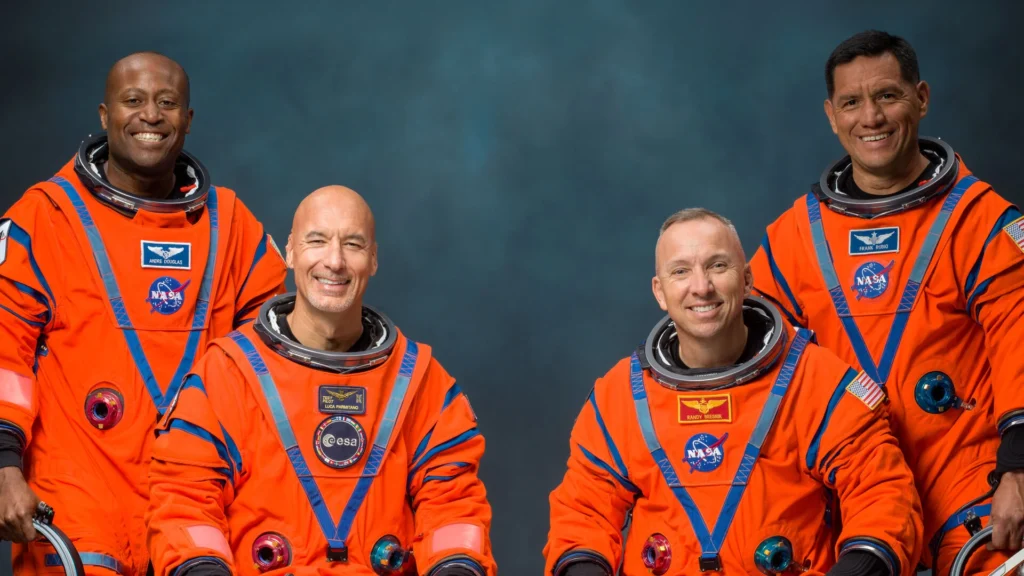
Cover Image: Artemis 3 Crew – Credit NASA
Humanity’s return to deep-space exploration has entered a new chapter. NASA has officially announced the crew of Artemis III, the next major mission in the Artemis program and a critical step toward establishing a sustainable human presence beyond Earth. While the mission has evolved from its original lunar landing objective into a complex orbital test flight, Artemis III remains one of the most ambitious crewed space missions ever attempted.
At the center of this international endeavor stands European Space Agency astronaut Luca Parmitano, who will serve as the mission’s pilot. His appointment marks a milestone not only for Europe’s contribution to lunar exploration but also for the growing partnership between NASA and ESA that is shaping the future of human spaceflight.
The Artemis III Crew
NASA has selected a highly experienced team to carry out the mission. Veteran astronaut Randy Bresnik will command Artemis III, joined by ESA astronaut Luca Parmitano as pilot. NASA astronauts Frank Rubio and Andre Douglas will serve as mission specialists responsible for supporting the flight’s advanced operational objectives.
Together, the four astronauts will undergo an intensive training campaign focused on Orion spacecraft operations, rendezvous and docking procedures, and coordination with future lunar landing systems.
Unlike previous Artemis missions, Artemis III will place particular emphasis on testing technologies and operational concepts that will be required for future lunar surface expeditions.
A Mission Designed to Prepare for Lunar Landings
Following recent adjustments to NASA’s Artemis architecture, Artemis III is now planned as a crewed test mission in Earth orbit. Rather than attempting an immediate lunar landing, the mission will demonstrate critical capabilities needed before astronauts once again descend to the Moon.
The primary objective will be to validate complex rendezvous and docking operations between the Orion spacecraft and prototypes of future human landing systems. These demonstrations will verify procedures, spacecraft interfaces, and operational techniques that future crews will rely upon during lunar missions beginning with Artemis IV.
The mission will also showcase an unprecedented level of launch coordination involving multiple heavy-lift rockets and spacecraft systems. Success will reduce technical risk for future lunar expeditions while advancing the technologies that could eventually support missions deeper into the Solar System.
Scariest Objects in Space: Ghost Nebula, Witch Head Nebula and the Demon Star
Griffin-1 Lunar Lander Completes Environmental Testing at NASA JPL
NASA 4-D Executive Space Programme: Eight Questions Answered by Paul Hawkins
Halloween Fireballs 2026: When to See the Orionid and Taurid Meteor Showers
Perseverance Passes Opportunity’s Driving Record: What 45 Kilometers on Mars Really Means
Why Space Teams Fail: Paul Hawkins on NASA’s 4-D Leadership System
As NASA Administrator Jared Isaacman noted, Artemis III represents another bold step in humanity’s return to the Moon and demonstrates the power of international cooperation in achieving exploration goals that no single nation could accomplish alone.
Luca Parmitano: From Test Pilot to Artemis Pilot
For Luca Parmitano, Artemis III represents the culmination of a remarkable career spanning military aviation, international spaceflight, and leadership in human space exploration.
The Italian astronaut has already accumulated 366 days in space across his two long-duration International Space Station missions, Volare and Beyond. During those expeditions, he participated in hundreds of scientific experiments, conducted six spacewalks totaling more than 30 hours, and became the first Italian commander of the International Space Station.
Since returning to Earth, Parmitano has continued to play a crucial role in human spaceflight operations. Serving as ESA’s representative at NASA’s Johnson Space Center in Houston, he has worked as a Capsule Communicator (CapCom), supported astronaut training programs, and instructed crews in extravehicular activity and robotic operations.
His involvement in Artemis preparations extends beyond the classroom. In 2025, he participated in NASA’s Underway Recovery Test 12 off the California coast, helping simulate astronaut recovery operations following an Orion splashdown.
Before becoming an astronaut, Parmitano built an exceptional aviation career. Selected by the Italian Air Force as a test pilot in 2007, he trained at the prestigious French test pilot school EPNER in Istres and eventually achieved the rank of Colonel. With more than 2,000 flight hours and qualifications on over 20 military aircraft and helicopter types, he brings precisely the operational expertise required for a mission focused on spacecraft testing and complex flight operations.
His appointment as Artemis III pilot highlights the increasing role of European astronauts in the future of deep-space exploration.
Europe’s Double Contribution
ESA’s role in Artemis III extends far beyond supplying one of the mission’s astronauts.
Europe will once again provide the European Service Module (ESM), the indispensable propulsion and support element of NASA’s Orion spacecraft. Artemis III will fly with ESM-3, the third European-built service module developed under ESA leadership.
The module serves as Orion’s powerhouse, providing propulsion, electrical power, thermal regulation, water, and breathable air for the crew. Without it, Orion would be unable to perform its mission.
Daniel Neuenschwander, ESA Director of Human and Robotic Exploration, described Artemis III as a mission in which Europe will play two decisive roles: through Parmitano’s operational leadership in the cockpit and through the European technology that keeps Orion functioning throughout the flight.
The ESM represents one of the most sophisticated industrial collaborations ever undertaken in European spaceflight. The module’s structure is manufactured by Thales Alenia Space in Turin, Italy, while final assembly is carried out by Airbus in Bremen, Germany. Its development involves contributions from 13 ESA member states, approximately 20 major contractors, and more than 100 suppliers across Europe.
The Legacy of the European Service Module
The European Service Module has already established an impressive track record.
ESM-1 successfully powered the uncrewed Artemis I mission in 2022, demonstrating Orion’s ability to travel to lunar distances and return safely to Earth. ESM-2 supported the crewed Artemis II mission earlier this year, carrying astronauts farther from Earth than any human crew since the Apollo era.
Now, ESM-3 is preparing for its own historic flight.
Currently undergoing final testing at NASA’s Kennedy Space Center in Florida, the module arrived in the United States aboard the transport vessel Canopée in August 2024. Following integration with Orion’s Crew Module Adapter, ESA formally handed the spacecraft element over to NASA in September 2025.
Recent acoustic testing has been completed successfully, and engineers are preparing to connect the service module with Orion’s crew module to create the fully integrated spacecraft. The installation of Orion’s four European-built solar arrays will follow before final launch preparations begin.
A New Golden Age of Exploration
Artemis III represents more than a spacecraft test mission. It symbolizes the transformation of space exploration into a truly international enterprise.
The mission brings together American leadership, European technology, and a multinational workforce united by a common goal: extending humanity’s reach beyond Earth. The lessons learned during Artemis III will directly influence future lunar landing missions and help establish the operational foundation for sustained exploration of the Moon.
For Europe, the mission marks an extraordinary achievement. An ESA astronaut will occupy one of the most critical positions aboard Orion, while European-built hardware will once again serve as the backbone of the spacecraft itself.
As humanity prepares for the next phase of lunar exploration, Artemis III demonstrates that the journey back to the Moon—and eventually onward to Mars—will be built on collaboration, innovation, and the shared ambition to explore the unknown.
With Luca Parmitano at the controls and European technology powering the mission, Europe will be helping to write one of the most important chapters in the history of human spaceflight.
Scariest Objects in Space: Ghost Nebula, Witch Head Nebula and the Demon Star
Griffin-1 Lunar Lander Completes Environmental Testing at NASA JPL
NASA 4-D Executive Space Programme: Eight Questions Answered by Paul Hawkins
Halloween Fireballs 2026: When to See the Orionid and Taurid Meteor Showers
Perseverance Passes Opportunity’s Driving Record: What 45 Kilometers on Mars Really Means