

Join the mailing list Free weekly briefing, no spam.
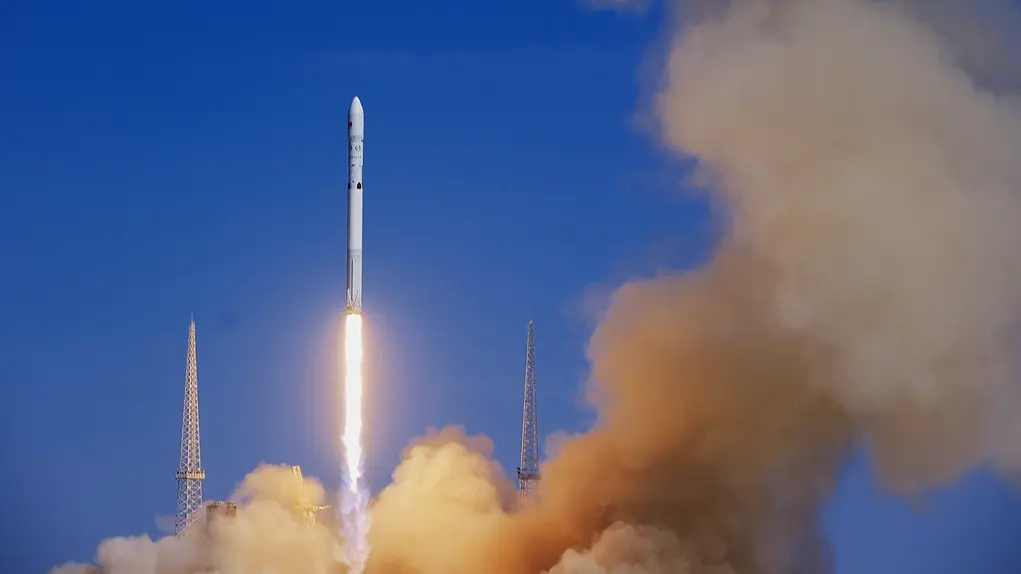
Cover Image: China’s Long March-12B carrier rocket makes its maiden flight from the Dongfeng commercial space innovation pilot zone in northwest China, June 1, 2026. /VCG
China’s space industry has taken another significant step toward reusable launch technology with the unexpected debut of the Long March 12B, a new partially reusable rocket whose design and ambitions bear a striking resemblance to SpaceX’s Falcon 9. The launch, conducted on June 1, 2026, attracted global attention not only because of the vehicle itself but also because it occurred with virtually no advance public warning, an unusual practice in modern orbital launch operations.
The mission successfully placed satellites into low Earth orbit for China’s rapidly expanding Qianfan, or “Thousand Sails,” broadband constellation, a network widely viewed as Beijing’s answer to SpaceX’s Starlink system. While the payload deployment was successful, the larger significance of the flight lies in what the rocket represents: China’s most visible effort yet to replicate the operational model that transformed the global launch industry over the past decade.

Scariest Objects in Space: Ghost Nebula, Witch Head Nebula and the Demon Star
Griffin-1 Lunar Lander Completes Environmental Testing at NASA JPL

NASA 4-D Executive Space Programme: Eight Questions Answered by Paul Hawkins

Halloween Fireballs 2026: When to See the Orionid and Taurid Meteor Showers
Perseverance Passes Opportunity’s Driving Record: What 45 Kilometers on Mars Really Means
Why Space Teams Fail: Paul Hawkins on NASA’s 4-D Leadership System
A Familiar Design Philosophy
Observers immediately noted the similarities between Long March 12B and Falcon 9. The Chinese launcher is a two-stage vehicle powered by nine engines on its first stage and uses liquid oxygen and kerosene propellants, mirroring the architecture that enabled SpaceX to achieve unprecedented launch cadence and cost reductions. The rocket is also designed for first-stage recovery and reuse, although no landing attempt was conducted during its maiden flight. Chinese officials indicated that recovery demonstrations will come in future missions.
The resemblance is not accidental. Since SpaceX demonstrated the economic advantages of reusable boosters, nearly every major spacefaring nation has begun pursuing similar capabilities. Reusability has become the defining technological trend of modern launch systems, promising lower costs, increased launch frequency, and greater flexibility for deploying large satellite constellations.
More Than One Challenger
The Long March 12B is only one element of a much broader transformation underway in China’s launch sector. Alongside state-owned aerospace giants, a growing number of commercial companies are developing reusable rockets inspired by Falcon 9.
Among them, the most prominent is LandSpace, whose Zhuque-3 rocket has emerged as China’s leading commercial reusable launcher project. Zhuque-3 completed its maiden orbital mission in late 2025 and attempted a booster recovery, reaching orbit successfully but failing during the final landing phase due to an anomaly during descent. Despite the unsuccessful recovery, the flight demonstrated substantial progress toward reusable operations and positioned LandSpace at the forefront of China’s commercial launch industry.
LandSpace’s ambitions are considerable. The company envisions a launcher capable of carrying more than 20 tonnes to low Earth orbit while reusing its first stage multiple times. If successful, Zhuque-3 could become China’s closest equivalent to Falcon 9 and one of the world’s most capable commercial launch vehicles outside the United States.
Closing the Reusability Gap
Despite rapid progress, China still faces a substantial challenge in matching SpaceX’s operational experience. Falcon 9 has accumulated hundreds of successful booster recoveries and routinely reflights stages that have already flown multiple missions. This experience provides SpaceX with a vast engineering and data advantage that competitors are only beginning to develop.
Reusable rocketry is far more complex than simply reaching orbit. After stage separation, a booster must survive atmospheric reentry, perform multiple precisely timed engine burns, navigate autonomously toward a landing site, and touch down safely for future use. Even small errors can result in mission failure. SpaceX spent years refining these capabilities before achieving operational reliability.
China’s current generation of reusable launch vehicles is therefore entering the same learning curve that SpaceX navigated a decade ago. The difference is that Chinese companies can now build upon an established blueprint rather than inventing the concept from scratch.
The Strategic Importance of Reusable Rockets
The emergence of vehicles such as Long March 12B and Zhuque-3 reflects a broader national strategy. China plans to deploy thousands of satellites for communications, Earth observation, and national infrastructure. Achieving those ambitions requires launch systems that are both affordable and capable of flying frequently. Reusability offers the most practical path toward those goals.
At the same time, Beijing is encouraging greater participation from private aerospace companies, creating a competitive ecosystem similar in some respects to the commercial space sector that developed in the United States. This shift is producing a growing roster of launch providers, each attempting to secure a role in China’s future space economy.
A New Phase of Global Competition
The surprise launch of Long March 12B may ultimately be remembered less for its secrecy and more for what it symbolizes. For years, Falcon 9 stood alone as the benchmark for reusable orbital launch systems. Today, a new generation of rockets is emerging around the world, and China appears determined to become the first nation to develop a credible large-scale alternative.
Whether Long March 12B, Zhuque-3, or another Chinese vehicle eventually achieves routine booster recovery remains uncertain. What is clear, however, is that the era of reusable rockets is no longer defined by a single company. The technologies pioneered by SpaceX are now reshaping the strategies of entire national space programs, and China is moving aggressively to ensure it plays a leading role in that future.
The race to make spaceflight cheaper, faster, and more sustainable has entered a new phase—and China intends to be one of its principal competitors.
Scariest Objects in Space: Ghost Nebula, Witch Head Nebula and the Demon Star
Griffin-1 Lunar Lander Completes Environmental Testing at NASA JPL
NASA 4-D Executive Space Programme: Eight Questions Answered by Paul Hawkins
Halloween Fireballs 2026: When to See the Orionid and Taurid Meteor Showers
Perseverance Passes Opportunity’s Driving Record: What 45 Kilometers on Mars Really Means
