
Join the mailing list Free weekly briefing, no spam.
In brief: ESA’s Hera is a planetary defence spacecraft heading to the binary asteroid Didymos–Dimorphos to measure what NASA’s DART impact actually did. DART proved that a kinetic impactor can change an asteroid’s motion. Hera measures the mass, the crater and the structure, which is what turns one successful experiment into a technique other missions can rely on. Launched on 7 October 2024, Hera is due to reach the system in November 2026, according to ESA.
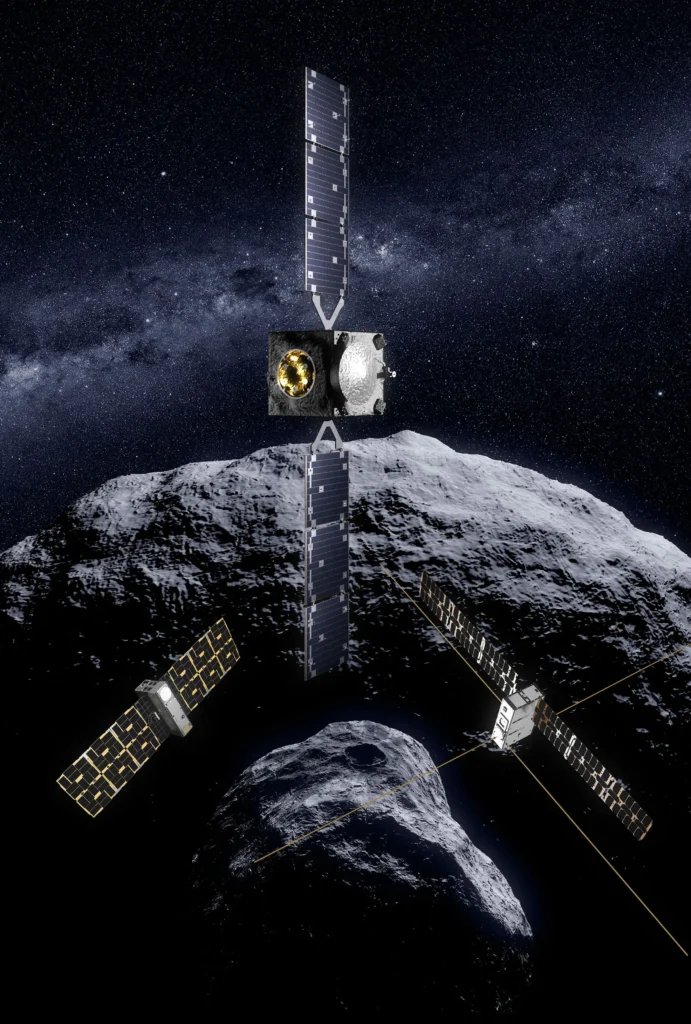
Featured image: Hera and its CubeSats at the Didymos system (artist’s impression). Credit: ESA – Science Office.
Key facts
- DART impact: 26 September 2022, 23:14 UTC, on Dimorphos
- Measured result: Dimorphos’s orbital period shortened by 33.0 ± 1.0 minutes
- Targets: Didymos (about 780 m) and Dimorphos (about 160 m)
- Hera launch: 7 October 2024, Falcon 9, Cape Canaveral
- Hera arrival: November 2026 (ESA planning)
- Hera instruments: 12, including those on two CubeSats
- Close approach: down to about 4.5 km from Dimorphos; at least six months at the system
What DART proved
DART hit Dimorphos at 23:14 UTC on 26 September 2022 as a planetary defence test. The orbital period of Dimorphos around Didymos changed by −33.0 ± 1.0 minutes. NASA calls it its first successful planetary defence test. That is far more than the roughly 7 minutes expected if the spacecraft’s momentum had simply been transferred to the asteroid in a perfectly inelastic collision. Before the impact, NASA had defined success as shortening the orbit by at least 73 seconds. DART beat that threshold by a wide margin.
The number that matters is not 33 minutes
In engineering terms, 33 minutes is the outcome, not the answer. The quantity that decides whether the method scales is the momentum enhancement factor, β: how much extra push the ejected debris gave the asteroid on top of the spacecraft’s own momentum. The impact reduced Dimorphos’s along-track velocity by 2.70 ± 0.10 mm/s, which the authors read as enhanced momentum transfer from the ejecta recoil.
The catch is that β cannot be pinned down without Dimorphos’s mass, and its mass was never measured directly. The uncertainty on that mass carries straight into β. Hera’s radio science and imaging are designed to close that gap. This is the real reason ESA flew a second spacecraft rather than trusting the first result.
What Hera will measure
- Mass and gravity field of Dimorphos, from tracking and from the CubeSats.
- The crater: its size, depth and the state of the surface around it.
- Internal structure, using radar on the Juventas CubeSat. See our Milani and Juventas guide.
- Surface composition in visible and near-infrared light.
A surprise from Earth’s side
A study published in March 2026 in Science Advances found that the impact also changed the orbit of the whole pair around the Sun. The 770-day period around the Sun shifted by a fraction of a second. It is a tiny effect, but it shows how much information a single well-observed impact carries.
Where Hera is now
Hera has already flown by Mars (March 2025) and performed a large deep-space manoeuvre in early 2026. ESA lists a rendezvous manoeuvre in October 2026 to bring the spacecraft close to the system, with arrival planned for November. Follow the countdown in our arrival guide.
Why this matters, and its limits
Neither asteroid is a threat to Earth; they were chosen because they pass relatively close to our planet and make a measurable test. A caution that is often missed: DART and Hera together calibrate a method on one rubble-pile moonlet. A different asteroid, with a different internal structure, would respond differently. What Hera gives planners is a validated model and a realistic error bar, not a guarantee.
Frequently asked questions
Did DART destroy Dimorphos?
No. It changed Dimorphos’s orbit around Didymos and excavated a crater. Hera will examine the result.
When does Hera arrive at Didymos?
ESA’s plan is November 2026. ESA announces the exact day on its Hera pages.
Why is a second mission needed after DART?
DART was a one-way impact. Hera measures the mass, crater and internal structure needed to turn the test into a reliable method.
Is any asteroid threatening Earth now?
Didymos and Dimorphos are not a threat. NASA says no known asteroid larger than 140 m has a significant chance of hitting Earth in the next 100 years.
Sources
- ESA, Hera operations · Hera FAQ · Early arrival at Didymos
- Michel et al., The ESA Hera Mission, Planetary Science Journal
- Thomas et al. 2023, Orbital period change of Dimorphos, Nature
- Cheng et al. 2023, Momentum transfer from the DART impact, Nature
- NASA, DART mission · Didymos and Dimorphos · DART changed the orbit of Didymos around the Sun
Related: ESA’s science roadmap beyond 2030 · All articles
Video: SpaceInfo Club on YouTube